


Premier Lin Chuan (林全) yesterday apologized for a wide-ranging power blackout on Tuesday last week, while reaffirming the government’s energy transition objectives.
The blackout was caused by a disruption in natural gas supply after technicians did not follow standard procedures during routine replacement of a power supplier to a gas metering system of a major power plant in Taoyuan’s Datan Township (大潭), causing all six generators at the plant to shut down, Lin said.
The blackout and ensuing power rationing affected 5.92 million households nationwide, while 423 manufacturers reported losses and about 900 elevator failures were reported.
Taiwan Power Co said it would waive the affected users’ electricity bill for the day, totaling NT$360 million (US$11.87 million), and conduct a complete re-examination of the nation’s power system, Lin said.
The outage foregrounded two long-existing problems of the power supply: over-reliance on major centralized power stations and inability to cope with emergency situations, he said.
However, “the determination to transition energy will not be affected by an unpredicted incident,” he added.
Chinese Nationalist Party (KMT) lawmakers questioned the government’s policy of running on a minimum-level operating reserve while increasing the percentage of electricity contributed by gas and “green” energy sources in a bid to phase out nuclear power and reduce the use of coal.
While the International Energy Agency advises an operating reserve of 22 to 30 percent, Taiwan’s reserve this year is only 7.8 percent, which cannot guarantee a stable supply, KMT Legislator Alicia Wang (王育敏) said.
The nation can deal with all emergency situations with a minimum operating reserve of 7.2 percent, Lin said, adding that it would be a waste of resources if it is increased to more than 15 percent.
“There is no power shortage issue in Taiwan,” Lin said. “It was not a low operating reserve, but a malfunctioning grid system that caused the outage.”
The nation’s operating reserve is only a little above the minimum during this initial transitional stage, but it is to gradually increase as new generators and solar and wind farms come online, boosting the reserve to 13.8 percent next year, he said.
KMT legislators Lin Wei-chou (林為洲) and Wang Hui-mei (王惠美) asked the premier to promise that no more outages or power rationing would take place during his term, but he refused, saying that no nation could guarantee an uninterrupted power supply at all times, but the risk of outages could be reduced when risk factors are identified.
The electricity bill waiver is good compensation, as few power companies elsewhere would recompense for the inconvenience caused by outages, Lin Chuan said in response to People First Party Legislator Chen Yi-chieh’s (陳怡潔) question if the waiver — amounting to NT$34 per household — was unacceptable.
Democratic Progressive Party Legislator Ho Hsin-chun (何欣純) asked if the spare nuclear capacity could have averted the blackout if relaunched, to which Lin Chuan said the incident was a grid management issue, not a capacity issue.
Even if an idle reactor at the Guosheng Nuclear Power Plant in New Taipei City’s Wanli District (萬里) had been reactivated, it could not have averted the blackout, Lin Chuan said.
However, it might have prevented a short reduction in air-conditioning in public buildings following the shutdown of the Ho-Ping Power Plant in Hualien County caused by a typhoon on July 29, he added.
Short-term power shortfalls should not necessitate the reactivation, Lin Chuan said, adding that a promised non-nuclear power source portfolio consisting of 50 percent gas, 30 percent coal and 20 percent renewable is an attainable goal by 2025.

The military has spotted two Chinese warships operating in waters near Penghu County in the Taiwan Strait and sent its own naval and air forces to monitor the vessels, the Ministry of National Defense (MND) said. Beijing sends warships and warplanes into the waters and skies around Taiwan on an almost daily basis, drawing condemnation from Taipei. While the ministry offers daily updates on the locations of Chinese military aircraft, it only rarely gives details of where Chinese warships are operating, generally only when it detects aircraft carriers, as happened last week. A Chinese destroyer and a frigate entered waters to the southwest
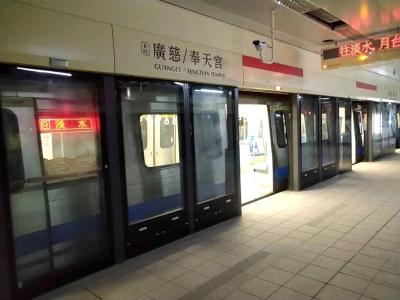
The eastern extension of the Taipei MRT Red Line could begin operations as early as late June, the Taipei Department of Rapid Transit Systems said yesterday. Taipei Rapid Transit Corp said it is considering offering one month of free rides on the new section to mark its opening. Construction progress on the 1.4km extension, which is to run from the current terminal Xiangshan Station to a new eastern terminal, Guangci/Fengtian Temple Station, was 90.6 percent complete by the end of last month, the department said in a report to the Taipei City Council's Transportation Committee. While construction began in October 2016 with an
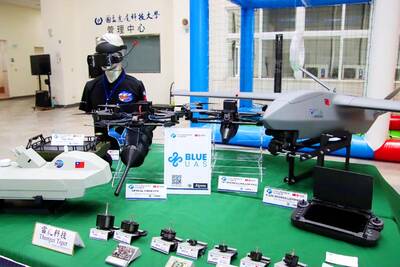
NON-RED SUPPLY: Boosting the nation’s drone industry is becoming increasingly urgent as China’s UAV dominance could become an issue in a crisis, an analyst said Taiwan’s drone exports to Europe grew 41.7-fold from 2024 to last year, with demand from Ukraine’s fight against Russian aggression the most likely driver of growth, a study showed. The Institute for Democracy, Society and Emerging Technology (DSET) in a statement on Wednesday said it found that many of Taiwan’s uncrewed aerial vehicle (UAV) sales were from Poland and the Czech Republic. These countries likely transferred the drones to Ukraine to aid it in its fight against the Russian invasion that started in 2022, it said. Despite the gains, Taiwan is not the dominant drone exporter to these markets, ranking second and fourth
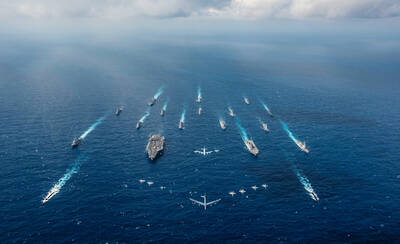
Japanese Prime Minister Sanae Takaichi’s comment last year on Tokyo’s potential reaction to a Taiwan-China conflict has forced Beijing to rewrite its invasion plans, a retired Japanese general said. Takaichi told the Diet on Nov. 7 last year that a Chinese naval blockade or military attack on Taiwan could constitute a “survival-threatening situation” for Japan, potentially allowing Tokyo to exercise its right to collective self-defense. Former Japan Ground Self-Defense Force general Kiyofumi Ogawa said in a recent speech that the remark has been interpreted as meaning Japan could intervene in the early stages of a Taiwan Strait conflict, undermining China’s previous assumptions


 RSS
RSS