


Liberty Times (LT): Why did you call it [Taiwan AI Labs] a lab instead of a company?
Ethan Tu (杜奕瑾): From our perspective, AI [artificial intelligence] is a new technological territory, as the Internet was at its beginning. There were very few things that are defined and it calls for innovation and initiative. If we set out to maximize profits and thinking of commercialization, we will be limiting creativity.
The lab will take a bottom-up approach to explore and solve problems in AI development. We will focus on the things others do not do well. We are going to collect good user experiences, find data that we need, use AI algorithms to other applications and publish our research.
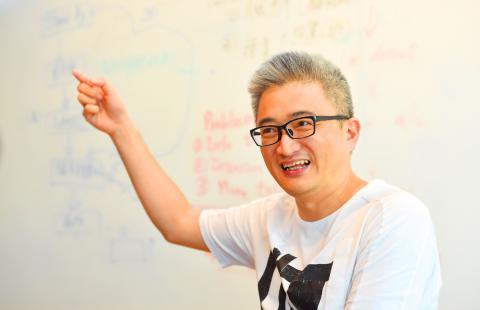
Photo: Liu hsin-de, Taipei Times
Taiwan lacks the intellectual paradigm suited for software development. For example, in the US’ Silicon Valley, corporations tolerate failure and they encourage persistence in the face of failure. Taiwan lacks this kind of environment.
Hopefully, the AI Lab will go on to become a template for successful software developers for Taiwan’s future reference and change the intellectual paradigm of Taiwanese industries.
LT: Do you think Taiwan has the market size and amount of data to sustain developers?
Tu: In the software development industry, market size is a non-issue, though the size of ambition is.
For example, the messenger apps we are all using, like Line, and popular game engines are usually made in South Korea.
The language of software is universal and so is the market for software. All you need is a good idea, a good experience and a petri dish to grow them in, like Taiwan. Once you have cultured something successful, it can be used in worldwide.
Finland made Angry Birds, UK-based Deep Mind created AlphaGo, Israel-based AI start-ups are very active and Singapore is very active in AI development. Those countries have small markets and populations, but it is the small countries that are moving quickly.
Not having enough data for big-data analysis is not a problem. Although the possessors of data have some advantage, the data that exists now is not necessarily what is needed for AI development.
There are 2 billion cellphones worldwide and more data is created on a daily basis of an order of magnitude greater than the past.
Adding the Internet of Things’s impact, it is estimated that there will be 25 billion devices by 2020. We can say that most of the data AI development needs is still in the process of being created or is as yet uncollected.
LT: Does Taiwan have enough people skilled in software and AI development?
Tu:The question we need to ask is whether it is a problem of a lack of talent leading to a lack of industry, or whether it is because we lack the industry so we cannot keep talented people here. Wherever you find people working on AI around the world you find Taiwanese.
For example, it was Taiwanese developer Aja Huang (黃士傑) working behind the scenes when the AlphaGo program beat go world champion Lee Sedol in Seoul.
The Monte Carlo Tree Search algorithm used by the Erica go-playing program was the very same one described by Huang in his doctoral thesis.
There were also many Taiwanese software engineers involved in the development of Microsoft’s Cortana Intelligence Suite AI software. National Taiwan University also ranked first — much higher than Japan’s Tokyo University — in a 2016 ranking of AI capabilities of Asian universities.
If Taiwanese universities produce such talented people in the field, why do they all leave the nation rather than staying here to work?
The reason must be that Taiwan is stuck in a traditional, stubborn mindset. They revere the spirit of the artisan and feel that if software does not bring direct profit in its early stages then it has no value. This is the key point.
Just like the spirit of the netizens on PTT, the Taiwan AI Labs project aims to foster a software-minded atmosphere in Taiwan, and to change the way people think about software.
However, this atmosphere is not enough on its own. We need the “sunlight, soil and water” to allow the industry and the people’s mindset to properly grow.
LT: Will Taiwan’s strengths in hardware be of benefit to the development of AI?
Tu: It is true that Taiwan is very strong in the area of hardware, which is the nation’s advantage, but to truly succeed in developing an AI industry there must be recognition that software and hardware are different and should be approached with different mindsets. Software and hardware have different DNA, different profit models and succeed under different conditions.
If you ask me how to successfully bring software and hardware together I would have a hard time answering you, but when it comes to creating new experiences that use hardware as the building blocks, this is where Taiwan dominates.
From a hardware perspective if you compared two cameras you would be comparing production costs rather than standards. A software perspective, on the other hand, would be looking at the camera as simply a tool.
In the development of AI there are so many uses we can develop — there is still an ocean of possibilities out there. With only a few ripples on the wave of software worldwide, Taiwan is still living in a hardware-centered mindset. When we talk about AI, for example, we talk about how we can use it to reduce manufacturing costs.
That is one thing we can look at, but it is not the most important thing. In the midst of this AI revolution Taiwan should find its own way to create value for the platform, and not let others dictate what its value or profit model should be.
The focus of Taiwan’s development of AI should not be merging software and hardware or making use of hardware, but rather should be establishing software “genes” and having the software lead the hardware in realizing the needs set for the platform.
In the past we would buy hardware and the software would be an afterthought. Today we live in a software age in which the value of hardware is changing.
Translated by staff writers Jonathan Chin and William Hetherington

FUKUOKA SITUATION: Japanese media reported that the pathogen is expected to be identified by the summer, while the CDC downplayed the idea that it was hMPV A “mysterious cold-like illness” reported in Japan’s Fukuoka Prefecture does not seem to be a new disease, but Japanese authorities have been asked about the situation, the Centers for Disease Control (CDC) said yesterday. The Fukuoka Prefectural Medical Association on Wednesday told a news conference that a “mystery cold” that has become a hot topic on social media is “highly likely to be caused by some kind of viral infection,” Japan’s KBC News reported. “Many people are experiencing symptoms starting with a sore throat, followed by a runny nose, phlegm and a severe cough,” KBC News reported, citing association officials. Health authorities are

Nvidia Corp CEO Jensen Huang (黃仁勳) arrived in Taiwan yesterday ahead of upcoming AI and technology events, saying he plans to meet with clients and Taiwan Semiconductor Manufacturing Co Chairman C.C. Wei (魏哲家) during his visit. After landing at Taipei Songshan Airport, Huang posed for photos with fans and handed out Yakult drinks to reporters and supporters waiting at the scene, saying he has “a lot to do” during the trip. Asked about reports that Nvidia’s planned headquarters site in Taipei’s Beitou Shilin Technology Park could break ground on May 27, Huang said that if the company holds an event, he would

Carrefour Taiwan is to begin using a new name from the start of July, but it cannot divulge the name until then, the chairman of the supermarket chain's parent company said today. President Chain Store Co chairman Lo Chih-hsien (羅智先) was asked by reporters after a shareholders' meeting to confirm whether the company has settled on a new name for the supermarket brand. In March, the government-registered name of two Carrefour Taiwan branches was quietly changed to "Le Chia Kang" (樂家康) in Chinese, raising speculation that has been selected as the name. Lo said that because of local regulations and contractual obligations, the

The Philippines would likely be involved in any conflict over Taiwan due to its proximity to the democracy claimed by China, President Ferdinand Marcos Jr said, reiterating a stance that risks angering Beijing. “In the Philippines, we do not have a choice because Taiwan is so close to the Philippines and we have almost 200,000 Filipino nationals living and working in Taiwan,” Marcos said in an interview with Japanese media in Manila on Monday. The Philippine leader’s comments come ahead of a state visit to Japan next week, where he is to meet with Japanese Prime Minister Sanae Takaichi to discuss security


 RSS
RSS