


President Tsai Ing-wen (蔡英文) has given the delegation that is to attend the inauguration of US president-elect Donald Trump next week the task of “congratulating, thanking and interacting,” the delegation’s leader said on Friday.
Former premier Yu Shyi-kun is to lead the 11-member delegation that includes lawmakers from across the political spectrum to the inauguration on Friday next week. The group is to depart for the US tomorrow.
Yu said Tsai told him before she departed for a nine-day state visit to four of Taiwan’s diplomatic allies in Central America on Saturday last week that “congratulating, thanking and interacting” would be the delegation’s task in the US.
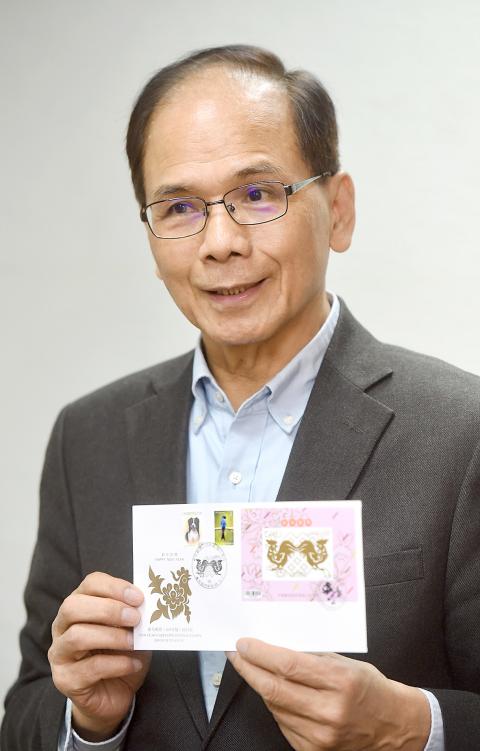
Photo: Chien Jung-fong, Taipei Times
“I will happily congratulate president Trump,” Yu said, adding that he would thank the US for its National Defense Authorization Act for this fiscal year and the “six assurances” that have kept Taiwan-US relations moving forward.
He said he has personally prepared 100 first day covers as gifts for US friends and Taiwanese expats during the upcoming trip.
The first day covers have little monetary value but are still meaningful, he said.
On each of the first day covers are three stamps, one issued under the name the Republic of China (Taiwan), one under the name the Republic of China, and one under the name Taiwan.
From the stamps, people can see it has been hard for Taiwan to become a “normal nation,” Yu said.
The delegation includes Yu’s wife, Yang Bao-yu (楊寶玉), Taichung Mayor Lin Chia-lung (林佳龍), Chiayi County Commissioner Helen Chang (張花冠), National Security Council adviser Tung Chen-yuan (童振源) and a number of lawmakers.
The delegation is scheduled to return to Taiwan on Jan. 23.
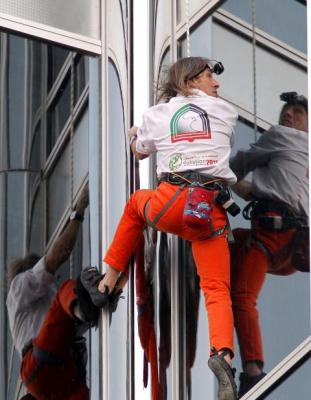
Alain Robert, known as the "French Spider-Man," praised Alex Honnold as exceptionally well-prepared after the US climber completed a free solo ascent of Taipei 101 yesterday. Robert said Honnold's ascent of the 508m-tall skyscraper in just more than one-and-a-half hours without using safety ropes or equipment was a remarkable achievement. "This is my life," he said in an interview conducted in French, adding that he liked the feeling of being "on the edge of danger." The 63-year-old Frenchman climbed Taipei 101 using ropes in December 2004, taking about four hours to reach the top. On a one-to-10 scale of difficulty, Robert said Taipei 101

Taiwanese and US defense groups are collaborating to introduce deployable, semi-autonomous manufacturing systems for drones and components in a boost to the nation’s supply chain resilience. Taiwan’s G-Tech Optroelectronics Corp subsidiary GTOC and the US’ Aerkomm Inc on Friday announced an agreement with fellow US-based Firestorm Lab to adopt the latter’s xCell, a technology featuring 3D printers fitted in 6.1m container units. The systems enable aerial platforms and parts to be produced in high volumes from dispersed nodes capable of rapid redeployment, to minimize the risk of enemy strikes and to meet field requirements, they said. Firestorm chief technology officer Ian Muceus said

MORE FALL: An investigation into one of Xi’s key cronies, part of a broader ‘anti-corruption’ drive, indicates that he might have a deep distrust in the military, an expert said China’s latest military purge underscores systemic risks in its shift from collective leadership to sole rule under Chinese President Xi Jinping (習近平), and could disrupt its chain of command and military capabilities, a national security official said yesterday. If decisionmaking within the Chinese Communist Party has become “irrational” under one-man rule, the Taiwan Strait and the regional situation must be approached with extreme caution, given unforeseen risks, they added. The anonymous official made the remarks as China’s Central Military Commission Vice Chairman Zhang Youxia (張又俠) and Joint Staff Department Chief of Staff Liu Zhenli (劉振立) were reportedly being investigated for suspected “serious

American climber Alex Honnold is to attempt a free climb of Taipei 101 today at 9am, with traffic closures around the skyscraper. To accommodate the climb attempt and filming, the Taipei Department of Transportation said traffic controls would be enforced around the Taipei 101 area. If weather conditions delay the climb, the restrictions would be pushed back to tomorrow. Traffic controls would be in place today from 7am to 11am around the Taipei 101 area, the department said. Songzhi Road would be fully closed in both directions between Songlian Road and Xinyi Road Sec 5, it said, adding that bidirectional traffic controls would


 RSS
RSS