


A recent poll found that close to half of Taiwanese believe that former president Chen Shui-bian (陳水扁) did not receive fair trials, but more than half do not think he was a victim of political persecution, the Taiwanese Public Opinion Foundation said yesterday.
Chen served more than six years of a 20-year prison sentence for several convictions on corruption charges before being released on medical parole in January last year.
While 45.9 percent of respondents said Chen was not given fair trials, 37.8 percent said he was.
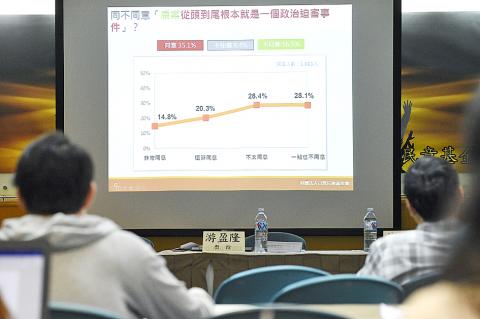
Photo: Chen Chih-chu, Taipei Times
Asked if former president Ma Ying-jeou (馬英九) was responsible for the improper prosecution of Chen, 45.7 percent of respondents said he was not, while 43.2 percent thought that he was.
Asked if Chen was a victim of political persecution, 56.5 percent said he was not, while 35.1 percent said he was.
“The poll results show that doubts persist over Chen’s cases, which are like a ‘specter haunting Taiwan,’” foundation chairman You Ying-lung (游盈隆) said.
The polarized perceptions over Chen’s convictions are a serious political issue, which the new government has tried to avoid, but the issue must be tackled if the government wants to ease social divisions, You said.
Former Democratic Progressive Party legislator Chien Hsi-chieh, the deputy director of an anti-corruption “red shirts” campaign against Chen, said the former president should be given a special pardon to reduce ethnic and political tensions.
“Chen’s corruption image will be remembered in history. Moral criticism is enough [to condemn him], and we do not have to use penal sentences to insult him anymore,” Chien said.
National Dong Hwa University professor Shih Cheng-feng (施正鋒) also called on President Tsai Ing-wen (蔡英文) to pardon Chen to ease social divisions.
“Tsai hesitates to pardon Chen because she is either seeking a consensus over the issue or trying to secure re-election. However, it is the president’s duty to ease social tension,” Shih said.
National Cheng Kung University law professor Hsu Chung-hsin (許忠信) said the lack of a pardon for Chen was behind the sharp decline in Tsai’s approval ratings, as voters in central and southern Taiwan are keen to see him pardoned.
There were procedural flaws in Chen’s prosecution and conviction, as one judge was unexpectedly replaced ahead of a trial, while Chen was convicted on a corruption charge without substantial evidence, as the judges ruled that he had “substantial influence” although not the authority over a land acquisition project of the Hsinchu Science Park, Hsu said.
The poll also showed that Tsai’s approval rating dipped by 0.7 percentage points from last month to 44 percent, showing that a sharp decline in her approval ratings has been halted, You said.
However, the percentage of people dissatisfied with Tsai’s performance has increased from 8.8 percent in May to 41.2 percent this month.
“The downward slide of Tsai’s approval ratings has stopped, but a ‘volcano’ has turned up in her way,” You said, referring to the dissatisfaction increase.
Asked about Tsai’s refusal to mention the so-called “1992 consensus” in her Double Ten National Day speech, 48.5 percent of respondents said they approved and 41.3 percent disapproved.
As for Premier Lin Chuan’s (林全) Cabinet, 49.9 percent said it does not have the ability to solve problems, while 32.4 percent said it does.
More than half of the respondents (53.7 percent) thought it was not appropriate that Ma has made two requests to travel abroad since leaving office, while 37.4 percent of respondents said it was alright.
The poll, conducted on Monday and Tuesday last week, collected 1,083 valid samples and has a margin of error of 2.98 percentage points.

LOUD AND PROUD Taiwan might have taken a drubbing against Australia and Japan, but you might not know it from the enthusiasm and numbers of the fans Taiwan might not be expected to win the World Baseball Classic (WBC) but their fans are making their presence felt in Tokyo, with tens of thousands decked out in the team’s blue, blowing horns and singing songs. Taiwanese fans have packed out the Tokyo Dome for all three of their games so far and even threatened to drown out home team supporters when their team played Japan on Friday. They blew trumpets, chanted for their favorite players and had their own cheerleading squad who dance on a stage during the game. The team struggled to match that exuberance on the field, with
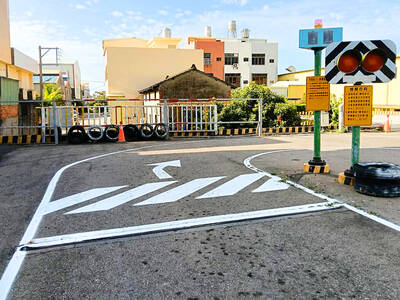
UPDATED TEST: The new rules aim to assess drivers’ awareness of risky behaviors and how they respond under certain circumstances, the Highway Bureau said Driver’s license applicants who fail to yield to pedestrians at intersections or to check blind spots, or omit pointing-and-calling procedures would fail the driving test, the Highway Bureau said yesterday. The change is set to be implemented at the end of the month, and is part of the bureau’s reform of the driving portion of the test, which has been criticized for failing to assess whether drivers can operate vehicles safely. Sedan drivers would be tested regarding yielding to pedestrians and turning their heads to check blind spots, while drivers of large vehicles would be tested on their familiarity with pointing-and-calling
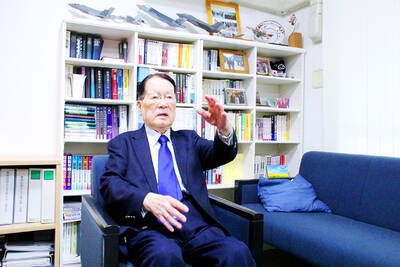
Whether Japan would help defend Taiwan in case of a cross-strait conflict would depend on the US and the extent to which Japan would be allowed to act under the US-Japan Security Treaty, former Japanese minister of defense Satoshi Morimoto said. As China has not given up on the idea of invading Taiwan by force, to what extent Japan could support US military action would hinge on Washington’s intention and its negotiation with Tokyo, Morimoto said in an interview with the Liberty Times (sister paper of the Taipei Times) yesterday. There has to be sufficient mutual recognition of how Japan could provide

A Taiwanese man apologized on Friday after saying in a social media post that he worked with Australia to provide scouting reports on Taiwan’s team, enabling Australia’s victory in this year’s World Baseball Classic (WBC), saying it was a joke and that he did not hold any position with foreign teams or Taiwan’s sports training center. Chen Po-hao (陳柏豪) drew the rage of many Taiwan baseball fans when he posted online on Thursday night, claiming credit for Australia’s 3-0 win over Taiwan in the opening game for Pool C, saying he worked as a physical therapist with the national team and


 RSS
RSS