


Minister of Education Pan Wen-chung (潘文忠) yesterday said that he is against a proposal to assign faculty members to the board of directors at private schools to safeguard workers’ rights, saying that teachers serving as directors could see them serving for “certain groups,” which could violate schools’ purpose of serving in the public interest.
Pan made the statement during a meeting of the legislature’s Education and Culture Committee, where he was asked to comment on a draft amendment to the Private School Act (私立學校法) proposed by Democratic Progressive Party (DPP) Legislator Chang Liao Wan-chien (張廖萬堅).
The DPP caucus tabled its own draft amendment, with the two drafts differing greatly.
Pan said that unlike corporations, which are aimed at making profits, schools aim to serve in the public interest, adding that assigning faculty members to the post of board member could cause a school’s policymaking to lean toward certain groups.
He said that allowing faculty members to serve on the board of directors would interfere with the policymaking carried out by deans.
During a question-and-answer session with Chinese Nationalist Party (KMT) Legislator Ko Chih-en (柯志恩), Pan said that “directors of public interest” selected from objective members of the public could fulfill the purpose of faculty members doubling as board members.
Ko questioned the legitimacy of the DPP’s draft amendment, which states that only private high schools and technology or vocational universities receiving more than NT$40 million (US$1.24 million), or ordinary universities receiving more than NT$80 million in annual subsidies from the ministry should be required to hire directors of public interest.
Citing as examples scandal-embroiled Nan Jeon University of Science and Technology and Chi Jen High School, Ko said that directors at schools receiving grants ranging from NT$20 million to NT$30 million are more prone to corruption, while those at well-financed schools are less prone.
Ko asked if the ministry had compiled a watchlist of private schools that could have engaged in illegal dealings or are on the verge of bankruptcy.
Pan said that there were a dozen on the list.
Ko said the ministry should publish the list to avoid public censure when new scandals erupt, but Pan said an evaluation panel would watch the schools and that the ministry would not publish the list.
DPP Legislator Rosalia Wu (吳思瑤) said that Pan is under immense pressure at the helm of private school reform, given the far-reaching collusions often associated with private schools.
Wu called on Pan to sign a declaration stating that he has no suicidal intentions, lest he is murdered.
When asked if he supports designating public interest directors and supervisors to make school finances more transparent, Pan said he does.
The minister also said that he is against the rigid stratification often seen on private schools boards of directors, where seats are often “hereditary” and controlled by families.
Chang Liao underlined the importance of private school management, citing a 2014 corrective report filed by the Control Yuan, which said that the ministry had been negligent in its management of private schools.
Pan ascribed the prevalence of scandals involving private schools to the way the act was written, saying that the ministry often finds out about malpractice after a scandal erupts.
Pan said that the ministry would move toward adjusting the percentage of relatives allowed to serve on a board of directors by reducing the maximum representation of board members from the same family from one-third to one-fifth of the total number of board members.
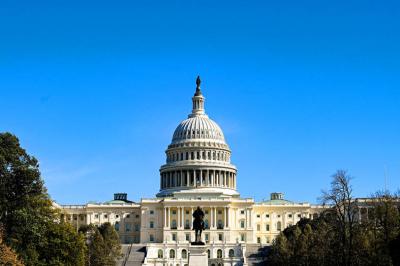
The US House of Representatives yesterday passed the PROTECT Taiwan Act, which stipulates that Washington would exclude China from participating in major global financial organizations if its actions directly threaten Taiwan’s security. The bill, proposed by Republican US Representative Frank Lucas, passed with 395 votes in favor and two against. It stipulates that if China’s actions pose any threat to Taiwan’s security, economic or social systems, the US would, “to the maximum extent practicable,” exclude China from international financial institutions, including the G20, the Bank for International Settlements and the Financial Stability Board. The bill makes it clear that China
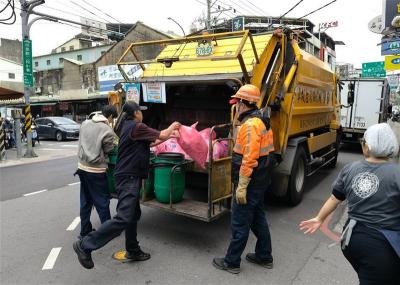
Garbage and recycling schedules are to vary from Saturday through Sunday next week over the Lunar New Year holiday period. The following collection information is from the governments of the six special municipalities. Taipei Regular service: Sunday to Monday next week. No service: Tuesday to Thursday next week. Extra service: Friday next week. Regular service resumes: Saturday next week. New Taipei City Extra service: Sunday. Adjusted collection time: Monday next week — garbage collection is to begin in the morning and end at 6pm. No service: Tuesday to Thursday next week. Regular service resumes: Friday next week. Note: Garbage can be dropped off at 70
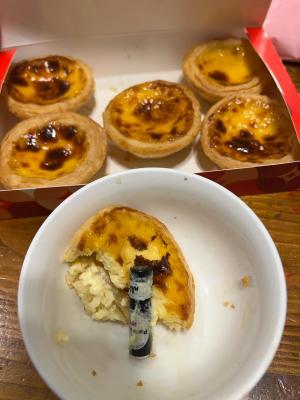
A KFC branch in Kaohsiung may be fined between NT$60,000 and NT$200 million (US$1,907 and US$6.37 million), after a customer yesterday found an entire AAA battery inside an egg tart, the Kaohsiung Department of Health said today. The customer was about to microwave a box of egg tarts they had bought at the fast-food restaurant’s Nanzih (楠梓) branch when they checked the bottom and saw a dark shadow inside one of them, they said in a Threads post. The customer filmed themself taking the egg tart apart to reveal an entire AAA battery inside, which apparently showed signs of damage. Surveillance footage showed
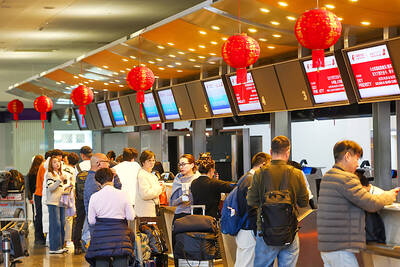
GROUP EFFORT: The number of inbound travelers rose 11 to 12 percent last month, with a significant increase in tourists from Europe and North America, an official said The government aims to attract 9.4 million visitors this year, the Tourism Administration said yesterday, citing last year’s success in diversifying tourist markets. Taiwan last year drew about 8.57 million international arrivals, 72.3 percent of pre-COVID-19 levels. By contrast, the nation had about 18.94 million outbound tourists last year, surpassing the pre-COVID-19 level of 17.1 million. The estimated tourism revenue deficit was about NT$700.9 billion (US$22.22 billion). Taoyuan International Airport Corp expects more than 160,000 passengers to pass through the nation’s largest airport daily during the Lunar New Year holiday, which begins on Saturday. As of Jan. 30, the nation’s average hotel occupancy rate


 RSS
RSS