


Amid renewed debates over the so-called “1992 consensus,” Mainland Affairs Council (MAC) Minister Katharine Chang (張小月) yesterday reiterated that President Tsai Ing-wen (蔡英文) administration respects the historical fact of the 1992 cross-strait talks.
Chang made the remarks on the sidelines of a meeting of the legislature’s Internal Administration Committee, which was reviewing proposed amendments to Article 17 of the Act Governing Relations Between the People of the Taiwan Area and the Mainland Area (臺灣地區與大陸地區人民關係條例).
“President Tsai has stated on multiple occasions our opinions on the ‘1992’ [consensus], which is that we respect the historical fact of the 1992 [talks], with the key being seeking common ground, while reserving differences,” Chang said.
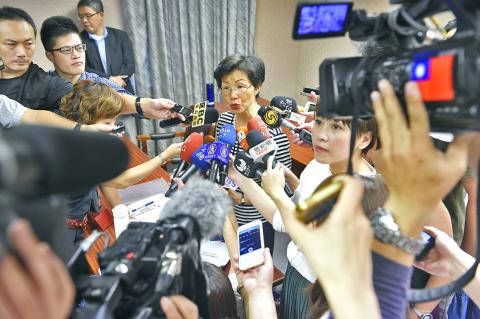
Photo: Chen Chih-chu, Taipei Times
Chang said that over the past two decades, both sides of the Taiwan Strait have made several achievements though communication and interaction.
Both sides should cherish and value these achievements, she said, adding that the government hopes to continue to improve cross-strait ties based on that political foundation.
The “1992 consensus” — a term former council chairman Su Chi (蘇起) admitted to making up in 2000 — refers to a tacit understanding between the Chinese Nationalist Party (KMT) and the Chinese Communist Party that both sides acknowledge there is “one China,” with each side having its own interpretation of what “China” means.
Debates about the existence of the “1992 consensus” have been renewed after American Institute in Taiwan Chairman Raymond Burghardt said in an interview with Voice of America in Washington on Wednesday last week that the term “1992 consensus” did not exist until Su used it in 2000.
China’s Taiwan Affairs Office spokesperson An Fengshan (安峰山) on Saturday said that cross-strait communications were suspended on May 20 due to Taiwan’s failure to recognize the “1992 consensus,” which An said is an embodiment of the “one China” principle serving as the political foundation for cross-strait relations.
Asked by reporters about Burghardt’s remarks, Chang said the government’s stance is that it respects the historical fact of the 1992 talks and the achievements accumulated over the past two decades based on the shared understanding of seeking common ground, while reserving differences.
“The council will continue communications with Beijing and keep up efforts to accumulate goodwill across the Taiwan Strait,” she said.
She added that the amount of Chinese investment in Taiwan between January and last month showed an upward trend.

Yangmingshan National Park authorities yesterday urged visitors to respect public spaces and obey the law after a couple was caught on a camera livestream having sex at the park’s Qingtiangang (擎天崗) earlier in the day. The Shilin Police Precinct in Taipei said it has identified a suspect and his vehicle registration number, and would summon him for questioning. The case would be handled in accordance with public indecency charges, it added. The couple entered the park at about 11pm on Thursday and began fooling around by 1am yesterday, the police said, adding that the two were unaware of the park’s all-day live
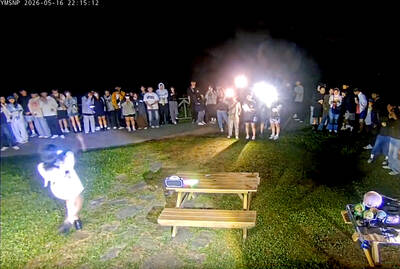
Yangmingshan National Park’s Qingtiangang (擎天崗) nature area has gone viral after a park livestream camera observed a couple in the throes of intimate congress, which was broadcast live on YouTube, drawing large late-night crowds and sparking a backlash over noise, bright lights and disruption to wildlife habitat. The area’s livestream footage appeared to show a couple engaging in sexual activity on a picnic table in the park on Friday last week, with the uncensored footage streamed publicly online. The footage quickly spread across social media, prompting a tide of visitors to travel to the site to “check in” and recreate the

Fast food chain McDonald's is to raise prices by up to NT$5 on some products at its restaurants across Taiwan, starting on Wednesday next week, the company announced today. The prices of all extra value meals and sharing boxes are to increase by NT$5, while breakfast combos and creamy corn soup would go up by NT$3, the company said in a statement. The price of the main items of those meals, if ordered individually, would remain the same. Meanwhile, the price of a medium-sized lemon iced tea and hot cappuccino would rise by NT$3, extra dipping sauces for chicken nuggets would go up

Minister of Digital Affairs Lin Yi-ching (林宜敬) yesterday cited regulatory issues and national security concerns as an expert said that Taiwan is among the few Asian regions without Starlink. Lin made the remarks on Facebook after funP Innovation Group chief executive officer Nathan Chiu (邱繼弘) on Friday said Taiwan and four other countries in Asia — China, North Korea, Afghanistan and Syria — have no access to Starlink. Starlink has become available in 166 countries worldwide, including Ukraine, Malaysia, the Philippines and Vietnam, in the six years since it became commercial, he said. While China and North Korea block Starlink, Syria is not


 RSS
RSS