


University students yesterday called for government intervention to stop Fu Jen Catholic University’s “discriminatory” policy of imposing a curfew on female dormitories.
Students from National Taiwan University (NTU), National Chengchi University (NCCU) and Soochow University staged a rally in front of the Ministry of Education building to voice their support for FJU Cinderella — a group formed by Fu Jen students opposed to the curfew — urging the university to abolish the curfew, which they said was built on a weak premise that violates female students’ freedom.
Fu Jen students said that female students are required to return to the dormitories by midnight, or they will receive a demerit barring them from participating in a draw for dormitory rooms the next semester and be required to perform two hours of chores for every half-hour they are late.
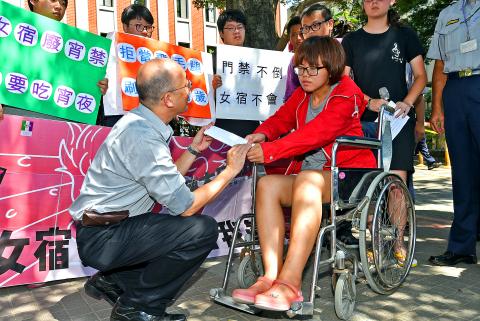
Photo: Chang Chia-ming, Taipei Times
Male students can enter their dormitories whenever they want, they said.
Sitting in a wheelchair, FJU student association chairwoman Liao Yu-wen (廖郁雯), who has been on a hunger strike to protest the curfew since Monday morning, said that a cleric at the school told her that the matter would be discussed at a hearing in October.
She said the university had been holding hearings on the standoff for one year, and that she was disappointed in the school’s perfunctory response.
NCCU Wildfire Front member Lin Tsung-chih (林宗志) said the curfew is undemocratic and outdated, and that Fu Jen should provide better arguments to convince students that a curfew can improve their safety.
He said that gender equality is a universal value that should not be subordinated by the autonomy enjoyed by universities.
He called on all college students to boycott universities that still implement curfews and the ministry to propose bills that would ensure gender equality on campus.
NTU student association head Cheng Ting-yin (鄭婷尹) said that her university in 1993 agreed to the association’s appeal and lifted the curfew on female dormitories.
Thanks to the abolition of curfew, students no longer have to stay out at night for fear of being punished, which greatly improved their safety, she said.
Cheng called on Fu Jen to improve communication with students, saying it was regrettable that its students have to resort to such drastic measures to hold a dialogue with the school administrators on an equal footing.
Independent music promoter and social activist Yao Ken-hsiang (姚茛翔), better known as Indie Dadee (音地大帝), was also on the scene to express solidarity with the students.
“There are many ways to protect students, and the worst thing to do is restrict their freedom, which reveals the school’s oppressive governance style,” Yao said.
Ni Chou-hua (倪周華), a division chief at the ministry’s Department of Higher Education, said the ministry would seek to resolve the standoff by establishing a communication platform between education officials, the university and the students within one month.
He urged students who have joined the hunger strike to take care of their health.
Fu Jen law major Wang Tzu-chi (王子綺) and philosophy major Lin Ya-hui (林雅惠) have also joined Liao in the hunger strike.

Actor Darren Wang (王大陸) was sentenced to six months in prison, commutable to a fine, by the New Taipei District Court today for contravening the Personal Data Protection Act (個人資料保護法) in a case linked to an alleged draft-dodging scheme. Wang allegedly paid NT$3.6 million (US$114,380) to an illegal group to help him evade mandatory military service through falsified medical documents, prosecutors said. He transferred the funds to Chen Chih-ming (陳志明), the alleged mastermind of a draft-evasion ring, although he lost contact with him as he was already in detention on fraud charges, they said. Chen is accused of helping a

SECURITY: Starlink owner Elon Musk has taken pro-Beijing positions, and allowing pro-China companies to control Taiwan’s critical infrastructure is risky, a legislator said Starlink was reluctant to offer services in Taiwan because of the nation’s extremely high penetration rates in 4G and 5G services, the Ministry of Digital Affairs said yesterday. The ministry made the comments at a meeting of the legislature’s Transportation Committee, which reviewed amendments to Article 36 of the Telecommunications Management Act (電信管理法). Article 36 bans foreigners from holding more than 49 percent of shares in public telecommunications networks, while shares foreigners directly and indirectly hold are also capped at 60 percent of the total, unless specified otherwise by law. The amendments, sponsored by Chinese Nationalist Party (KMT) Legislator Ko

UNREASONABLE SURVEILLANCE: A camera targeted on an road by a neighbor captured a man’s habitual unsignaled turn into home, netting him dozens of tickets The Taichung High Administrative Court has canceled all 45 tickets given to a man for failing to use a turn signal while driving, as it considered long-term surveillance of his privacy more problematic than the traffic violations. The man, surnamed Tseng (曾), lives in Changhua County and was reported 45 times within a month for failing to signal while driving when he turned into the alley where his residence is. The reports were filed by his neighbor, who set up security cameras that constantly monitored not only the alley but also the door and yard of Tseng’s house. The surveillance occurred from July

‘SAME OLD TRICK’: Even if Beijing resumes individual travel to Taiwan, it would only benefit Chinese tourism companies, the Economic Democracy Union convener said China’s 10 new “incentives” are “sugar-coated poison,” an official said yesterday, adding that Taiwanese businesses see them clearly for what they are, but that Beijing would inevitably find some local collaborators to try to drums up support. The official, speaking on condition of anonymity, made the remark ahead of a news conference the General Chamber of Commerce is to hold today. The event, titled “Industry Perspectives on China’s Recent Pro-Taiwan Policies,” is expected to include representatives from industry associations — such as those in travel, hotels, food and agriculture — to request the government cooperate with China’s new measures, people familiar with


 RSS
RSS