


China Airlines Ltd (CAL) flight attendants yesterday threatened to strike over new regulations that would reduce their leave time.
More than 100 mainly female demonstrators wearing sanitary masks and sunglasses brandished roses as they shouted slogans outside of the Ministry of Labor, protesting unilateral changes by CAL to working-hour calculations, along with the company’s demand that employees sign agreements waiving certain Labor Standards Act (勞動基準法) protections.
“While red roses are beautiful and may look fragile, they have thorns. Even though we may look beautiful, we are determined and there’s no way the company can force us to accept these conditions,” Taoyuan Flight Attendants Union secretary-general Lin Chia-wei (林佳瑋) said, waving copies of what she said were more than 1,900 letters of authorization from more than two-thirds of the firm’s flight attendants rejecting its demands.
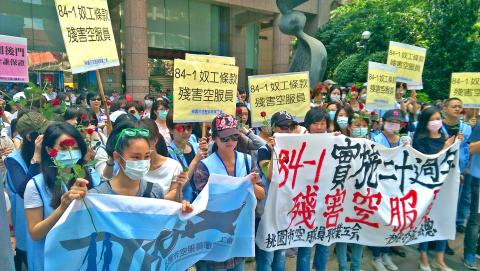
Photo: Huang Pang-ping, Taipei Times
The new work-hour formula would cut 80 minutes from the attendants’ daily hours by requiring them to report for work at Taoyuan International Airport instead of Taipei International Airport (Songshan airport), while halving the time allowed for them to complete post-flight duties.
Attendants are currently allowed to count commuting time from Songshan to Taoyuan as part of their working hours.
Lin said the new rules would slash workers’ rest time by cutting the number of work hours counted for many flights to less than 12 hours. Those working less than 12 hours on flights are allowed 12 hours of rest afterward, while those working longer are allowed 24 hours, she said, adding that the union promises moves to “disrupt” the flights if the airline fails to back down.
Union board director Chu Liang-chun (朱良駿) said CAL’s move was part of a broader attempt to unilaterally end a long-running controversy over how special exemptions from the Labor Standards Act should be applied to flight attendants.
Flight attendants have been interpreted as being included within the framework of the act’s article 84-1, which exempts special industries from work-hour restrictions, while requiring work-hour agreements to guarantee the health and wellbeing of employees.
“Ten years of negotiations have not produced any results, so the company has basically drafted its own version [of an application agreement] and demanded that everyone sign it,” he said. “CAL has continually sought to tie together working-hour calculations with the issue of special exemptions and now it is unilaterally imposing changes to pressure us to accept their terms.”
While CAL’s union had “sold out” workers by agreeing to special exemptions in a contract signed 10 years ago, the contract itself has never been fully implemented because of controversy, said Chu, whose union was established last year following a split between flight attendants and CAL’s union.
“The agreement has not been implemented in 10 years because it is riddled with problems, so CAL did not dare to push, but it plans to force the issue now that the Chinese Nationalist Party (KMT) is leaving power,” he said.
“We can sign an agreement based on article 84-1, but its content has to be appropriate to our work conditions and environment,” union vice president Betty Hung (洪蓓蒂) said, adding that applying special exemptions only made sense for international flights where it was impossible to guarantee normal working hours.
CAL said that new requirements that attendants report to Taoyuan airport reflected a 2005 contract signed by the company union, with flight technicians and flight attendants of other nationalities having already been required to report directly to Taoyuan airport after the company’s headquarters were relocated to the site in 2010.
It added that its proposed agreement to apply article 84-1 of the Labor Standards Act reflected the unique work environment of the aviation industry and had already been agreed to by flight technicians and flight attendants of other nationalities, with attendants to receive additional travel subsidies as compensation.
Mediation negotiations with CAL are scheduled for Saturday next week, with a union vote on striking to follow if no agreement is reached.
Additional reporting by CNA

Chinese spouse and influencer Guan Guan’s (關關) residency permit has been revoked for repeatedly posting pro-China videos that threaten national security, the National Immigration Agency confirmed today. Guan Guan has said many controversial statements in her videos posted to Douyin (抖音), including “the red flag will soon be painted all over Taiwan” and “Taiwan is an inseparable part of China,” and expressing hope for expedited reunification. The agency last year received multiple reports alleging that Guan Guan had advocated for armed reunification. After verifying the reports, the agency last month issued a notice requiring her to appear and explain her actions. Guan

GIVE AND TAKE: Blood demand continues to rise each year, while fewer young donors are available due to the nation’s falling birthrate, a doctor said Blood donors can redeem points earned from donations to obtain limited edition Formosan black bear travel mugs, the Kaohsiung Blood Center said yesterday, as it announced a goal of stocking 20,000 units of blood prior to the Lunar New Year. The last month of the lunar year is National Blood Donation Month, when local centers seek to stockpile blood for use during the Lunar New Year holiday. The blood demand in southern Taiwan — including Tainan and Kaohsiung, as well as Chiayi, Pingtung, Penghu and Taitung counties — is about 2,000 units per day, the center said. The donation campaign aims to boost

The Kaohsiung Tourism Bureau audited six hotels in an effort to prevent price gouging ahead of Korean band BTS’ concert tour in the city scheduled for Nov. 19, 21 and 22 this year. The bureau on Friday said that the audits — conducted in response to allegations of unfair pricing posted on social media — found no wrongdoing. These establishments included the local branches of Chateau de Chine, Hotel Nikko, My Humble House, and Grand Hai Lai, it said, adding that the Consumer Protection Commission would have penalized price gougers had the accusations been substantiated. The bureau said the Tourism Development Act
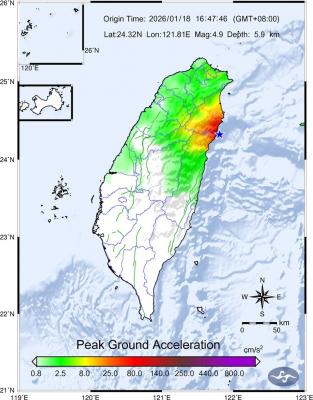
The Central Weather Administration (CWA) said a magnitude 4.9 earthquake that struck off the coast of eastern Taiwan yesterday was an independent event and part of a stress-adjustment process. The earthquake occurred at 4:47pm, with its epicenter at sea about 45.4km south of Yilan County Hall at a depth of 5.9km, the CWA said. The quake's intensity, which gauges the actual effects of a temblor, was highest in several townships in Yilan and neighboring Hualien County, where it measured 4 on Taiwan's seven-tier intensity scale, the CWA said. Lin Po-yu (林柏佑), a division chief at the CWA's Seismological Center, told a news conference


 RSS
RSS