


A legislative hearing turned stormy yesterday as Mainland Affairs Council (MAC) Deputy Minister Shih Hui-fen (施惠芬) was grilled over Kenya’s deportation of eight Taiwanese to China and lawmakers criticized the council for its lack of information on the matter.
The Legislative Yuan’s Finance Committee and Internal Administration Committee had jointly convened a morning meeting to examine the central government’s general financial statement for the 2014 fiscal year.
However, after news broke an hour before the scheduled start of the meeting that eight Taiwanese recently acquitted in a telecommunication fraud case in Kenya had been deported to China on Friday, several legislators called up Shih — the highest-ranking council official at the meeting — to answer questions about the incident.
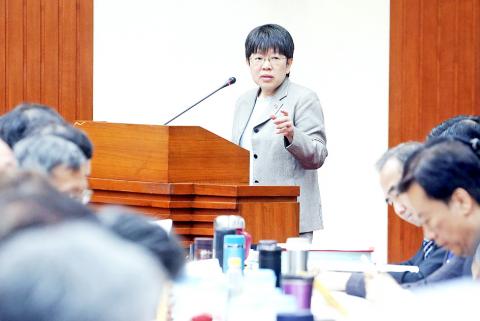
Photo: Chien Jung-fong, Taipei Times
New Power Party Legislator Huang Kuo-chang (黃國昌) asked Shih about the eight’s whereabouts.
“They were acquitted in Kenya. Our understanding is that the Ministry of Foreign Affairs had sought to arrange for their return to Taiwan, but China later took them to the mainland. The Ministry of Justice and the Criminal Investigation Bureau are contacting their Chinese counterparts to address the matter,” Shih told Huang.
“So in other words, you have no idea where they are?” Huang said.
“We still need to make some horizontal communications,” Shih replied.
Huang was not satisfied by Shih’s answer to his question about how China had pressured the Kenyan police into deporting the Taiwanese to China and when they would be returned home.
“You often tout the benefits of cross-strait treaties, but this incident will serve as a test as to whether your words can actually match reality,” Huang said before urging the council to “toughen up” and keep the public informed of the latest developments in the deportation case.
Fielding questions from Chinese Nationalist Party (KMT) Legislator Lai Shyh-bao (賴士葆), Shih said the council was notified of the deportations about midnight on Friday and that it was only aware that the plane carrying the eight had flown to Guangzhou, China.
“The deportation of the eight Taiwanese to China violated a consensus reached between Taipei and Beijing following a similar incident in 2011 that their nationals who commit wrongdoings in a foreign nation should be deported to their respective countries,” Shih said.
She was referring to the Philippines’ deportation of 14 Taiwanese fraud suspects to China for trial in February 2011.
Democratic Progressive Party (DPP) Legislator Lee Ying-yuan (李應元) asked Shih if the cross-strait hotline between the council and China’s Taiwan Affairs Office, set up in December last year, had played any part in the council’s efforts to ensure the eight are returned home.
As of yesterday morning, the hotline had yet to be connected, Shih said.
“Now should be the best time to use the cross-strait hotline. If you do not use the hotline, then what is the point of setting it up in the first place?” Lee said.
“President Ma Ying-jeou’s (馬英九) historic meeting with Chinese President Xi Jinping (習近平) in Singapore in November last year will be meaningless if such a simple matter cannot be addressed,” Lee said.

FUKUOKA SITUATION: Japanese media reported that the pathogen is expected to be identified by the summer, while the CDC downplayed the idea that it was hMPV A “mysterious cold-like illness” reported in Japan’s Fukuoka Prefecture does not seem to be a new disease, but Japanese authorities have been asked about the situation, the Centers for Disease Control (CDC) said yesterday. The Fukuoka Prefectural Medical Association on Wednesday told a news conference that a “mystery cold” that has become a hot topic on social media is “highly likely to be caused by some kind of viral infection,” Japan’s KBC News reported. “Many people are experiencing symptoms starting with a sore throat, followed by a runny nose, phlegm and a severe cough,” KBC News reported, citing association officials. Health authorities are

Nvidia Corp CEO Jensen Huang (黃仁勳) arrived in Taiwan yesterday ahead of upcoming AI and technology events, saying he plans to meet with clients and Taiwan Semiconductor Manufacturing Co Chairman C.C. Wei (魏哲家) during his visit. After landing at Taipei Songshan Airport, Huang posed for photos with fans and handed out Yakult drinks to reporters and supporters waiting at the scene, saying he has “a lot to do” during the trip. Asked about reports that Nvidia’s planned headquarters site in Taipei’s Beitou Shilin Technology Park could break ground on May 27, Huang said that if the company holds an event, he would

Carrefour Taiwan is to begin using a new name from the start of July, but it cannot divulge the name until then, the chairman of the supermarket chain's parent company said today. President Chain Store Co chairman Lo Chih-hsien (羅智先) was asked by reporters after a shareholders' meeting to confirm whether the company has settled on a new name for the supermarket brand. In March, the government-registered name of two Carrefour Taiwan branches was quietly changed to "Le Chia Kang" (樂家康) in Chinese, raising speculation that has been selected as the name. Lo said that because of local regulations and contractual obligations, the

The Philippines would likely be involved in any conflict over Taiwan due to its proximity to the democracy claimed by China, President Ferdinand Marcos Jr said, reiterating a stance that risks angering Beijing. “In the Philippines, we do not have a choice because Taiwan is so close to the Philippines and we have almost 200,000 Filipino nationals living and working in Taiwan,” Marcos said in an interview with Japanese media in Manila on Monday. The Philippine leader’s comments come ahead of a state visit to Japan next week, where he is to meet with Japanese Prime Minister Sanae Takaichi to discuss security


 RSS
RSS