


Liberty Times (LT): How should the party asset issue be handled?
Huang Shih-hsin (黃世鑫): To answer that, we must first look at the issue of transitional justice. The issue, according to German constitutional academic Hans Herbert von Arnim, is a dilemma of how to handle or ascertain the legal ownership of assets accrued by an autocratic one-party government as the society undergoes transition from an autocratic government to democracy.
Some people think there is little meaning, not to mention the great political cost, as well as confusion about how to recover the ill-gotten assets from the Chinese Nationalist Party (KMT) as it continues to liquidate them.
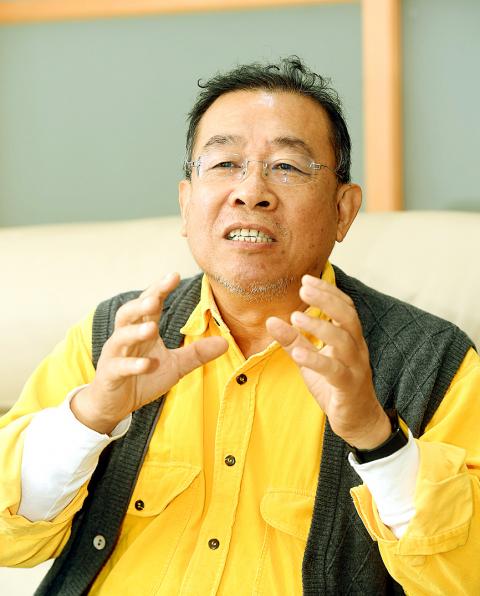
Photo: Fang Pin-chao, Taipei Times
The concept of transitional justice is not only about responding to past injustices, but, more importantly, conveying a “normative message” of political transition and the rule of law to deepen democracy.
The implications of the German government’s laws on party assets were twofold — the rebuilding of justice and returning the rights to those who suffered injustices, and to maintain “equal opportunity” for all German political parties after the unification of East and West Germany.
Thus, the main point is not the technicalities of whether party assets can be recovered, or how much can be recovered, but rather the establishment of the concept of transitional justice.
LT: How did Germany handle the party assets of former East Germany? Why were they able to succeed?
Huang: Prior to the unification, East Germany had already passed regulations on how to handle party assets. In March 1990, East Germany held its first open elections, resulting in the Socialist Unity Party of Germany (SED) being voted out of power for the first time in four decades.
In May of the same year, the new government amended the political parties and political groups act, of which two clauses dealt specifically with regulating the handling of party assets. By August 1990, East and West Germany had signed a unification treaty, including regulations on how to process party assets.
The establishment of the independent committee mandated that all political parties and affiliate organizations must tender a declaration to the committee the total amount of its assets bought, confiscated or obtained by other means since May 8, 1945, including those that had already been disposed of.
The parties also had to tender a detailed list of its assets and all subsequent changes to listed assets after Oct. 7, 1989.
Most importantly, to facilitate the committee’s functions, it was empowered to conduct investigations as allowed under the German equivalent of Taiwan’s Code of Criminal Procedure (刑事程序法) to conduct searches and seize items, while the former East German government, subsidiary organizations and people were mandated to assist the committee.
Due to the above powers, the committee was able to instruct German banks to block a fund transfer of 107 million German Deutsche mark to the Soviet Union and conduct a search of the SED chairperson’s house.
In addition, regulations were put in place so that any financial or asset changes in political parties or their subsidiaries had to be approved by the committee before they went into effect, while any assets and properties obtained after Oct. 7, 1989, had to be handed over to be managed by a trust.
The assets that were put into the trust were eventually disposed of using three methods; returned to the original owner; transferred to use for social welfare, particularly in the rebuilding of the economy in East Germany, due to difficulties in locating or inability to discern the original ownership; and allowing the original political party or private organization to keep their assets provided they could prove they obtained the assets under the principles of “the rule of law” of the Basic Law for the Federal Republic of Germany.
LT: How did Germany define “illegal” party assets?
Huang: Under the “rule of law” principle, of course. The process through which assets were acquired were subject to close scrutiny, although the standards they were being held to were no longer the laws of former East Germany, but under the Basic Law, which went on to become the constitution of Germany.
The KMT insists its party assets were acquired legally. So did the East German government. However, the constitution or laws of a dictatorial nation guarantees the continuation of a dictatorship, and such laws cannot be used; it is completely different from the rule of law under Western democracies.
There were two methods that Germany used to judge whether the assets were “illegal.” First, any infringement on the liberties or property rights of a third-party individual, including the violation of guarantees to property rights, the violation of freedom of vocation and the rights to freely operate a business. For example, if party-owned businesses enjoyed monopolization — whether actual or granted by law — it violated economic freedom by enjoying unfair or skewed competitiveness. Second, if the assets were obtained by abusing the power held by a one-party leadership.
Overall, confiscated property, properties obtained through misuse of power, bribery, threats or dishonesty, or through “national subsidization,” or property owned through party-owned businesses are all “illegal” party assets.
In addition, properties purchased via party funds are not automatically legal, either. Due to the SED’s unique position and absolute authority, only a few of its purchases through party funds were later recognized by the committee.
Claims of legitimacy related to the KMT’s party assets are actually weaker than the SED’s. Taiwanese laws state that only legal persons or natural persons can own property, and the KMT became a legal person only after it registered as such under the Civil Associations Act (人民團體法).
Therefore, all party asset registrations before that time are problematic and should be considered void.
LT: What was the reason behind the Democratic Progressive Party’s (DPP) failure to recover the assets from the KMT when it was in power from 2000 to 2008? How can Taiwan replicate the German model?
Huang: Laws regulating disposal of ill-gotten party assets were not passed at the time.
The peaceful transition of power meant that even though the DPP was voted in, many of the former KMT officials were still in place, making it even more difficult to resolve the issue, thus necessitating the special clause. As the DPP now comprises a majority of the Legislative Yuan following the [Jan. 16] elections, the chances of passing regulations is greater this time around.
Germany might be the only nation in the world with experience of handling party asset issues.
There are many similarities between the situation in Taiwan and in Germany, and Taiwan should learn from how Germany handled the issue.
By ratifying legislation, establishing an independent committee and mandating that all political parties and their affiliate organizations declare their assets by a certain date, the committee could then follow the Code of Criminal Procedure and investigate all declarations of assets.
Germany based their party asset investigation on the date of the SED’s founding, so Taiwan should use the date of the arrival of the KMT in Taiwan and demand that it declares all assets acquired after that time.
Aside from the KMT, the Chinese Youth Party and the Chinese Democratic Socialist Party must also declare their assets, as they have received many subsidies from the KMT for “distributing patriotic and anti-Communist propaganda.”
Other groups that have been subsidized by the KMT, such as the National Women’s League and the Chinese Youth Corps, should also declare their assets as they are 100 percent affiliated organizations of the KMT.
As for the definition of “illegal party assets,” Taiwan should also reference Germany’s methods and view all properties and assets obtained through abuse of power and violation of basic human rights as illegal party assets.
The example of the Institute on Policy Research and Development is a prime example. Although the land was said to be sold and bought, the original landowner has said that he did not sign the documents of his own free will.
Once the regulations for dealing with party assets passes and an independent committee is established, it would not matter if the KMT liquidates its assets — the committee needs only to ask for the contract.
If President Ma Ying-jeou (馬英九), when he was Taipei mayor, agreed in any form to help the buyers of the land to change what it was used for, then he is under suspicion for attempting to benefit the buyer and must answer to the law.
Even if the KMT liquidates its assets, there would be nowhere to hide the money; it can still be recovered.
Translated by Jake Chung

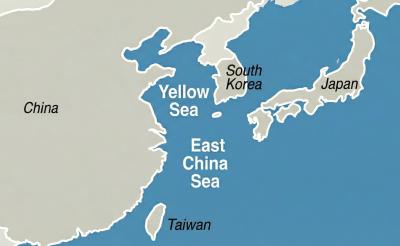
China has reserved offshore airspace in the Yellow Sea and East China Sea from March 27 to May 6, issuing alerts usually used to warn of military exercises, although no such exercises have been announced, the Wall Street Journal (WSJ) reported yesterday. Reserving such a large area for 40 days without explanation is an “unusual step,” as military exercises normally only last a few days, the paper said. These alerts, known as Notice to Air Missions (Notams), “are intended to inform pilots and aviation authorities of temporary airspace hazards or restrictions,” the article said. The airspace reserved in the alert is
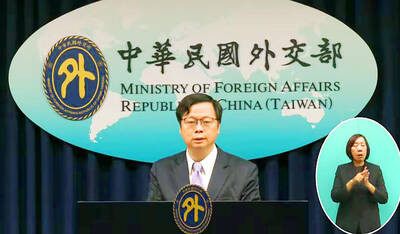
NAMING SPAT: The foreign ministry called on Denmark to propose an acceptable solution to the erroneous nationality used for Taiwanese on residence permits Taiwan has revoked some privileges for Danish diplomatic staff over a Danish permit that lists “Taiwan” as “China,” Eric Huang (黃鈞耀), head of the Ministry of Foreign Affairs’ Department of European Affairs, told a news conference in Taipei yesterday. Reporters asked Huang whether the Danish government had responded to the ministry’s request that it correct the nationality on Danish residence permits of Taiwanese, which has been listed as “China” since 2024. Taiwan’s representative office in Denmark continues to communicate with the Danish government, and the ministry has revoked some privileges previously granted to Danish representatives in Taiwan and would continue to review
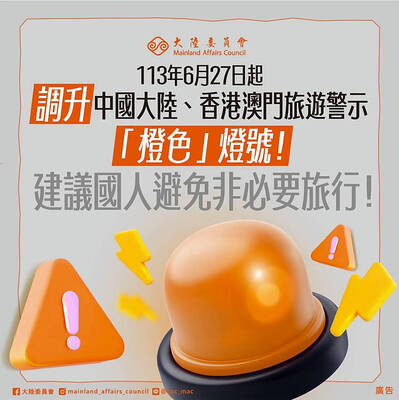
More than 6,000 Taiwanese students have participated in exchange programs in China over the past two years, despite the Mainland Affairs Council’s (MAC) “orange light” travel advisory, government records showed. The MAC’s publicly available registry showed that Taiwanese college and university students who went on exchange programs across the Strait numbered 3,592 and 2,966 people respectively. The National Immigration Agency data revealed that 2,296 and 2,551 Chinese students visited Taiwan for study in the same two years. A review of the Web sites of publicly-run universities and colleges showed that Taiwanese higher education institutions continued to recruit students for Chinese educational programs without
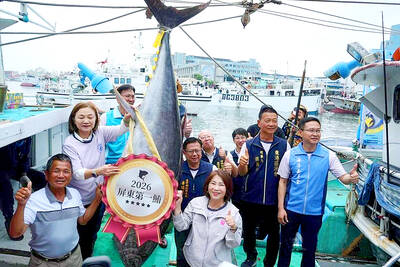
The first bluefin tuna of the season, brought to shore in Pingtung County and weighing 190kg, was yesterday auctioned for NT$10,600 (US$333.5) per kilogram, setting a record high for the local market. The auction was held at the fish market in Donggang Fishing Harbor, where the Siaoliouciou Island-registered fishing vessel Fu Yu Ching No. 2 delivered the “Pingtung First Tuna” it had caught for bidding. Bidding was intense, and the tuna was ultimately jointly purchased by a local restaurant and a local company for NT$10,600 per kilogram — NT$300 ,more than last year — for a total of NT$2.014 million. The 67-year-old skipper


 RSS
RSS