


The National Women’s League should disclose its assets as part of new broader financial reporting requirements for political organizations, New Power Party (NPP) Legislator Hsu Yung-ming (徐永明) said yesterday.
“The National Women’s League was established by the KMT, but they have refused to respond to the questions about exactly how much of the nation’s treasury flowed into their coffers,” he said. “To say that the government did not participate in the group’s fundraising efforts is ridiculous. Chiang Kai-shek (蔣介石) let his wife call for donations and then forced the entire nation to pay.”
Chiang’s wife Soong Mayling (宋美齡) established the league and served as its head for decades. A tariff called the “Military Benefit Tax” benefiting the league was levied on the US dollar value of all imported goods between 1955 to 1989, allowing the league to finance a broad range of charitable work, notably including the construction of military dependents’ villages.
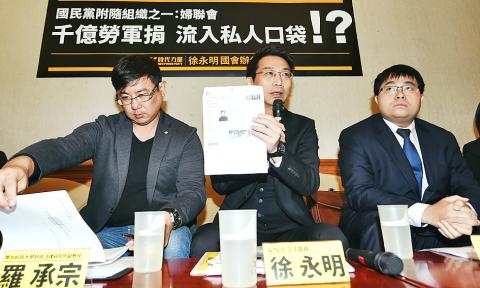
Photo: Fang Pin-chao, Taipei Times
Hsu criticized the Ministry of the Interior for not forcing the organization to publicize its finances, saying that it could use provisions of the Civil Associations Act (人民團體法) to threaten the league with dissolution for illegal behavior if it refuses to disclose its financial records.
“The league should not be let off the hook because it is special in that its assets came from the public. Because they used illegal measures to deduct more than NT$100 billion in taxes [US$3.03 billion], the government has an obligation to require them to become transparent,” said Huang Di-ying (黃帝穎), a lawyer and board member of the Taiwan Forever Association.
He said the forced deductions were illegal regardless of whether they were defined as “tax” or “donation,” because there was no legal foundation for them.
While ordinary civic groups are required to submit financial reports to the ministry, the league is an exception, because it is classified as a “political organization,” Department of Civil Affairs specialist Liu Li-fang (劉立方) said.
“Political organizations are not required to file financial reports under the law,” Liu said.
“Because political organizations have relationships with power, they should be required to reveal more about their finances. It makes absolutely no sense to require ordinary groups to make disclosures and then say that because the league is a political organization, there is nothing you can do,” Huang said.
Hsu said that political organizations should be required to meet the same requirements as other groups, because unlike political parties, they were not subject to ministry review.

The military has spotted two Chinese warships operating in waters near Penghu County in the Taiwan Strait and sent its own naval and air forces to monitor the vessels, the Ministry of National Defense (MND) said. Beijing sends warships and warplanes into the waters and skies around Taiwan on an almost daily basis, drawing condemnation from Taipei. While the ministry offers daily updates on the locations of Chinese military aircraft, it only rarely gives details of where Chinese warships are operating, generally only when it detects aircraft carriers, as happened last week. A Chinese destroyer and a frigate entered waters to the southwest

A magnitude 6.1 earthquake struck off the coast of Yilan County at 8:39pm tonight, the Central Weather Administration (CWA) said, with no immediate reports of damage or injuries. The epicenter was 38.7km east-northeast of Yilan County Hall at a focal depth of 98.3km, the CWA’s Seismological Center said. The quake’s maximum intensity, which gauges the actual physical effect of a seismic event, was a level 4 on Taiwan’s 7-tier intensity scale, the center said. That intensity level was recorded in Yilan County’s Nanao Township (南澳), Hsinchu County’s Guansi Township (關西), Nantou County’s Hehuanshan (合歡山) and Hualien County’s Yanliao (鹽寮). An intensity of 3 was

Japanese Prime Minister Sanae Takaichi’s comment last year on Tokyo’s potential reaction to a Taiwan-China conflict has forced Beijing to rewrite its invasion plans, a retired Japanese general said. Takaichi told the Diet on Nov. 7 last year that a Chinese naval blockade or military attack on Taiwan could constitute a “survival-threatening situation” for Japan, potentially allowing Tokyo to exercise its right to collective self-defense. Former Japan Ground Self-Defense Force general Kiyofumi Ogawa said in a recent speech that the remark has been interpreted as meaning Japan could intervene in the early stages of a Taiwan Strait conflict, undermining China’s previous assumptions
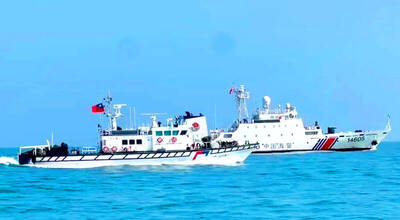
Instead of focusing solely on the threat of a full-scale military invasion, the US and its allies must prepare for a potential Chinese “quarantine” of Taiwan enforced through customs inspections, Stanford University Hoover fellow Eyck Freymann said in a Foreign Affairs article published on Wednesday. China could use various “gray zone” tactics in “reconfiguring the regional and ultimately the global economic order without a war,” said Freymann, who is also a nonresident research fellow at the US Naval War College. China might seize control of Taiwan’s links to the outside world by requiring all flights and ships entering or leaving Taiwan


 RSS
RSS