


Committee membership for legislators of smaller parties should not be determined by drawing lots, New Power Party (NPP) Legislator Huang Kuo-chang (黃國昌) said yesterday, after many of the party’s lawmakers did not make it onto their preferred committees.
Of the party’s five legislators, only Hsu Yung-ming (徐永明) and Hung Tzu-yung (洪慈庸) got their top choices, becoming members of the Economics Committee and the Social Welfare and Environmental Hygiene Committee respectively.
However, Freddy Lim (林昶佐) was allotted a seat on the Foreign and National Defense Committee instead of the Education and Culture Committee, which went to Amis Legislator Kawlo Iyun Pacidal, who was hoping for a place on the Internal Administration Committee governing Aboriginal affairs.
“If the larger parties have the generosity to let smaller parties pick from their areas of expertise, that would be a better way to handle it,” Huang, who doubles as the NPP’s executive chairman, said as he echoed comments by People First Party Legislator Lee Hung-chun (李鴻鈞).
Huang, who rose to prominence during the 2012 movement against monopolization of the media, was placed on the Finance Committee instead of the Transportation Committee, which has jurisdiction over the National Communications Commission, which regulates the media.
The Organic Law of Legislative Committees (立法院各委員會組織法) stipulates that parties that have too few legislators to qualify for seats on any of the legislature’s eight committees will have their committee membership determined by drawing lots.
Committee membership lasts for a year and lawmakers are allowed to trade positions if they fail to draw their preferred committee.
Parties with more than eight legislators are allotted committee membership proportionally and can directly submit committee membership lists.
In related news, Deputy Legislative Speaker Tsai Chi-chang (蔡其昌) yesterday met with Social Democratic Party (SDP) officials to discuss legislative reform as the party grapples with its future after failing to win any seats in last month’s legislative elections.
SDP spokesman Chen Shang-chih (陳尚志) said that the party would seek to attract new members, but that specific plans would have wait until a new governing committee is elected next month.
The party has about 100 members, he said.
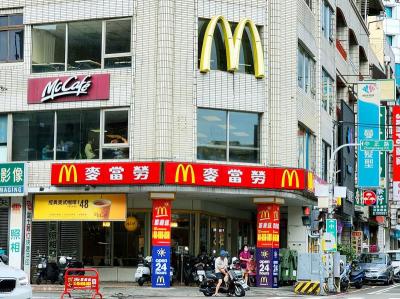
Fast food chain McDonald's is to raise prices by up to NT$5 on some products at its restaurants across Taiwan, starting on Wednesday next week, the company announced today. The prices of all extra value meals and sharing boxes are to increase by NT$5, while breakfast combos and creamy corn soup would go up by NT$3, the company said in a statement. The price of the main items of those meals, if ordered individually, would remain the same. Meanwhile, the price of a medium-sized lemon iced tea and hot cappuccino would rise by NT$3, extra dipping sauces for chicken nuggets would go up

Nvidia Corp CEO Jensen Huang (黃仁勳) arrived in Taiwan yesterday ahead of upcoming AI and technology events, saying he plans to meet with clients and Taiwan Semiconductor Manufacturing Co Chairman C.C. Wei (魏哲家) during his visit. After landing at Taipei Songshan Airport, Huang posed for photos with fans and handed out Yakult drinks to reporters and supporters waiting at the scene, saying he has “a lot to do” during the trip. Asked about reports that Nvidia’s planned headquarters site in Taipei’s Beitou Shilin Technology Park could break ground on May 27, Huang said that if the company holds an event, he would

FUKUOKA SITUATION: Japanese media reported that the pathogen is expected to be identified by the summer, while the CDC downplayed the idea that it was hMPV A “mysterious cold-like illness” reported in Japan’s Fukuoka Prefecture does not seem to be a new disease, but Japanese authorities have been asked about the situation, the Centers for Disease Control (CDC) said yesterday. The Fukuoka Prefectural Medical Association on Wednesday told a news conference that a “mystery cold” that has become a hot topic on social media is “highly likely to be caused by some kind of viral infection,” Japan’s KBC News reported. “Many people are experiencing symptoms starting with a sore throat, followed by a runny nose, phlegm and a severe cough,” KBC News reported, citing association officials. Health authorities are

Carrefour Taiwan is to begin using a new name from the start of July, but it cannot divulge the name until then, the chairman of the supermarket chain's parent company said today. President Chain Store Co chairman Lo Chih-hsien (羅智先) was asked by reporters after a shareholders' meeting to confirm whether the company has settled on a new name for the supermarket brand. In March, the government-registered name of two Carrefour Taiwan branches was quietly changed to "Le Chia Kang" (樂家康) in Chinese, raising speculation that has been selected as the name. Lo said that because of local regulations and contractual obligations, the


 RSS
RSS