

The US remains committed to supporting Taiwan’s “confidence and dignity” through increased participation in the international community and enhanced security, a senior Washington official said on Thursday.
“Our efforts at supporting Taiwan’s self-defense capabilities extend beyond arms sales,” US Deputy Assistant Secretary for East Asia Susan Thornton said.
“We support Taiwan’s capacity-building efforts through visits, maintenance programs and exchanges,” she told a US congressional hearing on the future of US-Taiwan relations.
The hearing, called by the House of Representatives Subcommittee on Asia and the Pacific, turned almost testy at times as members quizzed Thornton on Taiwan’s trade deficit with the US, on Taipei’s possible entry to the Trans-Pacific Partnership (TPP) and arms sales.
She repeatedly refused to discuss defense deals in the open hearing, but promised to give more details in a classified briefing for subcommittee members which was scheduled for later in the day.
However, as a result of the congressional voting schedule the briefing was canceled.
A US Department of State source said the closed-door briefing would probably be rescheduled for next week.
Democrat Representative Gerald Connolly asked Thornton why Washington had still not decided — after 15 years of consideration — if it would sell diesel-electric submarine technology to Taiwan.
She said that the issue was “complicated.”
Several committee members urged the administration of US President Barack Obama to be more active in finding ways to help Taiwan gain entry to the TPP.
In her opening statement, Thornton heaped praise on Taiwan.
“The people of Taiwan have built a prosperous, free and orderly society, with strong institutions worthy of emulation and envy,” she said.
She said the US continued to support Taiwan’s membership in organizations that did not require statehood and meaningful participation in those that do.
“At a time when pressure to squeeze Taiwan out of international organizations is growing, we are finding new ways for Taiwan to earn the dignity and respect that its contributions to global challenges merit,” Thornton said.
She said that over the past few years, the US had nearly doubled the number of its annual security cooperation events — further enabling Taiwan to improve its self-defense capabilities.
“Due in part to these stepped up contacts and strong US partnership, Taipei has gained confidence in its engagement with Beijing,” Thornton said.
She said that the Obama administration would continue to call on both sides of the Taiwan Strait to engage in dialogue on the basis of dignity and respect after president-elect Tsai Ing-wen (蔡英文) takes office in May.
Thornton said that during the transition period, Washington remains in close contact with the present administration and the incoming administration to encourage them to work constructively to ensure a smooth transition, and to continue to promote peace and stability in the region.
“We are committed to ensuring that this relationship will continue to thrive as we find new innovative ways to deepen our unofficial ties,” she said. “The innovative spirit, democratic dynamism and courageous vision of the people on Taiwan make us proud to be their friend and partner.”
Republican Representative Steve Chabot said that restrictions on high-level visits to Washington by high-ranking Taiwanese officials were both insulting and counterproductive.
“I have long said that this policy is nonsense and should be changed — it is an insult to Taiwan,” Chabot said.
Subcommittee Chairman Matt Salmon, a Republican, said that he worried about the potential for cross-strait stability with China issuing “a steady stream” of threats.
“In a time when Taiwan’s security is not assured from coercion or potential attacks, I urge our administration to continue to support Taiwan,” Salmon said. “We must prioritize Taiwan’s active and meaningful participation on the global stage, ensure its self-defense capabilities are sufficient and ensure that its economy continues to grow vibrantly.”
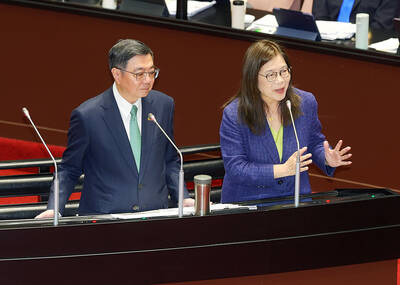
The donation of offshore patrol vessel Kinmen to the Philippines includes provisions that protect Taiwanese fishers and facilitate security cooperation across the First Island Chain, officials said yesterday. The comment was made during the Cabinet’s comprehensive administrative report at the legislature after Chinese Nationalist Party (KMT) Legislator Hsu Yu-chen (許宇甄) expressed concerns about the decision to give a ship to a country whose coast guard had in 2013 fired on a Taiwanese trawler and killed its captain without provocation. The Cabinet should lay out the safeguards that have been established to prevent the Philippine government from using the Kinmen to harass, expel
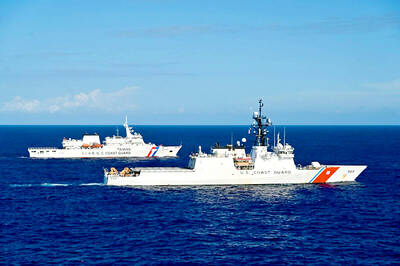
GROWING TIES: The CGA is planning a goodwill mission to the Philippines, in what would be the first time since 1975 a Taiwanese paramilitary vessel has visited the country The Coast Guard Administration (CGA) plans to significantly expand its participation in international security cooperative frameworks and its operational capabilities, a budget proposal for next year showed. The budget indicates a transformation of the CGA from a maritime law enforcement arm into a national defense and intelligence gathering entity capable of tackling larger regional security matters. The proposal showed that personnel from the coast guard’s Intelligence Division and Special Action Support Center are to participate in high-level national security talks with the US. As the CGA has dealt with China’s rising “gray zone” threats around Taiwan, it has become a valuable asset to
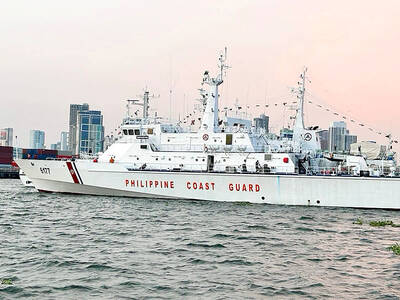
A patrol vessel donated by the Coast Guard Administration (CGA) to the Philippines was commissioned into the Philippine Coast Guard (PCG) on Friday, a Philippine non-governmental organization said. The CGA on Sept. 16 confirmed media reports that Taiwan had donated a retired 500-tonne patrol vessel to the Philippines. The Manila-based We Protect Our Seas (WPS) foundation, which served as an intermediary in the transfer, said that the vessel was formerly the CGA’s 500-tonne petrol vessel Kinmen (CG123). The WPS, in a statement issued on Friday, said the vessel, renamed as the BRP Sarangani, had been commissioned into the PCG the
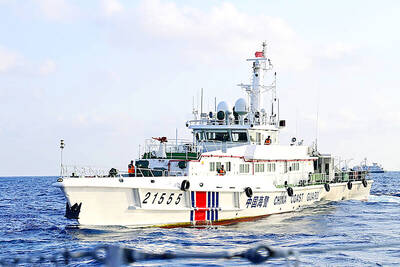
‘GRAY ZONE’ TACTICS: Beijing sent two China Coast Guard vessels to escort a ‘supposedly private research ship,’ a Philippine Coast Guard spokesman said The Coast Guard Administration (CGA) yesterday confirmed that it had recently deployed three patrol vessels to waters in Taiwan’s overlapping exclusive economic zone with the Philippines to monitor three Chinese vessels. CGA Deputy Director-General Hsieh Ching-chin (謝慶欽) said the agency regularly monitors Chinese vessels around Taiwan, and that the deployment south of Oluanpi (鵝鑾鼻), Taiwan proper’s southernmost point, was carried out in accordance with standard procedures. He added that the waters fall within the overlapping exclusive economic zones of Taiwan and the Philippines, which extend 200 nautical miles (370km) from their coastlines. Hsieh made the comments when asked about a


 RSS
RSS