


Agricultural losses caused by the cold front enveloping the nation yesterday reached NT$132.15 million (US$3.93 million), according to Council of Agriculture estimates.
In an unprecedented move, the council said it would award cash grants to eligible municipalities and counties before the areas have undertaken the previously required damage assessments.
Tainan suffered the largest agricultural losses, estimated at NT$81.38 million, followed by Miaoli County with losses of NT$35.40 million and Hsinchu County with NT$4.38 million, the council said, citing figures valid as of 5pm yesterday.

Photo: CNA
All Tainan’s losses were in the farmed aquaculture sector, with products hardest hit including milkfish, groupers and orient clams.
Agricultural product losses were estimated at NT$50.74 million, with 688 hectares of crops affected, the council said.
Strawberries were the hardest-hit crop, suffering losses of NT$22.02 million, followed by oranges, ginger, wax apples and grafted pears, the council said.
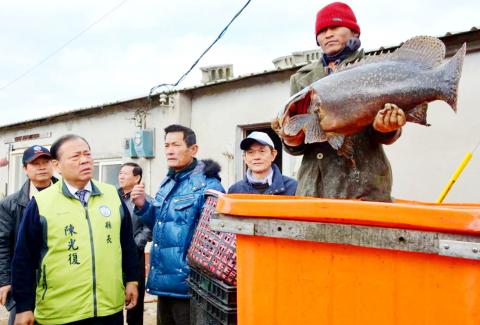
Photo: CNA
“The low temperatures have caused disasters for farmers across the nation, which is very rare, but only 10 cities and counties have reported losses to the council today. The losses are expected to rise considerably in the next few days,” Council of Agriculture Secretary-General Tai Yu-yen (戴玉燕) said.
There is a considerable time lag between the arrival of a cold front and the occurrence of an agricultural disaster, Tai said, calling on local governments to keep tabs on the current situation.
“Vegetable and fruit prices are expected to rise due to the cold weather, but the rise should be moderate, as winter is the harvest season for vegetables, so the supply should remain stable. No heavy losses have been reported in the major vegetable supplier counties of Changhua, Yunlin and Chiayi — ahead of the Lunar New Year holiday,” she said.
Although the aquaculture sector suffered the biggest losses, it would have a limited impact on the supply of aquatic products, because the nation’s fisherman can catch more wild fish to make up for the shortage in farmed products, she said.
The council said it would announce the municipalities eligible for cash grants and low interest rate loans as early as yesterday, so the relief should arrive before the Lunar New Year holiday, Tai said.

Yangmingshan National Park authorities yesterday urged visitors to respect public spaces and obey the law after a couple was caught on a camera livestream having sex at the park’s Qingtiangang (擎天崗) earlier in the day. The Shilin Police Precinct in Taipei said it has identified a suspect and his vehicle registration number, and would summon him for questioning. The case would be handled in accordance with public indecency charges, it added. The couple entered the park at about 11pm on Thursday and began fooling around by 1am yesterday, the police said, adding that the two were unaware of the park’s all-day live

A former soldier and an active-duty army officer were yesterday indicted for allegedly selling classified military training materials to a Chinese intelligence operative for a total of NT$79,440. The Taipei District Prosecutors’ Office indicted Chen Tai-yin (陳泰尹) and Lee Chun-ta (李俊達) for contravening the National Security Act (國家安全法) and the Anti-Corruption Act (貪污治罪條例). Chen left the military in September 2013 after serving alongside then-staff sergeant Lee, now an army lieutenant, at the 21st Artillery Command of the army’s Sixth Corps from 2011 to 2013, according to the indictment. Chen met a Chinese intelligence operative identified as “Wang” (王) through a friend in November

Minister of Digital Affairs Lin Yi-ching (林宜敬) yesterday cited regulatory issues and national security concerns as an expert said that Taiwan is among the few Asian regions without Starlink. Lin made the remarks on Facebook after funP Innovation Group chief executive officer Nathan Chiu (邱繼弘) on Friday said Taiwan and four other countries in Asia — China, North Korea, Afghanistan and Syria — have no access to Starlink. Starlink has become available in 166 countries worldwide, including Ukraine, Malaysia, the Philippines and Vietnam, in the six years since it became commercial, he said. While China and North Korea block Starlink, Syria is not

The Grand Hotel Taipei has rejected media reports claiming that the hotel had prevented CBS from broadcasting coverage of the Beijing summit between U.S. President Donald Trump and Chinese President Xi Jinping (習近平) on its premises. Media reports alleging that the hotel owner, dissatisfied with CBS’s coverage, prohibited the network from broadcasting political content on the hotel premises, are not true, the hotel said in a statement issued last night. The reports were “inconsistent with how the hotel actually handled the matter,” it said. The hotel said it received a refund request from a


 RSS
RSS