


The Supreme Prosecutors’ Office on Friday said that it cannot accept the Taiwan High Court’s ruling on Farglory Land Development Co (遠雄建設) chairman Chao Teng-hsiung (趙藤雄), while legal experts said that the ruling seemed to serve wealthy and powerful elites.
The Taiwan High Court on Friday sentenced Chao to two years in prison for paying bribes to secure the contracts for three housing construction projects, with the sentence suspended for five years.
Chao was also fined NT$200 million (US$6.1 million) and had his civil rights suspended for two years. As Chao was not guilty of a major offense, the court’s verdict was final.
A statement issued by the Supreme Prosecutors’ Office said it will not rule out filing an extraordinary appeal.
“Our nation’s laws have always been lenient on people who paid bribes. Oftentimes when they are caught, they admit to wrongdoing and receive reduced punishments or suspended sentences. I was not too surprised at the outcome of Chao’s trial,” former Judicial Reform Foundation executive director Kao Yung-cheng (高涌誠) said.
When the court allowed Chao, who is the head of a large corporation and owns great personal wealth, to make a donation in lieu of serving a prison term, Kao said it re-enforced the commonly-held perception that Taiwan’s legal system “lets the defendant live if they are rich, but receive the death sentence if they are poor.”
“It seems the courts are now exclusively in the service of wealthy and powerful elites,” Kao said.”
Lawyer Chou Wu-jung (周武榮) said that Chao’s belated admission to all the charges in the extra hearing session two weeks ago must have had very little influence on the ruling.
“To give Chao a suspended sentence in this case does not conform with the spirit of the law,” Chou said. “Also, the financial gains Chao has made through bribing government officials to secure construction projects most likely exceeded the amount he was ordered to pay as a donation, which is NT$200 million. For most people, it is very difficult to accept the trial’s outcome.”
Chou said that to implement the legal practice of granting reduced punishments to those who admit to being guilty, the admission must help the investigation and the trial.
“It is supposed to help clarify the details of the case and to reveal the nature of the crime. However, Chao and his company executive Wei (魏) only pleaded guilty to all charges just before the court was to announce its decision for the second ruling on the case,” he said, referring to former Farglory deputy chairman Wei Chun-hsiung (魏春雄), a codefendant in the case, who also pleaded guilty to the charges at the extra hearing, and received a sentence of 22 months in prison, suspended for five years, as well as a fine of NT$100 million.
“At that time, the judicial system had already spent resources on the investigation and legal proceedings of the case. The defendants’ crimes were more or less clear to most people by then,” Chou said.
“However, the High Court handed out lenient sentences to Chao and Wei, and allowed them to donate a sum of money in lieu of serving jail time. The ruling was clearly contrary to the spirit of the law, regarding sentence reduction,” he said.
Chao and Wei pleading guilty that late into the trial and still being rewarded with leniency would let others suspects to follow suit, Chou said.

The military has spotted two Chinese warships operating in waters near Penghu County in the Taiwan Strait and sent its own naval and air forces to monitor the vessels, the Ministry of National Defense (MND) said. Beijing sends warships and warplanes into the waters and skies around Taiwan on an almost daily basis, drawing condemnation from Taipei. While the ministry offers daily updates on the locations of Chinese military aircraft, it only rarely gives details of where Chinese warships are operating, generally only when it detects aircraft carriers, as happened last week. A Chinese destroyer and a frigate entered waters to the southwest
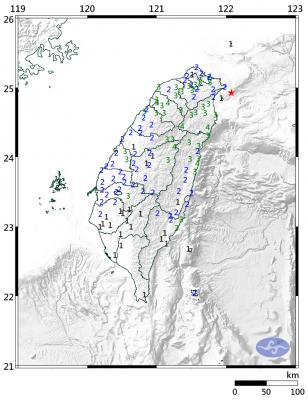
A magnitude 6.1 earthquake struck off the coast of Yilan County at 8:39pm tonight, the Central Weather Administration (CWA) said, with no immediate reports of damage or injuries. The epicenter was 38.7km east-northeast of Yilan County Hall at a focal depth of 98.3km, the CWA’s Seismological Center said. The quake’s maximum intensity, which gauges the actual physical effect of a seismic event, was a level 4 on Taiwan’s 7-tier intensity scale, the center said. That intensity level was recorded in Yilan County’s Nanao Township (南澳), Hsinchu County’s Guansi Township (關西), Nantou County’s Hehuanshan (合歡山) and Hualien County’s Yanliao (鹽寮). An intensity of 3 was

Japanese Prime Minister Sanae Takaichi’s comment last year on Tokyo’s potential reaction to a Taiwan-China conflict has forced Beijing to rewrite its invasion plans, a retired Japanese general said. Takaichi told the Diet on Nov. 7 last year that a Chinese naval blockade or military attack on Taiwan could constitute a “survival-threatening situation” for Japan, potentially allowing Tokyo to exercise its right to collective self-defense. Former Japan Ground Self-Defense Force general Kiyofumi Ogawa said in a recent speech that the remark has been interpreted as meaning Japan could intervene in the early stages of a Taiwan Strait conflict, undermining China’s previous assumptions
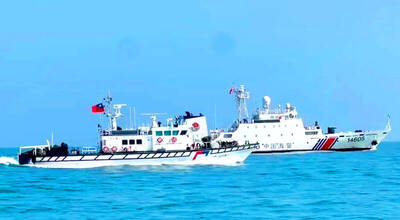
Instead of focusing solely on the threat of a full-scale military invasion, the US and its allies must prepare for a potential Chinese “quarantine” of Taiwan enforced through customs inspections, Stanford University Hoover fellow Eyck Freymann said in a Foreign Affairs article published on Wednesday. China could use various “gray zone” tactics in “reconfiguring the regional and ultimately the global economic order without a war,” said Freymann, who is also a nonresident research fellow at the US Naval War College. China might seize control of Taiwan’s links to the outside world by requiring all flights and ships entering or leaving Taiwan


 RSS
RSS