


The Chinese Nationalist Party (KMT) caucus yesterday blasted Democratic Progressive Party (DPP) presidential candidate Tsai Ing-wen’s (蔡英文) piggy bank campaign, calling it a greedy scheme to fill Tsai’s already full pockets.
Former KMT legislator Chiu Yi (邱毅) told a news conference at the legislature that it was preposterous for Tsai to launch a donation scheme to ask for money from impoverished people, when Tsai and her family have allegedly reaped billions of New Taiwan dollars in profit from land speculation.
“Tsai has paid lip service to housing justice. Last year, when campaigning for then-DPP Taoyuan mayoral candidate Cheng Wen-tsan (鄭文燦), Tsai said the government should not serve as an accomplice for land speculators. Now the culprit could become [the leader of] our government next year,” Chiu said.
Chiu said it was the “biggest joke in the Republic of China’s [ROC] history” that someone born with a silver spoon in her mouth like Tsai would need to ask supporters to donate piggy banks filled with their hard-earned money.
Voters are urged to “buy and immediately refund” their piggy banks as a way of boycotting Tsai’s donation scheme, Chiu said, in an apparent reference to a controversial campaign targeting food products made by subsidiaries of the scandal-ridden Ting Hsin International Group (頂新集團).
KMT caucus deputy whip Alicia Wang (王育敏) asked how Tsai could face her conscience after taking money probably saved on food by her supporters.
An estimated 150,000 piggy banks have been given out since August to DPP supporters.
Chiu and other KMT lawmakers have accused Tsai of engaging in speculation on rezoned lands in Taipei, including two plots measuring 477 ping and 644 ping (1,577m2 and 2,129m2) in Neihu District (內湖).
They claimed that both lots were purchased by Tsai’s family in 1980 and sold in 2008 and 2010 for a combined profit of at least NT$3.4 billion.
When a reporter from the Chinese-language Liberty Times (the Taipei Times sister newpaper) asked why the KMT still accepted political donations when it sits on huge illegal assets and why did it constitute land speculation when Tsai’s family owned the lots for as long as three decades before selling them, Chiu lashed out at the late Rong San Lin (林榮三) — the publisher of the two papers.
“Lin did not have the right to launch his own media outlets. He was a land speculator himself,” Chiu said.

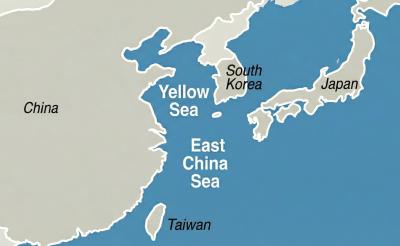
China has reserved offshore airspace in the Yellow Sea and East China Sea from March 27 to May 6, issuing alerts usually used to warn of military exercises, although no such exercises have been announced, the Wall Street Journal (WSJ) reported yesterday. Reserving such a large area for 40 days without explanation is an “unusual step,” as military exercises normally only last a few days, the paper said. These alerts, known as Notice to Air Missions (Notams), “are intended to inform pilots and aviation authorities of temporary airspace hazards or restrictions,” the article said. The airspace reserved in the alert is
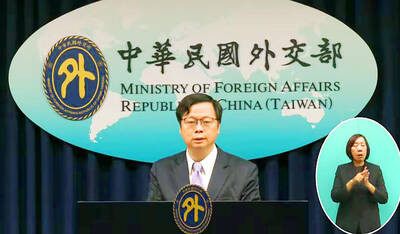
NAMING SPAT: The foreign ministry called on Denmark to propose an acceptable solution to the erroneous nationality used for Taiwanese on residence permits Taiwan has revoked some privileges for Danish diplomatic staff over a Danish permit that lists “Taiwan” as “China,” Eric Huang (黃鈞耀), head of the Ministry of Foreign Affairs’ Department of European Affairs, told a news conference in Taipei yesterday. Reporters asked Huang whether the Danish government had responded to the ministry’s request that it correct the nationality on Danish residence permits of Taiwanese, which has been listed as “China” since 2024. Taiwan’s representative office in Denmark continues to communicate with the Danish government, and the ministry has revoked some privileges previously granted to Danish representatives in Taiwan and would continue to review

More than 6,000 Taiwanese students have participated in exchange programs in China over the past two years, despite the Mainland Affairs Council’s (MAC) “orange light” travel advisory, government records showed. The MAC’s publicly available registry showed that Taiwanese college and university students who went on exchange programs across the Strait numbered 3,592 and 2,966 people respectively. The National Immigration Agency data revealed that 2,296 and 2,551 Chinese students visited Taiwan for study in the same two years. A review of the Web sites of publicly-run universities and colleges showed that Taiwanese higher education institutions continued to recruit students for Chinese educational programs without

A bipartisan group of US senators has introduced a bill to enhance cooperation with Taiwan on drone development and to reduce reliance on supply chains linked to China. The proposed Blue Skies for Taiwan Act of 2026 was introduced by Republican US senators Ted Cruz and John Curtis, and Democratic US senators Jeff Merkley and Andy Kim. The legislation seeks to ease constraints on Taiwan-US cooperation in uncrewed aerial systems (UAS), including dependence on China-sourced components, limited access to capital and regulatory barriers under US export controls, a news release issued by Cruz on Wednesday said. The bill would establish a "Blue UAS


 RSS
RSS