


The Democratic Progressive Party (DPP) yesterday called on Chinese Nationalist Party (KMT) presidential candidate Eric Chu (朱立倫) to publicize his finances and explain an increase in personal assets.
The past week has seen the KMT repeatedly question DPP presidential candidate Tsai Ing-wen’s (蔡英文) finances, accusing her of engaging in land speculation. The DPP has responded by publicizing Tsai’s personal assets, and yesterday challenged Chu to do the same.
“Chu should follow Tsai’s example and make public his campaign finances, as well as explain changes in his personal property declarations,” DPP spokesperson Ruan Jhao-syong (阮昭雄) told a news conference at party headquarters. “Chu should not dodge this question.”
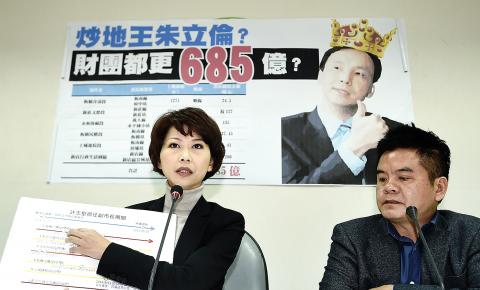
Photo: Fang Pin-chao, Taipei Times
Ruan said that from 1999 to 2000, after factoring in Chu’s salary as a lawmaker, as well as revenue from stocks and securities that he had declared, “there is still as much as NT$17.39 million [US$527,769] in unexplained income.”
From 2002 to 2003, there was an increase of NT$8.48 million in Chu’s property declaration from an unknown source, Ruan said.
“From 2010 to 2011, Chu reported two new real-estate properties with a total estimated value of NT$27.77 million, but his cash holding decreased by only a little more than NT$1 million,” Ruan said. “We wonder how he paid for those purchases?”
Chu should explain to the public these suspicious changes in his property declarations, Ruan said.
“He should explain how he was able to accumulate so much wealth as two or three generations of his family only served as public servants,” Ruan added.
DPP Legislator Chen Chi-mai (陳其邁) said that while the New Taipei City mayor has always insisted that his property declarations were made according to the law, he has never responded when asked about them in the city council or by reporters.
Chen also urged Chu to make public details of his campaign finances, and explain whether the KMT has allocated part of its party assets to support his campaign.
“Tsai has made public her campaign financial statements in September and earlier this month; Chu should do the same,” Chen said.
Ruan also addressed former KMT legislator Chiu Yi’s (邱毅) latest allegations that Tsai, along with her brother, and seafood restaurant chain Hai Pa Wang (海霸王) president Chuang Jung-te (莊榮德), were involved in land speculation, purchasing several plots of land in Taipei’s Songshan District (松山) in 1993.
Ruan said that people making “baseless” allegations should be prepared to face legal consequences.
“Tsai focused on teaching or serving in government after returning to Taiwan with a [doctoral] degree [from the UK], and has declared all her personal properties according to the law,” Ruan said.
“The so-called additional plots of land the KMT mentioned today [yesterday] do not belong to Tsai. If [the KMT] continues to make up baseless allegations, it will have to face its legal responsibility,” Ruan added.

The military has spotted two Chinese warships operating in waters near Penghu County in the Taiwan Strait and sent its own naval and air forces to monitor the vessels, the Ministry of National Defense (MND) said. Beijing sends warships and warplanes into the waters and skies around Taiwan on an almost daily basis, drawing condemnation from Taipei. While the ministry offers daily updates on the locations of Chinese military aircraft, it only rarely gives details of where Chinese warships are operating, generally only when it detects aircraft carriers, as happened last week. A Chinese destroyer and a frigate entered waters to the southwest
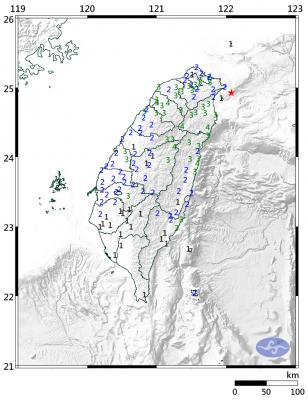
A magnitude 6.1 earthquake struck off the coast of Yilan County at 8:39pm tonight, the Central Weather Administration (CWA) said, with no immediate reports of damage or injuries. The epicenter was 38.7km east-northeast of Yilan County Hall at a focal depth of 98.3km, the CWA’s Seismological Center said. The quake’s maximum intensity, which gauges the actual physical effect of a seismic event, was a level 4 on Taiwan’s 7-tier intensity scale, the center said. That intensity level was recorded in Yilan County’s Nanao Township (南澳), Hsinchu County’s Guansi Township (關西), Nantou County’s Hehuanshan (合歡山) and Hualien County’s Yanliao (鹽寮). An intensity of 3 was

Japanese Prime Minister Sanae Takaichi’s comment last year on Tokyo’s potential reaction to a Taiwan-China conflict has forced Beijing to rewrite its invasion plans, a retired Japanese general said. Takaichi told the Diet on Nov. 7 last year that a Chinese naval blockade or military attack on Taiwan could constitute a “survival-threatening situation” for Japan, potentially allowing Tokyo to exercise its right to collective self-defense. Former Japan Ground Self-Defense Force general Kiyofumi Ogawa said in a recent speech that the remark has been interpreted as meaning Japan could intervene in the early stages of a Taiwan Strait conflict, undermining China’s previous assumptions
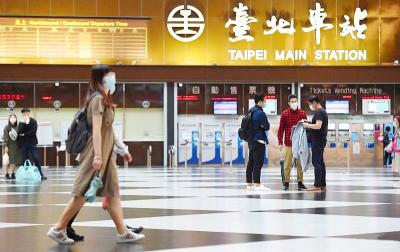
Taiwan Railways Corp (TRC) today announced that Shin Kong Mitsukoshi has been selected as the preferred bidder to operate the Taipei Railway Station shopping mall, replacing the current operator, Breeze Development Co Ltd. Among eight qualified firms that delivered presentations and were evaluated by a review committee, Shin Kong Mitsukoshi was ranked first, while Breeze was named the runner-up, the rail company said in a statement. Contract negotiations are to proceed in accordance with regulations, it said, adding that if negotiations with the top bidder fail, it could invite the second-ranked applicant to enter talks. Breeze in a statement today expressed doubts over


 RSS
RSS