


Legislative Speaker Wang Jin-pyng (王金平) yesterday expressed his disappointment after cross-party negotiations on legislative reforms broke down, dimming hopes that they would be passed before the current legislative session ends tomorrow.
Wang released a statement after the Democratic Progressive Party (DPP) caucus nixed a proposal to have the Chinese Nationalist Party (KMT)-initiated reform bills placed directly on the legislative agenda for second and third readings, sidestepping the first reading and committee review, so they could clear the floor before tomorrow.
In the statement, Wang said that despite a clear consensus on the direction of reform, such as the Legislative Yuan’s right to investigate and hold hearings, and four cross-caucus negotiations having been called on the matter, it is regrettable that “certain party caucuses” did not agree with the proposal to pass the reform bills before the session ends.
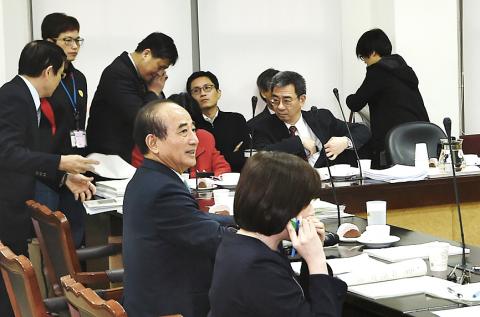
Photo: Fang Pin-chao, Taipei Times
“[My] resolve in enacting reforms will not die although the timing of legislative reform has been delayed by certain parties. I urge all politicians to renounce arrogance, face the people and promise that we will meet their expectations by completing legislative reform-related bills immediately after the ninth legislature is formed,” after the Jan. 16 legislative elections, Wang wrote.
DPP caucus whip Ker Chien-ming (柯建銘) said the party firmly supports legislative reform, but it opposes perfunctory passage of the bills, which should be thoroughly discussed and reviewed by members of the next legislature, who would be representative of new public opinion.
Separately yesterday, Deputy Legislative Speaker Hung Hsiu-chu (洪秀柱) dismissed a report by the Chinese-language Next Magazine saying she is to meet Chinese President Xi Jinping (習近平) in her forthcoming trip to China.
Hung said she would meet with Taiwanese businesspeople in Shanghai and attend a religious activity dedicated to Matsu (媽祖) and a seminar on cross-strait marriage in Kunshan, Jiangsu Province, after her arrival in China on Dec. 19.
The latest issue of the magazine, which came out yesterday, claimed that a Taiwanese businessperson had arranged for Hung to meet Xi.
“This is nonsense,” Hung said. “You do not even need to think with your brain, just your toes, to know [that is not possible].”
“I would love to know this high and mighty Taiwanese businessperson, if there is one,” she added.
As to the report’s claims that Hung is Beijing’s choice for next KMT chairperson, Hung said that figuring out the party’s next step is a more pressing issue than who should be the next party head.

The military has spotted two Chinese warships operating in waters near Penghu County in the Taiwan Strait and sent its own naval and air forces to monitor the vessels, the Ministry of National Defense (MND) said. Beijing sends warships and warplanes into the waters and skies around Taiwan on an almost daily basis, drawing condemnation from Taipei. While the ministry offers daily updates on the locations of Chinese military aircraft, it only rarely gives details of where Chinese warships are operating, generally only when it detects aircraft carriers, as happened last week. A Chinese destroyer and a frigate entered waters to the southwest

A magnitude 6.1 earthquake struck off the coast of Yilan County at 8:39pm tonight, the Central Weather Administration (CWA) said, with no immediate reports of damage or injuries. The epicenter was 38.7km east-northeast of Yilan County Hall at a focal depth of 98.3km, the CWA’s Seismological Center said. The quake’s maximum intensity, which gauges the actual physical effect of a seismic event, was a level 4 on Taiwan’s 7-tier intensity scale, the center said. That intensity level was recorded in Yilan County’s Nanao Township (南澳), Hsinchu County’s Guansi Township (關西), Nantou County’s Hehuanshan (合歡山) and Hualien County’s Yanliao (鹽寮). An intensity of 3 was

Japanese Prime Minister Sanae Takaichi’s comment last year on Tokyo’s potential reaction to a Taiwan-China conflict has forced Beijing to rewrite its invasion plans, a retired Japanese general said. Takaichi told the Diet on Nov. 7 last year that a Chinese naval blockade or military attack on Taiwan could constitute a “survival-threatening situation” for Japan, potentially allowing Tokyo to exercise its right to collective self-defense. Former Japan Ground Self-Defense Force general Kiyofumi Ogawa said in a recent speech that the remark has been interpreted as meaning Japan could intervene in the early stages of a Taiwan Strait conflict, undermining China’s previous assumptions

Instead of focusing solely on the threat of a full-scale military invasion, the US and its allies must prepare for a potential Chinese “quarantine” of Taiwan enforced through customs inspections, Stanford University Hoover fellow Eyck Freymann said in a Foreign Affairs article published on Wednesday. China could use various “gray zone” tactics in “reconfiguring the regional and ultimately the global economic order without a war,” said Freymann, who is also a nonresident research fellow at the US Naval War College. China might seize control of Taiwan’s links to the outside world by requiring all flights and ships entering or leaving Taiwan


 RSS
RSS