


The defense of Taiwan is probably the most critical and enduring strategic challenge facing US security professionals today, Project 2049 Institute research fellow Ian Easton said on Saturday.
“No other flashpoint is as likely to see the world’s two strongest nations go to war,” Easton told the annual banquet meeting of the Formosan Association for Public Affairs.
Easton said that China was building up for the day when it could project “overwhelming violence” across the Taiwan Strait.
“The Chinese military’s No. 1 mission is the invasion of Taiwan — including a pre-emptive attack on US forces that would come to Taiwan’s aid,” he said.
Chinese military planners want to use Taiwan as a military base to threaten Japan, South Korea and the Philippines, he said.
Easton criticized Washington for only offering arms sales designed to avoid provoking Beijing.
“Taiwan deserves to have the best weapons systems the US sells, not the cheap stuff that doesn’t scare Beijing,” he said. “Having frequent, as well as high-quality sales, is incredibly important for the strategic message it sends.”
Easton said that arms sales needed to be regular and of high quality, and that the US should also help Taiwan build submarines and sell it new fighter jets.
“The US Department of Defense should be sending high-ranking officials to visit Taiwan, not just mid-ranking desk officers,” he said. “The Pacific Command should be sending its best admirals and generals to visit Taiwan, and learn about the battle space firsthand — our defense attache in Taipei should be a one-star general, not a colonel.”
At the same time, the US should be holding bilateral military exercises with Taiwan, and US Navy ships should make port calls at Keelung and Kaohsiung, he said.
Easton argued that the US should include Taiwan in the fight against terrorism, piracy and human trafficking, and that the FBI should have a legal attache in Taipei.
More should be done, he said, to work with Taiwan against the shared cyberwarfare threat and to jointly conduct disaster relief operations.
“I would submit that fear, not logic, is driving many decisions in Washington, but I am confident that is going to change,” Easton said.
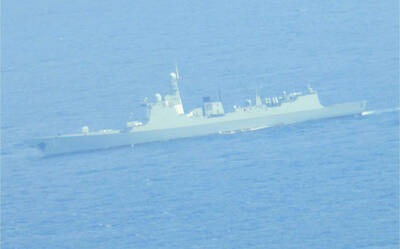
The military has spotted two Chinese warships operating in waters near Penghu County in the Taiwan Strait and sent its own naval and air forces to monitor the vessels, the Ministry of National Defense (MND) said. Beijing sends warships and warplanes into the waters and skies around Taiwan on an almost daily basis, drawing condemnation from Taipei. While the ministry offers daily updates on the locations of Chinese military aircraft, it only rarely gives details of where Chinese warships are operating, generally only when it detects aircraft carriers, as happened last week. A Chinese destroyer and a frigate entered waters to the southwest
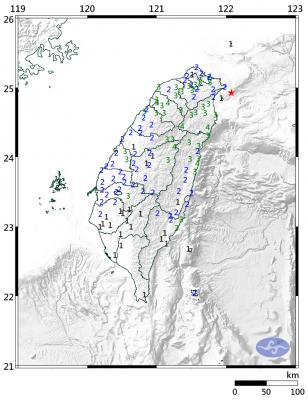
A magnitude 6.1 earthquake struck off the coast of Yilan County at 8:39pm tonight, the Central Weather Administration (CWA) said, with no immediate reports of damage or injuries. The epicenter was 38.7km east-northeast of Yilan County Hall at a focal depth of 98.3km, the CWA’s Seismological Center said. The quake’s maximum intensity, which gauges the actual physical effect of a seismic event, was a level 4 on Taiwan’s 7-tier intensity scale, the center said. That intensity level was recorded in Yilan County’s Nanao Township (南澳), Hsinchu County’s Guansi Township (關西), Nantou County’s Hehuanshan (合歡山) and Hualien County’s Yanliao (鹽寮). An intensity of 3 was
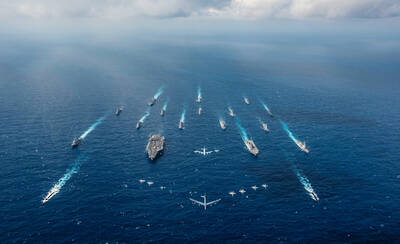
Japanese Prime Minister Sanae Takaichi’s comment last year on Tokyo’s potential reaction to a Taiwan-China conflict has forced Beijing to rewrite its invasion plans, a retired Japanese general said. Takaichi told the Diet on Nov. 7 last year that a Chinese naval blockade or military attack on Taiwan could constitute a “survival-threatening situation” for Japan, potentially allowing Tokyo to exercise its right to collective self-defense. Former Japan Ground Self-Defense Force general Kiyofumi Ogawa said in a recent speech that the remark has been interpreted as meaning Japan could intervene in the early stages of a Taiwan Strait conflict, undermining China’s previous assumptions
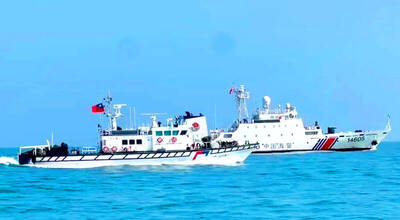
Instead of focusing solely on the threat of a full-scale military invasion, the US and its allies must prepare for a potential Chinese “quarantine” of Taiwan enforced through customs inspections, Stanford University Hoover fellow Eyck Freymann said in a Foreign Affairs article published on Wednesday. China could use various “gray zone” tactics in “reconfiguring the regional and ultimately the global economic order without a war,” said Freymann, who is also a nonresident research fellow at the US Naval War College. China might seize control of Taiwan’s links to the outside world by requiring all flights and ships entering or leaving Taiwan


 RSS
RSS