


Former president Lee Teng-hui (李登輝) yesterday called on Taiwan Solidarity Union (TSU) supporters to mobilize at least 1.5 million votes for the party’s at-large legislative seats, while casting their presidential ballots for Democratic Progressive Party (DPP) chairperson Tsai Ing-wen (蔡英文), to defend the nation’s sovereignty against Beijing’s ambitions.
“On January 16, please cast your party ballot for the TSU and the presidential ballot for Tsai,” Lee said to hundreds of people attending the TSU’s 14th anniversary celebration in Taipei, during which the TSU also released its list of 16 at-large legislative candidates.
Lee said that the Jan. 16 elections would mark the beginning of changes in Taiwan and that it is equally important to have the Legislative Yuan help Taiwan to “stand firmly” and to “walk toward a new direction,” as it is to have Tsai elected as president.
He said that in the past the TSU has served as a barrier against President Ma Ying-jeou’s (馬英九) China-leaning policies and that the TSU would continue to defend Taiwan’s sovereignty in the legislature in the future.
Lee added that the nation’s polices have undergone some changes since the Sunflower movement last year, as more young people are becoming involved in politics.
Lee said that the TSU would represent traditional Taiwan-oriented politics and the party would work together to defend national sovereignty.
Former vice president Annette Lu (呂秀蓮) and DPP Secretary-General Joseph Wu (吳釗燮) also attended the event.
The TSU’s at-large candidate list includes the legislators Lai Chen-chang (賴振昌) and Chou Ni-an (周倪安), while the head of the pro-independence group Radical Flank (基進側翼), Chen Yi-chi (陳奕齊) tops the list, showing the TSU’s determination to join forces with new and younger politicians, TSU Chairman Huang Kun-huei (黃昆輝) said.
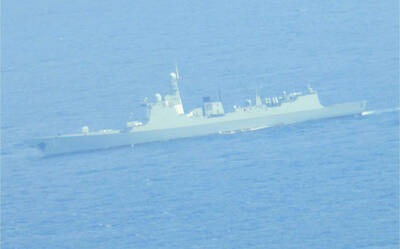
The military has spotted two Chinese warships operating in waters near Penghu County in the Taiwan Strait and sent its own naval and air forces to monitor the vessels, the Ministry of National Defense (MND) said. Beijing sends warships and warplanes into the waters and skies around Taiwan on an almost daily basis, drawing condemnation from Taipei. While the ministry offers daily updates on the locations of Chinese military aircraft, it only rarely gives details of where Chinese warships are operating, generally only when it detects aircraft carriers, as happened last week. A Chinese destroyer and a frigate entered waters to the southwest
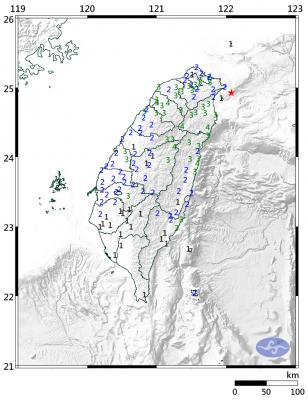
A magnitude 6.1 earthquake struck off the coast of Yilan County at 8:39pm tonight, the Central Weather Administration (CWA) said, with no immediate reports of damage or injuries. The epicenter was 38.7km east-northeast of Yilan County Hall at a focal depth of 98.3km, the CWA’s Seismological Center said. The quake’s maximum intensity, which gauges the actual physical effect of a seismic event, was a level 4 on Taiwan’s 7-tier intensity scale, the center said. That intensity level was recorded in Yilan County’s Nanao Township (南澳), Hsinchu County’s Guansi Township (關西), Nantou County’s Hehuanshan (合歡山) and Hualien County’s Yanliao (鹽寮). An intensity of 3 was
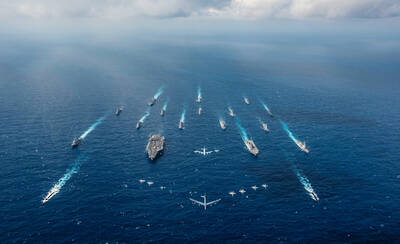
Japanese Prime Minister Sanae Takaichi’s comment last year on Tokyo’s potential reaction to a Taiwan-China conflict has forced Beijing to rewrite its invasion plans, a retired Japanese general said. Takaichi told the Diet on Nov. 7 last year that a Chinese naval blockade or military attack on Taiwan could constitute a “survival-threatening situation” for Japan, potentially allowing Tokyo to exercise its right to collective self-defense. Former Japan Ground Self-Defense Force general Kiyofumi Ogawa said in a recent speech that the remark has been interpreted as meaning Japan could intervene in the early stages of a Taiwan Strait conflict, undermining China’s previous assumptions
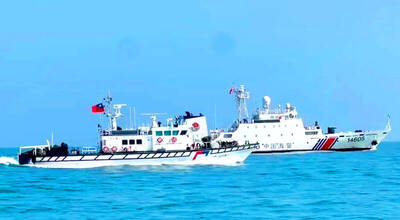
Instead of focusing solely on the threat of a full-scale military invasion, the US and its allies must prepare for a potential Chinese “quarantine” of Taiwan enforced through customs inspections, Stanford University Hoover fellow Eyck Freymann said in a Foreign Affairs article published on Wednesday. China could use various “gray zone” tactics in “reconfiguring the regional and ultimately the global economic order without a war,” said Freymann, who is also a nonresident research fellow at the US Naval War College. China might seize control of Taiwan’s links to the outside world by requiring all flights and ships entering or leaving Taiwan


 RSS
RSS