


A trade in goods agreement with China would flood the market with cheap Chinese foodstuffs, undermining food safety and harming the agricultural sector, protesters said yesterday during a protest outside the Executive Yuan, calling for negotiations to be halted.
Homemakers United Foundation secretary-general Lai Hsiao-fen (賴曉芬) said government negotiators were considering dropping regular inspection requirements for Chinese foodstuffs, potentially allowing them to be imported without any inspection as long as the importers sign a letter of guarantee sayinh they meet Taiwanese regulatory standards.
“The agreement would increase food safety risks because Chinese regulations are not rigorous enough. At a time when Taiwan’s own food safety problems are worsening, if we allow large amounts of Chinese products in, I believe our own government would not be able to provide effective regulation,” said Hsu Hsiu-chaio (許秀嬌), Homemakers Union Consumers Co-op chairperson, saying that food-quality imported Chinese medicinal herbs often contain unsafe levels of fertilizer residues and heavy metals.
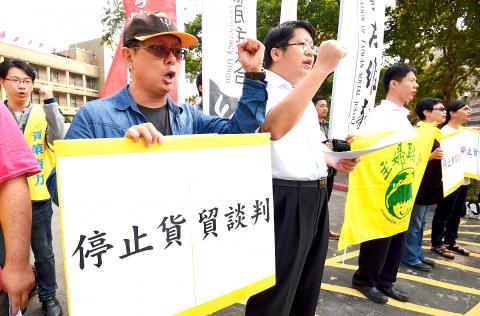
Photo: Lo Pei-der, Taipei Times
She said that because of the safety risks, the herbs already occupied a disproportionate portion of the testing budget of her organization, which is an organic food cooperative founded by environmental group the Homemakers United Foundation.
A trade in goods agreement would flood the domestic market with Chinese foodstuffs, she said.
“As China is very large and does not have rigorous regulations, their costs are lower. Businesspeople will choose the foodstuffs that cost the least, battering our agricultural sector,” she said.
Taiwan Rural Front spokesperson Chen Ping-hsuan (陳平軒) said he condemned the government for refusing to publish a full list of products being negotiated.
Even if the government kept its promise of refusing to drop protections for agricultural products, decreasing tariffs on imported processed foodstuffs would still shock the market for some agricultural goods, he said.
He cited the market for red beans, saying that 70 percent of beans produced domestically are used to make red bean paste.
The agricultural sector and food safety should not sacrificed for the interests of the petrochemical, automotive and flat panel industry, he said, citing products Taiwanese negotiators have targeted for tariff reductions.
The protesters called for negotiations to be halted until a bill for establishing a mechanism to oversee cross-strait agreements is passed by the Legislative Yuan, also calling for meaningful participation in negotiations by civic groups along with better transitional mechanisms to help affected sectors.
Minister of Economic Affairs John Deng (鄧振中) earlier this month said that safety testing was a “critical” part of the negotiations, adding that Taiwanese negotiators would insist on the nation’s right to continue testing, refusing to accept Chinese safety certificates.

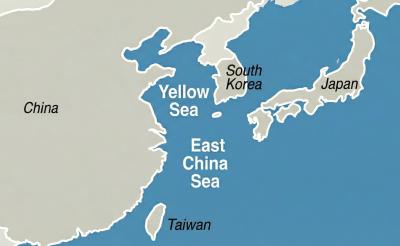
China has reserved offshore airspace in the Yellow Sea and East China Sea from March 27 to May 6, issuing alerts usually used to warn of military exercises, although no such exercises have been announced, the Wall Street Journal (WSJ) reported yesterday. Reserving such a large area for 40 days without explanation is an “unusual step,” as military exercises normally only last a few days, the paper said. These alerts, known as Notice to Air Missions (Notams), “are intended to inform pilots and aviation authorities of temporary airspace hazards or restrictions,” the article said. The airspace reserved in the alert is
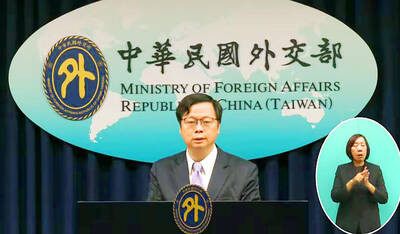
NAMING SPAT: The foreign ministry called on Denmark to propose an acceptable solution to the erroneous nationality used for Taiwanese on residence permits Taiwan has revoked some privileges for Danish diplomatic staff over a Danish permit that lists “Taiwan” as “China,” Eric Huang (黃鈞耀), head of the Ministry of Foreign Affairs’ Department of European Affairs, told a news conference in Taipei yesterday. Reporters asked Huang whether the Danish government had responded to the ministry’s request that it correct the nationality on Danish residence permits of Taiwanese, which has been listed as “China” since 2024. Taiwan’s representative office in Denmark continues to communicate with the Danish government, and the ministry has revoked some privileges previously granted to Danish representatives in Taiwan and would continue to review
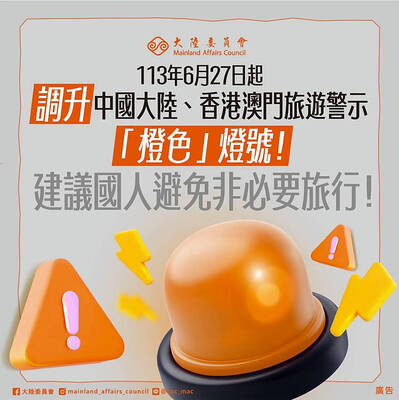
More than 6,000 Taiwanese students have participated in exchange programs in China over the past two years, despite the Mainland Affairs Council’s (MAC) “orange light” travel advisory, government records showed. The MAC’s publicly available registry showed that Taiwanese college and university students who went on exchange programs across the Strait numbered 3,592 and 2,966 people respectively. The National Immigration Agency data revealed that 2,296 and 2,551 Chinese students visited Taiwan for study in the same two years. A review of the Web sites of publicly-run universities and colleges showed that Taiwanese higher education institutions continued to recruit students for Chinese educational programs without
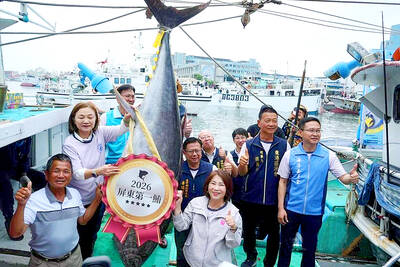
The first bluefin tuna of the season, brought to shore in Pingtung County and weighing 190kg, was yesterday auctioned for NT$10,600 (US$333.5) per kilogram, setting a record high for the local market. The auction was held at the fish market in Donggang Fishing Harbor, where the Siaoliouciou Island-registered fishing vessel Fu Yu Ching No. 2 delivered the “Pingtung First Tuna” it had caught for bidding. Bidding was intense, and the tuna was ultimately jointly purchased by a local restaurant and a local company for NT$10,600 per kilogram — NT$300 ,more than last year — for a total of NT$2.014 million. The 67-year-old skipper


 RSS
RSS