


Despite a lack of experience, one man is credited with developing the images and icons that represent the nation’s top-flight baseball competition.
Manga artist Chung Meng-shun (鍾孟舜) 25 years ago produced in a four-year period all the commercial art designs for the Chinese Professional Baseball League (CPBL), as well as mascots, logos and promotional materials for its four founding teams.
Before becoming a manga artist with multiple publications under his belt and Comic Artist Labor Union president, Chung had already put his stamp on Taiwanese baseball and cartoon history by creating the iconic logos of the then-Chinatrust Brother Elephants, the Uni-President Lions, and the now-defunct Mercuries Tigers and Wei Chuan Dragons.

Photo: Wu Po-hsuan, Taipei Times
Unique circumstances made him the CPBL’s de facto general director of art, Chung said.
In 1989, Chung left the army equipped with a Taiwan University of Art bachelor’s degree in traditional Chinese painting and a passion for manga, but no formal training in commercial design or cartoons.
He decided to give the CPBL a try simply because its preparatory office was hiring artists.
Brother Hotel Inc chairman Hung Tung-sheng (洪騰勝), who was emerging as a key figure in the CPBL, took a personal interest in Chung’s work and put Chung on every design-related project within the league, including making logos, mascots and posters for the teams, Chung said.
Chung said that in the following four years he served as the CPBL’s “first and only art director,” working simultaneously for all four teams.
Chung’s job description was all-encompassing. At one point, he was even asked to put together cheerleading squads, he said.
Even the championship trophy for the first CPBL season was his design, Chung said.
“Actually, in the first six months prior to the league’s first official game, I had to role-play being a spectator and watched ‘games’ all day long,” he said.
“My butt hurt plenty,” he added.
Chung designed cartoon baseball cards featuring individual players, drawing caricatures of noted baseballers, as well as writing a book, Baseball Stars: A Concept Art Special Edition (職棒明星漫畫造型-鍾孟舜專輯).
The players for whom he designed cards included luminaries such as pitcher Chen “Holiday Flycutter” Yi-hsin (陳義信), who earned the nickname for his skills and because the Elephants fielded him in games on holidays; leading base-stealer and later Brother Elephants skipper Lin “Commander Stealer” Yi-tseng (林易增); and Lee “Mister Baseball” Chu-ming (李居明), a famed hitter and center fielder who was a stalwart of the national team.
Chung said his experiences with the CPBL provided him with plenty of material for comic books after he left the league.
Chung’s comic book Violent Baseball (暴力棒球) was based on match-fixing that he heard of or witnessed during his time in the league, with mobsters telling players to throw games with threats against life and limb.
Controversial at the time, Chung was vindicated when baseball scandals became public knowledge years later.
“I had so much fun,” Chung said of his four years in the CPBL.
“Every trick of the trade I know, I learned on the job,” he said.
“I didn’t know anything at the time, but I caught a big break by never saying: ‘I don’t know how’ when I faced a challenge,” Chung said.
“Experience is not important; what you do not know, you can ask,” he added. “Anything is possible if you try.”

FUKUOKA SITUATION: Japanese media reported that the pathogen is expected to be identified by the summer, while the CDC downplayed the idea that it was hMPV A “mysterious cold-like illness” reported in Japan’s Fukuoka Prefecture does not seem to be a new disease, but Japanese authorities have been asked about the situation, the Centers for Disease Control (CDC) said yesterday. The Fukuoka Prefectural Medical Association on Wednesday told a news conference that a “mystery cold” that has become a hot topic on social media is “highly likely to be caused by some kind of viral infection,” Japan’s KBC News reported. “Many people are experiencing symptoms starting with a sore throat, followed by a runny nose, phlegm and a severe cough,” KBC News reported, citing association officials. Health authorities are

Nvidia Corp CEO Jensen Huang (黃仁勳) arrived in Taiwan yesterday ahead of upcoming AI and technology events, saying he plans to meet with clients and Taiwan Semiconductor Manufacturing Co Chairman C.C. Wei (魏哲家) during his visit. After landing at Taipei Songshan Airport, Huang posed for photos with fans and handed out Yakult drinks to reporters and supporters waiting at the scene, saying he has “a lot to do” during the trip. Asked about reports that Nvidia’s planned headquarters site in Taipei’s Beitou Shilin Technology Park could break ground on May 27, Huang said that if the company holds an event, he would

The Ministry of Finance this afternoon announced the winning numbers for the March-April uniform invoice lottery. The winning number for the NT$10 million (US$318,060) special prize is 19531471, and the winning number for the NT$2 million grand prize is 85941329. Three numbers were drawn for the NT$200,000 first prize: 07225810, 20231230 and 83518781. Those with receipts matching the last seven digits of any of the first-prize numbers will win the NT$40,000 second prize, while those matching the last six digits will win the NT$10,000 third prize. Those whose receipts match the last five digits of the first-prize numbers can claim the NT$4,000 fourth prize,
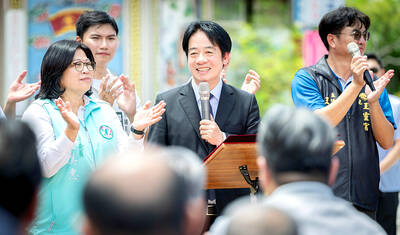
SIX SUBSIDIES: The monthly allowance for older farmers is to increase to NT$10,000, and NT$5,000 is to be given to homemakers under the national pension system, Lai said The government is to implement major welfare policies for disadvantaged groups, including raising the monthly allowance for older farmers to NT$10,000 and providing homemakers with NT$5,000 per month, President William Lai (賴清德) said yesterday. Lai made the remarks during a visit to Wangling Temple in Chiayi County, saying that the planned increases were being introduced amid economic growth and an increase in tax revenue. Touting a policy, in which the government plans to provide a monthly allowance of NT$5,000 for every child under the age of 18 in a bid to address Taiwan’s low birthrate, Lai said that if received for the


 RSS
RSS