


A shortage of regulations over standard prices for animal blood transfusions, as well as no established archive data for pets’ blood banks has led to outrageous prices for animal blood, the Consumers’ Foundation said.
According to the foundation, a pet owner in New Taipei City’s Sinjhuang District (新莊) who brought a puppy to a veterinarian to be treated said that the animal would need a transfusion.
The owner said the clinic quoted NT$7,000 for every 100cm3 of blood, according to the foundation.
A shortage of blood banks makes transfusions difficult, as vets have to find a healthy supply to match an animal needing blood, the foundation said, adding that as transfusions are rare, vets are not likely to have dogs available in situations where they are required to give blood.
Without knowing blood types, transfusions can cause hemolytic reactions, which can be fatal to cats and dogs, the foundation said.
There are approximately eight canine blood types and the process of ascertaining which type is needed is the predominant reason for the high costs of transfusions, National Taiwan University professor Fei Chang-yung (費昌勇) said.
However, with increasing attention being paid to pets, the National Health Insurance (NHI) might consider including animals in insurance policies, Fei said.
The foundation called on the Council of Agriculture to establish industry regulations.
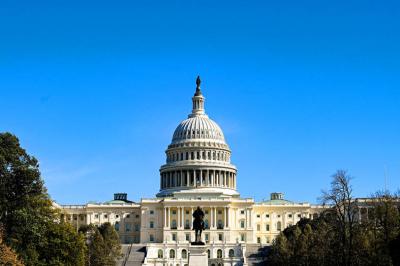
The US House of Representatives yesterday passed the PROTECT Taiwan Act, which stipulates that Washington would exclude China from participating in major global financial organizations if its actions directly threaten Taiwan’s security. The bill, proposed by Republican US Representative Frank Lucas, passed with 395 votes in favor and two against. It stipulates that if China’s actions pose any threat to Taiwan’s security, economic or social systems, the US would, “to the maximum extent practicable,” exclude China from international financial institutions, including the G20, the Bank for International Settlements and the Financial Stability Board. The bill makes it clear that China
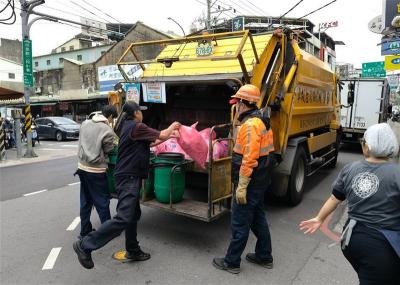
Garbage and recycling schedules are to vary from Saturday through Sunday next week over the Lunar New Year holiday period. The following collection information is from the governments of the six special municipalities. Taipei Regular service: Sunday to Monday next week. No service: Tuesday to Thursday next week. Extra service: Friday next week. Regular service resumes: Saturday next week. New Taipei City Extra service: Sunday. Adjusted collection time: Monday next week — garbage collection is to begin in the morning and end at 6pm. No service: Tuesday to Thursday next week. Regular service resumes: Friday next week. Note: Garbage can be dropped off at 70

A KFC branch in Kaohsiung may be fined between NT$60,000 and NT$200 million (US$1,907 and US$6.37 million), after a customer yesterday found an entire AAA battery inside an egg tart, the Kaohsiung Department of Health said today. The customer was about to microwave a box of egg tarts they had bought at the fast-food restaurant’s Nanzih (楠梓) branch when they checked the bottom and saw a dark shadow inside one of them, they said in a Threads post. The customer filmed themself taking the egg tart apart to reveal an entire AAA battery inside, which apparently showed signs of damage. Surveillance footage showed
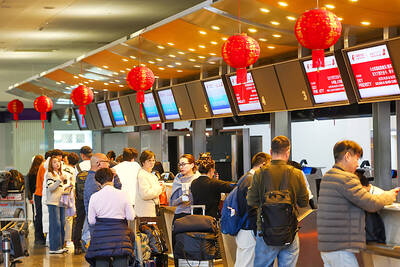
GROUP EFFORT: The number of inbound travelers rose 11 to 12 percent last month, with a significant increase in tourists from Europe and North America, an official said The government aims to attract 9.4 million visitors this year, the Tourism Administration said yesterday, citing last year’s success in diversifying tourist markets. Taiwan last year drew about 8.57 million international arrivals, 72.3 percent of pre-COVID-19 levels. By contrast, the nation had about 18.94 million outbound tourists last year, surpassing the pre-COVID-19 level of 17.1 million. The estimated tourism revenue deficit was about NT$700.9 billion (US$22.22 billion). Taoyuan International Airport Corp expects more than 160,000 passengers to pass through the nation’s largest airport daily during the Lunar New Year holiday, which begins on Saturday. As of Jan. 30, the nation’s average hotel occupancy rate


 RSS
RSS