


People First Party (PFP) presidential candidate James Soong (宋楚瑜) has become embroiled in controversy once again after a two-minute televised commercial aired during the 50th Golden Bell Awards ceremony on Saturday.
Produced by a pro-Soong organization titled the “Spring Breeze Youth Policy Think Tank,” the commercial featured video clips of Soong visiting people affected by natural catastrophes during his term as Taiwan provincial governor from 1994 to 1998, joining political events and interacting with his late wife, Chen Wan-shui (陳萬水).
A slogan appeared a few seconds before the advertisement ended, reading: “[Only those who are] faithful to their wives and faithful to their children will be faithful to their country.”
The commercial quickly drew criticism online.
Some netizens said the commercial’s underlying concept equated single people to disloyal residents, while others said Soong must have been unfaithful to his country before he got married and had children.
Taipei City Councilor Kao Chia-yu (高嘉瑜) of the Democratic Progressive Party (DPP) said on Facebook on Saturday night that the PFP was relapsing into its old habit of attacking single women.
“The PFP has just apologized for its attack on unmarried, single women. And now it is doing it again,” Kao said.
Kao shared a screenshot of a much-criticized picture posted by a PFP-managed fan page on Monday last week, which depicted presidential candidates Tsai Ing-wen (蔡英文) of the Democratic Progressive Party and Hung Hsiu-chu (洪秀柱) of the Chinese Nationalist Party (KMT) against the backdrop of a photograph of a mother carrying her child on her back.
It featured a slogan reading: “How can two single women possibly understand the needs of a family?”
The picture was removed after severe criticism online and PFP Deputy Secretary-General Liu Wen-hsiung (劉文雄) apologized over “inappropriate comments” aimed at single women.
Soong campaign office spokesperson Chen Yi-chieh (陳怡潔) said the advertisement was made by PFP supporters and that the party did not play any part in its production.
“Soong is grateful for all the support he has received from the public ... but the slogan depicted in the ad does not reflect his values or principles,” Chen Yi-chieh said.

In a historic first, Taiwanese officials participated in this year’s Riga Strategic Communications Dialogue in Latvia from Wednesday to Friday last week, which debuted a breakout session focused on Taiwan The event organizer, the NATO Strategic Communications Center of Excellence, displayed Taiwan’s national flag and the officials’ formal titles on their Web site. Taiwanese attendees included National Security Council (NSC) Deputy Secretary-General Lin Fei-fan (林飛帆) and deputy head of the Taipei Representative Office in the UK, Chiang Ya-chi (江雅綺). In addition to the session discussing Taiwan titled “Taiwan: Navigating Strategic Communication in a Tense Environment,” the dialogue also included sessions
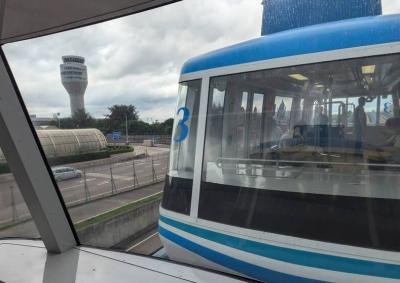
Taiwan Taoyuan International Airport is to suspend its automated Skytrain service connecting Terminal 1 and Terminal 2 starting on July 1 to facilitate connection works for the upcoming Terminal 3, the airport operator said today. Passengers and staff who need to travel between the two terminals after the suspension can instead use the Taoyuan MRT or the airport's 24-hour shuttle bus service, Taoyuan International Airport Corp said. The Taoyuan MRT Airport Line directly links the two terminals, while the shuttle buses are to operate around the clock, the company added. The Skytrain provides free transportation between the airport’s two terminals for travelers and
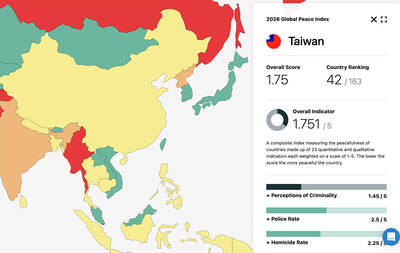
Taiwan ranked 42nd in terms of peacefulness among 163 countries, down five places from last year, according to this year’s Global Peace Index. With an overall score of 1.751, Taiwan dropped from 37th last year, the report published by the global Institute for Economics and Peace showed. The overall score measures a country’s level of peacefulness using 23 quantitative and qualitative indicators across three domains — ongoing domestic and international conflict, societal safety and security, and militarization. While Taiwan ranked 42nd worldwide, it was listed in ninth place among the 19 Asian-Pacific countries in the report, after New Zealand, Singapore, Japan, Malaysia,
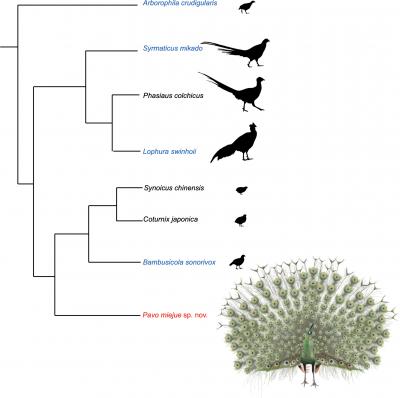
Through analyzing fossil evidence, a research team at National Taiwan University (NTU) discovered the largest endemic bird to have lived in Taiwan, naming it Pavo miejue, or extinct peafowl (滅絕孔雀). The Mikado pheasant, which is printed on the back of the NT$1,000 bank note, was previously believed to be the biggest endemic bird to Taiwan. The research team’s findings suggest that Pavo miejue lived during the Pleistocene epoch tens of thousands of years ago. It is the first endemic extinct bird species discovered and formally named in Taiwan. The study was coauthored by NTU Institute of Ecology and Evolutionary Biology professor Tsai Cheng-hsiu (蔡政修),


 RSS
RSS