


Civil groups and scores of migrant fishermen rallied in front of the Ministry of Labor headquarters in Taipei yesterday, saying their employers have improperly docked money from their salaries and comparing their working conditions to slavery.
Protesters and migrant fishermen, mostly Filipinos, performed a skit and shouted slogans in different languages, demanding free accommodation and direct payment of salaries for migrant fishermen.
Taiwan International Workers’ Association researcher Wu Jing-ru (吳靜如) said many migrant fishermen have NT$5,000 deducted from their pay per month for onboard accommodation, as employers are allowed to provide lodging or other benefits worth up to NT$5,000 in lieu of the full minimum wage, according to the Labor Standards Act (勞基法).
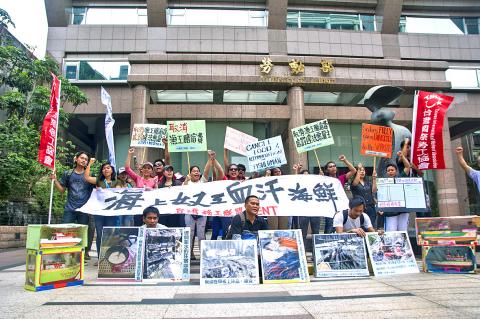
Photo: CNA
The onboard lodging is not worth the money, but migrant workers — who usually earn the minimum wage — have to pay for it as well as brokerage fees, making their real wage much lower than the minimum, Wu said.
A Filipino fisherman using the name Joel said he could not sleep in the fishing boat he works on because the crew’s cabin is too hot and noisy due to its proximity to the engine, forcing him to sleep on a makeshift bed of cardboard on deck.
During a six-day layover due to a typhoon, he and another crew member were given only NT$500 for dining expenses, and they had to pick fruit on a nearby mountain to survive, Joel said.
Another fisherman, who gave his name as Joeril, said his captain limits water use and does not allow crew to do laundry onboard, while giving them only rice porridge for breakfast.
Wu said that human resource agencies often concoct various excuses to deduct migrant fishermen’s salaries, such as exacting brokerage fees, but listing the payment as “mortgage,” and forcing workers to sign a “mortgage contract” with the agencies’ subsidiaries registered in migrant workers’ countries of origin.
The ministry has been negligent by failing to conduct any inspections over such practices, Wu said, adding that it claims that the docking of pay — as it is a “mortgage” made between foreign workers and foreign-registered firms — is regulated by the labor exporting nation, instead of recognizing the practice as a breach of the act.
According to the ministry’s Foreign Workers Living and Caring Service Planning Book (外國人生活照顧服務計畫書), employers of migrant workers are required to provide accommodation that meets the workers’ needs, but the ministry has failed to ensure the implementation of the rule, Wu said.
Vietnamese Catholic priest Peter Nguyen Van Hung said that Vietnamese migrant fishermen faced a similar plight before they were blocked from working in Taiwan in 2004, with the situation remaining unchanged for years.
Ministry Senior Executive Officer Hou Song-yen (侯松延), who accepted the protesters’ petition, said it is legally permissible for employers to provide accommodation in lieu of payment, but added that the ministry would look into the protesters’ claims to determine whether there is any illegal activity going on.
The ministry is yet to conduct an inspection of the fishing industry due to its unique working patterns, Hou said, adding that it is the Fisheries Agency’s duty to inspect working conditions of fishing vessels operating outside Taiwan’s territorial waters.

The Ministry of Finance this afternoon announced the winning numbers for the March-April uniform invoice lottery. The winning number for the NT$10 million (US$318,060) special prize is 19531471, and the winning number for the NT$2 million grand prize is 85941329. Three numbers were drawn for the NT$200,000 first prize: 07225810, 20231230 and 83518781. Those with receipts matching the last seven digits of any of the first-prize numbers will win the NT$40,000 second prize, while those matching the last six digits will win the NT$10,000 third prize. Those whose receipts match the last five digits of the first-prize numbers can claim the NT$4,000 fourth prize,

SIX SUBSIDIES: The monthly allowance for older farmers is to increase to NT$10,000, and NT$5,000 is to be given to homemakers under the national pension system, Lai said The government is to implement major welfare policies for disadvantaged groups, including raising the monthly allowance for older farmers to NT$10,000 and providing homemakers with NT$5,000 per month, President William Lai (賴清德) said yesterday. Lai made the remarks during a visit to Wangling Temple in Chiayi County, saying that the planned increases were being introduced amid economic growth and an increase in tax revenue. Touting a policy, in which the government plans to provide a monthly allowance of NT$5,000 for every child under the age of 18 in a bid to address Taiwan’s low birthrate, Lai said that if received for the
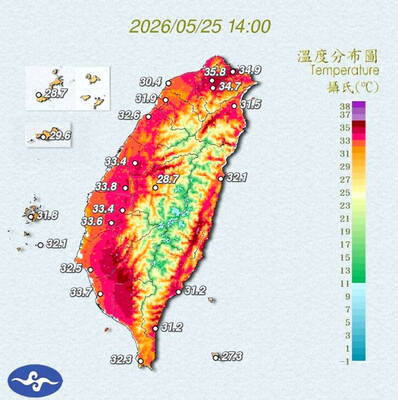
STAY COOL: The HPA recommended that people stay hydrated, use air-conditioning or fans while indoors, wear loose-fitting clothes and walk in the shade while outdoors Employers must implement measures such as installing cooling equipment, and providing drinking water and rest breaks for outdoor workers starting from Monday next week, the Taipei Department of Labor said on Sunday. Employers who fail to comply could face fines of NT$30,000 to NT$300,000 under the Occupational Safety and Health Act (職業安全衛生法), the department said. Businesses in Taipei employing fewer than 100 workers, as well as registered self-employed workers with labor insurance coverage, could receive on-site assessments and guidance from occupational safety consultants to help them apply for central government subsidies to implement or improve heat-protection measures, it said. Under the Ministry of

NATIONAL SECURITY: Authorities are working to confirm the identities of the military personnel involved and investigating possible illegal conduct and regulatory violations Authorities are probing possible national security implications after Kinmen police and immigration officers on Sunday found a Chinese woman allegedly posing as a tourist while engaging in prostitution involving more than 10 military personnel. The woman, surnamed Chen (陳), has since been deported, authorities said, adding that investigators are still working to confirm the identities of those implicated, as the records only listed code names and aliases. The case stemmed from a report received by the Kinmen District Prosecutors’ Office on Friday last week from the Jinhu Precinct of the Kinmen County Police Bureau. On Sunday, police, along with the National Immigration


 RSS
RSS