


The highly anticipated Suhua Highway improvement project achieved a major milestone yesterday when construction of a section of the longest tunnel along the coastal highway was completed.
Finishing the 1.4km section at the center of the southbound section of the 7.9km Kuanyin Tunnel is likely to speed up work in the tunnel, according to the Ministry of Transportation and Communications.
Engineers accessed the center of the tunnel from the side via an old railway tunnel and can now access equipment that can drill to both ends of the tunnel fairly quickly, officials said.
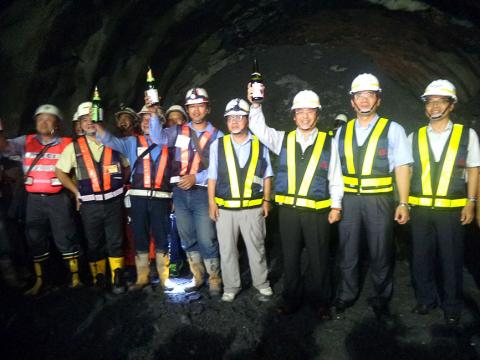
Photo: CNA
Minister of Transportation and Communications Chen Jian-yu (陳建宇) said the ministry expects to wrap up construction of the southbound section the tunnel in June next year, while the northbound section is due to be completed by the end of this year.
“Upon completion, the tunnel will save one hour of travel time,” Chen said at a ceremony inside the tunnel in Nanao Township (南澳) in Yilan County.
Suhua Highway is the main artery highway connecting southern Yilan County to Hualien County along the east coast.
The Suhua Highway’s winding, narrow roads perched above the Pacific Ocean are the scene of frequent accidents and are especially vulnerable to landslides.
Calls for an upgrade gained urgency in 2010 after torrential rains from Typhoon Megi triggered landslides on the road and killed 26 people.
The 38.8km project, which is aimed at improving road safety and reducing travel time between Suao and Hualien County, is divided into three sections — from Suao to Dongao Township (東澳), from Nanao (南澳) to Heping (和平) townships (which includes the Kuanyin Tunnel), and from Heping to Chingshui.
The road is mostly tunnels that cut through mountainous terrain and replace the Suhua Highway’s most vulnerable stretches.
The project is expected to be completed by the end of 2017.

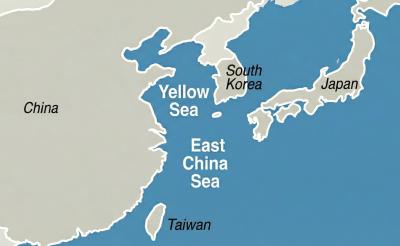
China has reserved offshore airspace in the Yellow Sea and East China Sea from March 27 to May 6, issuing alerts usually used to warn of military exercises, although no such exercises have been announced, the Wall Street Journal (WSJ) reported yesterday. Reserving such a large area for 40 days without explanation is an “unusual step,” as military exercises normally only last a few days, the paper said. These alerts, known as Notice to Air Missions (Notams), “are intended to inform pilots and aviation authorities of temporary airspace hazards or restrictions,” the article said. The airspace reserved in the alert is

NAMING SPAT: The foreign ministry called on Denmark to propose an acceptable solution to the erroneous nationality used for Taiwanese on residence permits Taiwan has revoked some privileges for Danish diplomatic staff over a Danish permit that lists “Taiwan” as “China,” Eric Huang (黃鈞耀), head of the Ministry of Foreign Affairs’ Department of European Affairs, told a news conference in Taipei yesterday. Reporters asked Huang whether the Danish government had responded to the ministry’s request that it correct the nationality on Danish residence permits of Taiwanese, which has been listed as “China” since 2024. Taiwan’s representative office in Denmark continues to communicate with the Danish government, and the ministry has revoked some privileges previously granted to Danish representatives in Taiwan and would continue to review
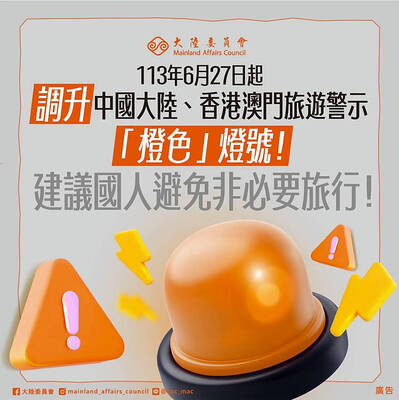
More than 6,000 Taiwanese students have participated in exchange programs in China over the past two years, despite the Mainland Affairs Council’s (MAC) “orange light” travel advisory, government records showed. The MAC’s publicly available registry showed that Taiwanese college and university students who went on exchange programs across the Strait numbered 3,592 and 2,966 people respectively. The National Immigration Agency data revealed that 2,296 and 2,551 Chinese students visited Taiwan for study in the same two years. A review of the Web sites of publicly-run universities and colleges showed that Taiwanese higher education institutions continued to recruit students for Chinese educational programs without
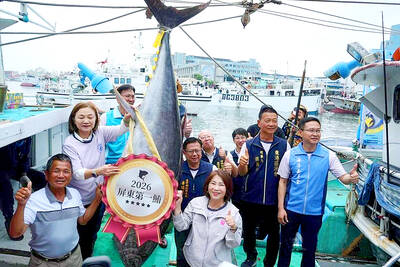
The first bluefin tuna of the season, brought to shore in Pingtung County and weighing 190kg, was yesterday auctioned for NT$10,600 (US$333.5) per kilogram, setting a record high for the local market. The auction was held at the fish market in Donggang Fishing Harbor, where the Siaoliouciou Island-registered fishing vessel Fu Yu Ching No. 2 delivered the “Pingtung First Tuna” it had caught for bidding. Bidding was intense, and the tuna was ultimately jointly purchased by a local restaurant and a local company for NT$10,600 per kilogram — NT$300 ,more than last year — for a total of NT$2.014 million. The 67-year-old skipper


 RSS
RSS