


Several key Chinese Nationalist Party (KMT) figures absented themselves from KMT presidential candidate Hung Hsiu-chu’s (洪秀柱) visits to Changhua and Yunlin counties on Friday and Saturday, a gesture that political observers said were aimed at drawing a line between them and Hung.
The visits were part of a nationwide campaign launched last week, but Hung’s trip to Changhua on Friday saw the absence of local KMT legislators Lin Tsang-min (林滄敏) and Cheng Ru-fen (鄭汝芬), and an early exit by KMT Legislator Wang Hui-mei (王惠美), unlike the warm reception Hung received from all eight KMT legislators in Taichung on Thursday.
Former Yunlin County commissioner Chang Jung-wei (張榮味) and KMT Legislator Chang Chia-chun (張嘉郡) did not attend Hung’s campaign event in Yunlin on Saturday.
A senior KMT legislator, who declined to be named, said that the cold shoulder Hung received could become a theme as she heads farther south, as legislative candidates doubt her ability to win votes in constituencies in central and southern Taiwan.
Hung’s narratives have been unsatisfying, and her previous unilateral discourse on China has squandered the KMT’s advantage on cross-strait issues, alienating herself from pro-localization KMT legislators, in addition to her inability to court neutral voters, the unnamed legislator said.
“If you are not helpful, others cannot help but distance themselves from you,” the unnamed legislator said.
The legislator quoted some KMT members from central and southern municipalities as saying: “Hung’s visit is harmful to us. Voters would cross out anyone who is associated with Hung.”
KMT Legislator Chen Ken-te (陳根德) said that the party has earned a dim electoral prospect with Hung’s cross-strait policies and a sluggish economy caused by President Ma Ying-jeou’s (馬英九) administration, coupled with a provocative remark by a KMT member at the party’s national congress, who said: “Taiwanese have failed the KMT.”
Chen questioned the KMT’s strategy of tying the legislative campaign to the presidential campaign, saying: “If the legislative campaigns are bundled with the presidential campaigns, the candidates might all go to hell.”
Saying that the party could not shift the responsibility onto district legislative candidates alone, Chen questioned what contribution the KMT headquarters and the party’s local chapters have made in formulating separate strategies for legislative and presidential campaigns.
Likening Hung to a mother hen, with legislative candidates as her chicks, Chen said that the hen’s inability to lead the chicks had brought about the absence of local legislators from Hung’s campaign events.
“The mother hen might trample her chicks to death, but the chicks are tied to the hen; they would die with her,” Chen said.
The KMT should separate presidential and legislative campaigns, and the party should mobilize prominent local politicians to stump for Hung, while campaigning for legislative candidates in different, but more useful, ways, which could help the KMT retain a few more seats in the legislature if it loses the presidential race, Chen said.
The KMT should analyze the results of last year’s nine-in-one elections and disconnect the legislative campaigns from the presidential campaign in pan-green strongholds to minimize collateral damage, he said.
Democratic Progressive Party Legislator Chen Chi-mai (陳其邁) said that Hung’s stumping is a recipe for disaster for other candidates, as her inclination toward hasty unification and blatant refusal of localization pose a sharp contrast to public sentiment in the nation’s south.
Election is realpolitik, and the KMT’s pro-localization legislators are not to blame if they adopt a more practical measure by separating their campaigns from Hung’s, Chen said.
In related news, Hung spokesman Jack Yu (游梓翔) yesterday said he plans to stand down from his position on Saturday, a little more than a month after he accepted the role.
On Facebook, Yu said he would return to his teaching job at Shih Hsin University, but that he would continue to advise Hung’s campaign team on matters related to public and media relations.
Additional reporting by CNA

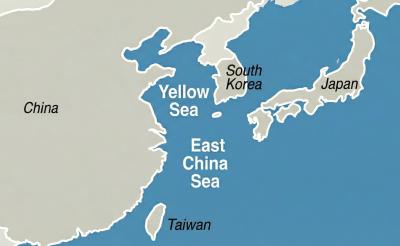
China has reserved offshore airspace in the Yellow Sea and East China Sea from March 27 to May 6, issuing alerts usually used to warn of military exercises, although no such exercises have been announced, the Wall Street Journal (WSJ) reported yesterday. Reserving such a large area for 40 days without explanation is an “unusual step,” as military exercises normally only last a few days, the paper said. These alerts, known as Notice to Air Missions (Notams), “are intended to inform pilots and aviation authorities of temporary airspace hazards or restrictions,” the article said. The airspace reserved in the alert is
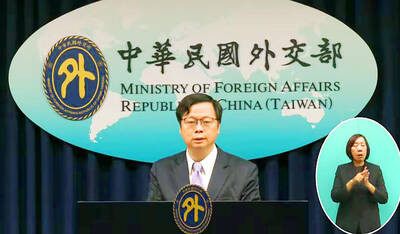
NAMING SPAT: The foreign ministry called on Denmark to propose an acceptable solution to the erroneous nationality used for Taiwanese on residence permits Taiwan has revoked some privileges for Danish diplomatic staff over a Danish permit that lists “Taiwan” as “China,” Eric Huang (黃鈞耀), head of the Ministry of Foreign Affairs’ Department of European Affairs, told a news conference in Taipei yesterday. Reporters asked Huang whether the Danish government had responded to the ministry’s request that it correct the nationality on Danish residence permits of Taiwanese, which has been listed as “China” since 2024. Taiwan’s representative office in Denmark continues to communicate with the Danish government, and the ministry has revoked some privileges previously granted to Danish representatives in Taiwan and would continue to review

More than 6,000 Taiwanese students have participated in exchange programs in China over the past two years, despite the Mainland Affairs Council’s (MAC) “orange light” travel advisory, government records showed. The MAC’s publicly available registry showed that Taiwanese college and university students who went on exchange programs across the Strait numbered 3,592 and 2,966 people respectively. The National Immigration Agency data revealed that 2,296 and 2,551 Chinese students visited Taiwan for study in the same two years. A review of the Web sites of publicly-run universities and colleges showed that Taiwanese higher education institutions continued to recruit students for Chinese educational programs without
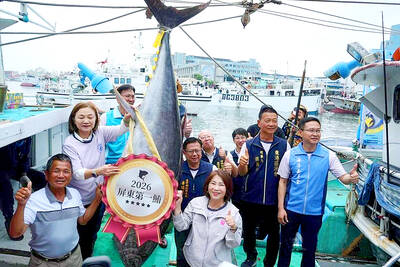
The first bluefin tuna of the season, brought to shore in Pingtung County and weighing 190kg, was yesterday auctioned for NT$10,600 (US$333.5) per kilogram, setting a record high for the local market. The auction was held at the fish market in Donggang Fishing Harbor, where the Siaoliouciou Island-registered fishing vessel Fu Yu Ching No. 2 delivered the “Pingtung First Tuna” it had caught for bidding. Bidding was intense, and the tuna was ultimately jointly purchased by a local restaurant and a local company for NT$10,600 per kilogram — NT$300 ,more than last year — for a total of NT$2.014 million. The 67-year-old skipper


 RSS
RSS