


Taiwan and China have found a model for peaceful coexistence — namely, the so-called “1992 consensus,” or “one China, different interpretations,” President Ma Ying-jeou (馬英九) said on two separate occasions in Boston on Saturday.
Addressing a banquet in honor of Taiwanese expatriates in the US, Ma said that the concept of the “1992 consensus” was proposed by Taiwan and accepted by China.
Some people have described the policy as a “masterpiece of ambiguity,” he said.
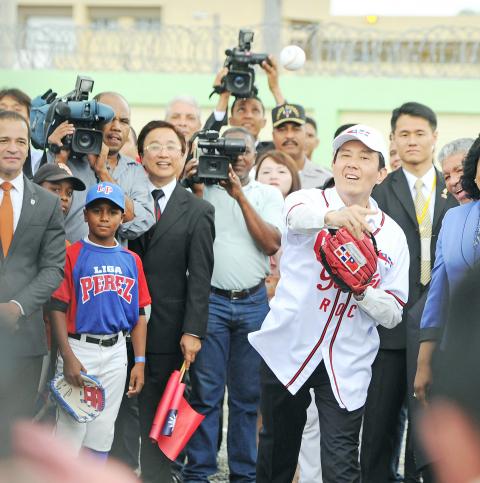
Photo: CNA
Regardless of whether it is ambiguous, the consensus has helped the two sides of the Taiwan Strait set aside their sovereignty disputes and pool their efforts for mutual benefit, Ma said.
The “1992 consensus” — a term former Mainland Affairs Council chairman Su Chi (蘇起) admitted making up in 2000 — refers to a tacit understanding between the Chinese Nationalist Party (KMT) and the Chinese government that both sides acknowledge there is “one China,” with each side having its own interpretation of what “China” means.
To promote peace, Ma said that since he took office, he has been promoting cross-strait relations, and trade and tourism exchanges have reached their highest point in 66 years.
Exchanges between the two sides are helpful for both sides, the president said, adding that he hopes they can continue exchanges and interactions based on the principle of the “1992 consensus.”
During the banquet, Ma also thanked the Massachusetts State House for its concern over burns victims from the June 27 explosion and fire at the Formosa Fun Coast water park in New Taipei City.
Ma also spoke at a seminar at Harvard University, with students, teachers, as well as US academics familiar with Taiwanese affairs attending.
The president reiterated his administration’s commitment to the “status quo,” his “three noes” policy of “no unification, no independence and no use of force,” and peaceful and prosperous cross-strait relations based on the Republic of China’s Constitution and the “1992 consensus.”
Up to 80 percent of the Taiwanese public supports maintaining the “status quo,” an indication that they hope to maintain peaceful and prosperous cross-strait relations created by his administration over the past seven years, Ma was reported as saying.
New York University School of Law professor Jerome Cohen reportedly proposed that Ma be nominated for the Nobel Peace Prize for his initiatives to resolve disputes in the East and South China seas.
Cohen made his proposal during the question-and-answer session after Ma’s speech, saying that he expects Ma to provide more proactive measures to promote peace on Itu Aba (Taiping Island, 太平島) in the South China Sea, according to a person who attended the seminar.
Itu Aba is the biggest Taiwan-controlled island in the contested and resource-rich South China Sea region, which is claimed either entirely or in part by Taiwan, Brunei, China, Malaysia, Vietnam and the Philippines.
Ma touted the benefits of a fisheries’ agreement signed in 2013 between Taiwan and Japan to address fishing disputes in waters surrounding the disputed Diaoyutai Islands (釣魚台) after his East China Sea peace initiative — which calls for shelving disputes and seeking joint development of resources — was proposed.
Ma said his proposal was based on the idea that “while national sovereignty cannot be divided or compromised, natural resources can be shared,” according to the attendee.
Ma arrived in Boston earlier that day en route to the Caribbean and Central America as part of his 11th overseas visit since assuming office in 2008.
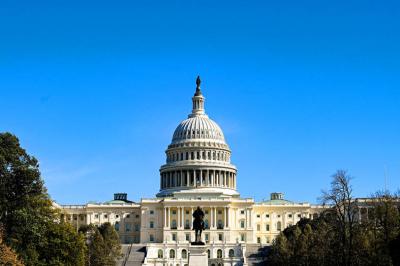
The US House of Representatives yesterday passed the PROTECT Taiwan Act, which stipulates that Washington would exclude China from participating in major global financial organizations if its actions directly threaten Taiwan’s security. The bill, proposed by Republican US Representative Frank Lucas, passed with 395 votes in favor and two against. It stipulates that if China’s actions pose any threat to Taiwan’s security, economic or social systems, the US would, “to the maximum extent practicable,” exclude China from international financial institutions, including the G20, the Bank for International Settlements and the Financial Stability Board. The bill makes it clear that China
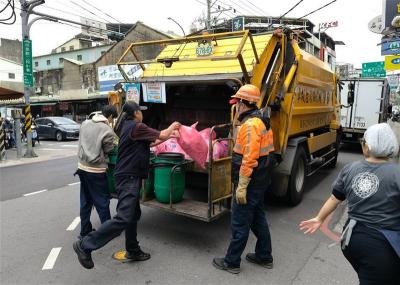
Garbage and recycling schedules are to vary from Saturday through Sunday next week over the Lunar New Year holiday period. The following collection information is from the governments of the six special municipalities. Taipei Regular service: Sunday to Monday next week. No service: Tuesday to Thursday next week. Extra service: Friday next week. Regular service resumes: Saturday next week. New Taipei City Extra service: Sunday. Adjusted collection time: Monday next week — garbage collection is to begin in the morning and end at 6pm. No service: Tuesday to Thursday next week. Regular service resumes: Friday next week. Note: Garbage can be dropped off at 70
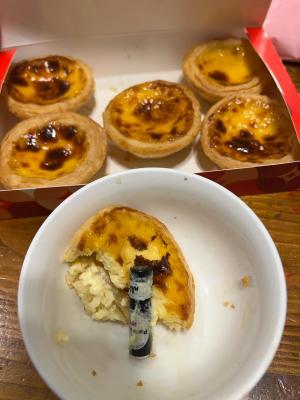
A KFC branch in Kaohsiung may be fined between NT$60,000 and NT$200 million (US$1,907 and US$6.37 million), after a customer yesterday found an entire AAA battery inside an egg tart, the Kaohsiung Department of Health said today. The customer was about to microwave a box of egg tarts they had bought at the fast-food restaurant’s Nanzih (楠梓) branch when they checked the bottom and saw a dark shadow inside one of them, they said in a Threads post. The customer filmed themself taking the egg tart apart to reveal an entire AAA battery inside, which apparently showed signs of damage. Surveillance footage showed
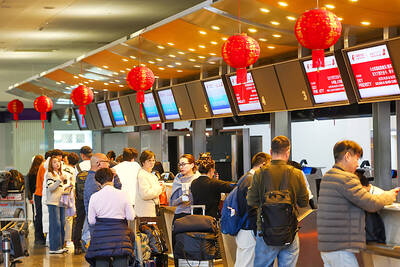
GROUP EFFORT: The number of inbound travelers rose 11 to 12 percent last month, with a significant increase in tourists from Europe and North America, an official said The government aims to attract 9.4 million visitors this year, the Tourism Administration said yesterday, citing last year’s success in diversifying tourist markets. Taiwan last year drew about 8.57 million international arrivals, 72.3 percent of pre-COVID-19 levels. By contrast, the nation had about 18.94 million outbound tourists last year, surpassing the pre-COVID-19 level of 17.1 million. The estimated tourism revenue deficit was about NT$700.9 billion (US$22.22 billion). Taoyuan International Airport Corp expects more than 160,000 passengers to pass through the nation’s largest airport daily during the Lunar New Year holiday, which begins on Saturday. As of Jan. 30, the nation’s average hotel occupancy rate


 RSS
RSS