


An expert in Asian security affairs is calling on US President Barack Obama to sell more arms to Taiwan.
In a plea published by the Center for Strategic and International Studies, Shirley Kan said the president has “failed to exercise leadership” by not selling much-needed weapons.
Kan, who recently retired from the US Congressional Research Service, has written a personal analysis of Obama’s policy on arms sales to Taiwan and says that the policy needs “credibility and clarity.”
Considered to be one of Washington’s best-informed experts on US policy on Taiwan, Kan was not free to express her own views until now.
“US leadership and credibility regarding the rebalance to Asia requires decisive, urgent action regarding Taiwan,” she wrote.
“That policy should include tangible follow-up actions to support Taiwan, maintain stability in the Asia-Pacific and help Taiwan avoid coercion and conflict,” Kan wrote.
Obama has failed to notify the US Congress of major foreign military sales to Taiwan for almost four years.
“As Congress will soon recess in August, the president has an imperative to submit arms sales for Congressional review,” she wrote.
She says that Obama’s “inaction” cannot be explained by a lack of defensive requirements, by a lack of interest and funding in Taiwan or by military-to-military contacts with China.
Kan said that leaves three other explanations: a shift in policy, a decision to wait until after a visit by Chinese President Xi Jinping (習近平) in September or that the administration is timing the arms sales to influence the presidential and legislative elections in Taiwan scheduled for January.
“To dispel dangerous perceptions that the administration is at odds with US principles, policies and laws, Obama should now submit the pending notifications to Congress for major arms sales to Taiwan,” she wrote.
In particular, Kan is calling for Obama to notify Congress now that he is transferring two Perry-class frigates to Taiwan — an arms sale that has already been approved by Capitol Hill.
Kan said that at the same time, the president should give “a straight answer” to Congress, industry and Taiwan on whether to assist Taiwan’s diesel-electric submarine program.
“This option involves the approval or denial of technical assistance for Taiwan’s indigenous defense programs,” she wrote.
“The president should finalize decisionmaking to determine if Taiwan needs new fighters to replace aging aircraft,” Kan said. “Finally, Obama should review policy with transparency, consultation with Congress and coordination with allies, examining whether a new approach is needed to accommodate changing circumstances in the Taiwan Strait.”
Kan said that the Congress has ways to ensure presidential compliance with the Taiwan Relations Act (TRA).
It could write letters to elicit explanations about pending actions, consider legislation to require reports on the TRA’s implementation or hold up confirmations of nominees in the US Department of Defense or Department of State, she said.
“Along with restricting funds for spending for military contacts with China, especially as the Pentagon doubles down on such contacts, Congress could shift such spending for use in military cooperation with Taiwan,” Kan wrote.
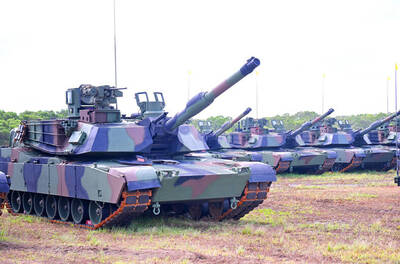
The manufacture of the remaining 28 M1A2T Abrams tanks Taiwan purchased from the US has recently been completed, and they are expected to be delivered within the next one to two months, a source said yesterday. The Ministry of National Defense is arranging cargo ships to transport the tanks to Taiwan as soon as possible, said the source, who is familiar with the matter. The estimated arrival time ranges from late this month to early next month, the source said. The 28 Abrams tanks make up the third and final batch of a total of 108 tanks, valued at about NT$40.5 billion

Two Taiwanese prosecutors were questioned by Chinese security personnel at their hotel during a trip to China’s Henan Province this month, the Mainland Affairs Council (MAC) said yesterday. The officers had personal information on the prosecutors, including “when they were assigned to their posts, their work locations and job titles,” MAC Deputy Minister and spokesman Liang Wen-chieh (梁文傑) said. On top of asking about their agencies and positions, the officers also questioned the prosecutors about the Cross-Strait Joint Crime-Fighting and Judicial Mutual Assistance Agreement, a pact that serves as the framework for Taiwan-China cooperation on combating crime and providing judicial assistance, Liang
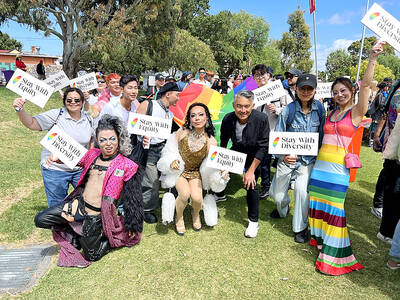
A group from the Taiwanese Designers in Australia association yesterday represented Taiwan at the Midsumma Pride March in Melbourne. The march, held in the St. Kilda suburb, is the city’s largest LGBTQIA+ parade and the flagship event of the annual Midsumma Festival. It attracted more than 45,000 spectators who supported the 400 groups and 10,000 marchers that participated this year, the association said. Taiwanese Designers said they organized a team to march for Taiwan this year, joining politicians, government agencies, professionals and community organizations in showing support for LGBTQIA+ people and diverse communities. As the first country in Asia to legalize same-sex
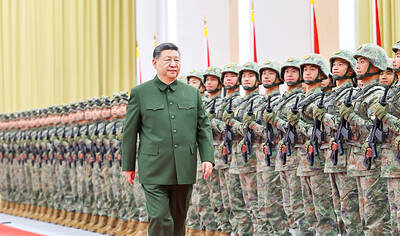
MOTIVES QUESTIONED The PLA considers Xi’s policies toward Taiwan to be driven by personal considerations rather than military assessment, the Epoch Times reports Chinese President Xi Jinping’s (習近平) latest purge of the Chinese People’s Liberation Army (PLA) leadership might have been prompted by the military’s opposition to plans of invading Taiwan, the Epoch Times said. The Chinese military opposes waging war against Taiwan by a large consensus, putting it at odds with Xi’s vision, the Falun Gong-affiliated daily said in a report on Thursday, citing anonymous sources with insight into the PLA’s inner workings. The opposition is not the opinion of a few generals, but a widely shared view among the PLA cadre, the Epoch Times cited them as saying. “Chinese forces know full well that


 RSS
RSS