


Nanliao Village (南寮) on the sparsely populated outlying island of Penghu might not look very different from any other rural Taiwanese community at first, but take a closer look and the fishing-turned-farming community is full of surprises.
A distinctive feature of Nanliao is that coral is used as a building material, which can be seen in the caijhai (菜宅, vegetable houses) — windbreaks set up to protect vegetable plots from the northeast monsoon winds which blow from September to April, and on the facades of older houses
Due to its arid weather — the village has an annual precipitation of only about 1m — and the sandy composition of its soil, farmers in Nanliao mostly grow peanuts and sweet potatoes, which do not need much warer, said Nanliao Village Warden Chao Chia-hsieh (趙嘉協), who has been promoting organic farming in the community for many years.
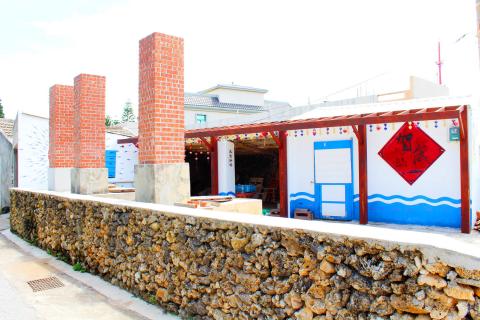
Photo: Sean Lin, Taipei Times
Describing Nanliao as an eco-friendly community with an emphasis on recycling, he said that residents have found applications for many things that are usually regarded as worthless, including coral, cow manure, discarded plastic fishing floats and even the small evergreen tree white popinac — which is not native to Taiwan.
Chao said that “cow manure cakes,” made from cow manure mixed with crushed peanut shells to increase flammability, are used as fuel for cooking fish in a “fish stove,” a lidded, well-like structure where fish, usually sardines, are cooked before being dried in the sun and sold.
Small dried fish are a popular snack, especially for people living on Taiwan proper, he said.
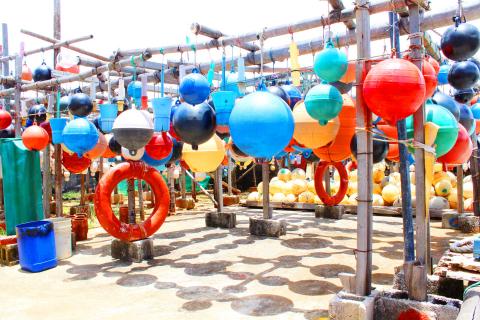
Photo: Sean Lin, Taipei Times
Making cow manure cakes is a decades-old tradition passed down from a time when the community was destitute and had trouble finding firewood during winter.
He said that residents used the white popinac cut down by the Penghu County Government and boiled its bark to extract an orange dye used to color the veils worn by women when they work in the fields.
As to the uses of the spherical fishing floats used by coastal fish farms to secure fish nets, he said that the most famous example is a piece of installation art created by local man Chao Chang-shou (趙長壽), 82.
The piece features more than 100 fishing floats of various colors suspended from a wooden frame.
The floats are also a favorite at a community workshop where tourists can experience life in Nanliao, he said.
Floats are cut open, decorated and turned into artworks, he said.
He said that his vision for the village is the pursuit of steady development without the sacrifice of cultural heritage.
Chao, who grows fruit and vegetables on his organic farm, said his dream is to start a farmers’ market in the village.
Wang Chen-ju (王貞儒), a community planner and teacher at the workshop, said that her aim is to restore the village to its original state by rediscovering its uniqueness.
Wang said she stumbled upon the idea of restoring the village after an old well paved with coral stones was reconstructed with gravel, which upset many residents, who said that they would like the well to be fashioned in the traditional way.
“People want to relive the good old days. Even though we did not have much, we were happy,” she said. “It prompted me to start tracing the ‘lights’ and ‘shadows’ of this community. I started looking for the things characteristic of this area and the parts that need improving.”
She said that the residents’ hard work to promote the village’s culture finally came into fruition when the county government granted funds to the workshop to reinforce and redecorate some dilapidated buildings, which prompted many young people studying or working on Taiwan proper to bring their friends to visit over the most recent Tomb Sweeping Day holiday.
She said that her experience with Nanliao’s community revival can be summed up as “allowing residents to do the things they love without forcing them to accept unfamiliar ideas.”
The burgeoning business from reviving the community has prompted young people working or studying on Taiwan proper to return to the village to help with farming and promote local culture, Wang added.

More than half of the bamboo vipers captured in Tainan in the past few years were found in the city’s Sinhua District (新化), while other districts had smaller catches or none at all. Every year, Tainan captures about 6,000 snakes which have made their way into people’s homes. Of the six major venomous snakes in Taiwan, the cobra, the many-banded krait, the brown-spotted pit viper and the bamboo viper are the most frequently captured. The high concentration of bamboo vipers captured in Sinhua District is puzzling. Tainan Agriculture Bureau Forestry and Nature Conservation Division head Chu Chien-ming (朱健明) earlier this week said that the

NAMING SPAT: The foreign ministry called on Denmark to propose an acceptable solution to the erroneous nationality used for Taiwanese on residence permits Taiwan has revoked some privileges for Danish diplomatic staff over a Danish permit that lists “Taiwan” as “China,” Eric Huang (黃鈞耀), head of the Ministry of Foreign Affairs’ Department of European Affairs, told a news conference in Taipei yesterday. Reporters asked Huang whether the Danish government had responded to the ministry’s request that it correct the nationality on Danish residence permits of Taiwanese, which has been listed as “China” since 2024. Taiwan’s representative office in Denmark continues to communicate with the Danish government, and the ministry has revoked some privileges previously granted to Danish representatives in Taiwan and would continue to review
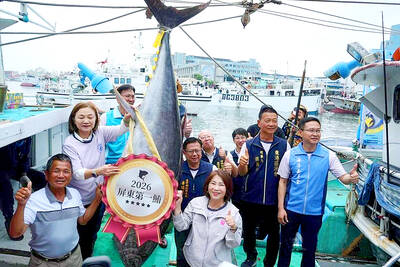
The first bluefin tuna of the season, brought to shore in Pingtung County and weighing 190kg, was yesterday auctioned for NT$10,600 (US$333.5) per kilogram, setting a record high for the local market. The auction was held at the fish market in Donggang Fishing Harbor, where the Siaoliouciou Island-registered fishing vessel Fu Yu Ching No. 2 delivered the “Pingtung First Tuna” it had caught for bidding. Bidding was intense, and the tuna was ultimately jointly purchased by a local restaurant and a local company for NT$10,600 per kilogram — NT$300 ,more than last year — for a total of NT$2.014 million. The 67-year-old skipper

China has reserved offshore airspace over the Yellow Sea and East China Sea from March 27 to May 6, issuing alerts that are usually used to warn of military exercises, although no such exercises have been announced, the Wall Street Journal (WSJ) reported on Sunday. Reserving such a large area for 40 days without explanation is an “unusual step,” as military exercises normally only last a few days, the paper said. The alerts, known as notice to air missions (NOTAMs), “are intended to inform pilots and aviation authorities of temporary airspace hazards or restrictions,” the article said. The airspace reserved in the alert


 RSS
RSS