


An elderly woman in Fongshan Village (豐山) in Chiayi County’s Alishan Township (阿里山) has had more opportunity than most to reflect on the relationship between life and death, as she has served as both the village’s midwife and its undertaker for six decades.
Huang Yang Ching-mei (黃楊清妹), 95, arrived in Fongshan in 1947 with her husband, who worked as a laborer processing camphor.
Huang Yang took on the responsibility of midwife for the community’s about 10 families at the time due to her experience assisting nurses during childbirth.
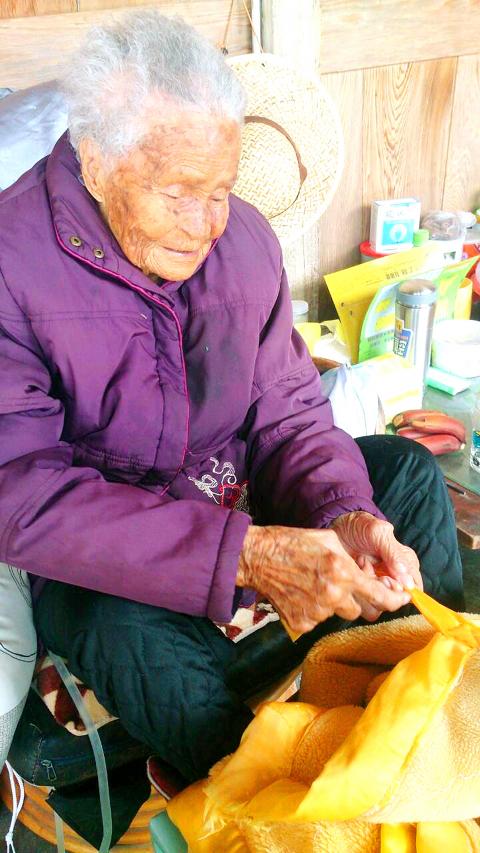
Photo: Yu Hsueh-lan, Taipei Times
According to Huang Yang, she encountered many difficult situations as a midwife, including premature births, abnormal fetal positioning and heavy uterine bleeding, but was always able to ensure the safety of mother and child.
One event that led to her becoming famous in the region was when she helped deliver a stillborn baby that had been trapped in the mother’s womb for more than a week.
Huang Yang chanted some mantras while caressing the mother’s belly before pulling out the baby, which already smelled of decomposition and whose hands had become separated from its body.
Due to her reputation as a skillful midwife, Huang Yang was also asked to help deliver children in distant Aboriginal villages such as Dabang Village (達邦) — seven hours’ travel from Fongshan.
Huang Yang said that due to the high birthrates in the area, she once helped deliver four children in one day, adding that she often carried her own child on her back to reach the mothers.
Despite the custom of thanking midwives with red envelopes, Huang Yang declined such offers, saying the joy she felt at bringing new life into the world was payment enough, but adding that she would often take an empty red envelope as a symbolic gesture.
While serving as the area’s midwife, Huang Yang also took lessons from a Taoist religious practitioner on funeral rites.
Huang Yang said that at first she was very afraid of corpses and would even lose sleep from the shock of seeing the dead, but with her teacher’s tips she soon conquered her fear of the dead and became a professional mortician.
Huang Yang said she would help to repair any facial damage to corpses caused by accidents, would apply makeup, dress them, put them in a coffin and assist in their interment.
Although she charged a fee for her service as a mortician, if she worked for poor families she would always return the money, Huang Yang said, adding that there were many times during her career that she would intuitively know when her services were needed.
Her sixth sense proved to be correct every time, she said.
Huang Yang continued to serve as a midwife to the community until she was in her late 70s, and the last baby she delivered, a girl named Yeh Yi-shai (葉怡曬), is now 17.
Huang Yang said she had continued to serve as mortician until she was close to 90, when she passed the trade down to her granddaughter Huang Feng-chu (黃鳳珠).
Having seen birth and death too many times to count, Huang Yang, who is always in high spirits and ready to share a joke, said she is content with life.

LOUD AND PROUD Taiwan might have taken a drubbing against Australia and Japan, but you might not know it from the enthusiasm and numbers of the fans Taiwan might not be expected to win the World Baseball Classic (WBC) but their fans are making their presence felt in Tokyo, with tens of thousands decked out in the team’s blue, blowing horns and singing songs. Taiwanese fans have packed out the Tokyo Dome for all three of their games so far and even threatened to drown out home team supporters when their team played Japan on Friday. They blew trumpets, chanted for their favorite players and had their own cheerleading squad who dance on a stage during the game. The team struggled to match that exuberance on the field, with
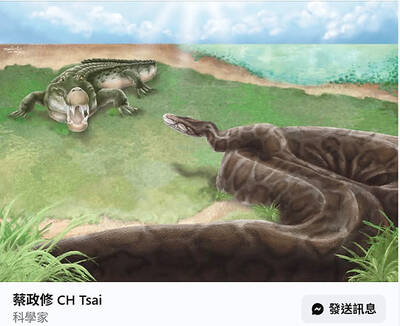
Taiwanese paleontologists have discovered fossil evidence that pythons up to 4m long inhabited Taiwan during the Pleistocene epoch, reporting their findings in the international scientific journal Historical Biology. National Taiwan University (NTU) Institute of Ecology and Evolutionary Biology associate professor Tsai Cheng-hsiu (蔡政修) led the team that discovered the largest snake fossil ever found in Taiwan. The single trunk vertebra was discovered in Tainan at the Chiting Formation, dated to between 400,000 and 800,000 years ago in the Middle Pleistocene, the paper said. The area also produced Taiwan’s first avian fossil, as well as crocodile, mammoth, saber-toothed cat and rhinoceros fossils, it said. Discoveries

Taiwanese paleontologists have discovered fossil evidence that pythons up to 4m long inhabited Taiwan during the Pleistocene epoch, reporting their findings in the international scientific journal Historical Biology. National Taiwan University (NTU) Institute of Ecology and Evolutionary Biology associate professor Tsai Cheng-hsiu (蔡政修) led the team that discovered the largest snake fossil ever found in Taiwan. A single trunk vertebra was discovered in Tainan at the Chiting Formation, dated to between 800,000 to 400,000 years ago in the Middle Pleistocene, the paper said. The area also produced Taiwan’s first avian fossil, as well as crocodile, mammoth, sabre-toothed cat and rhinoceros fossils, it said. Discoveries
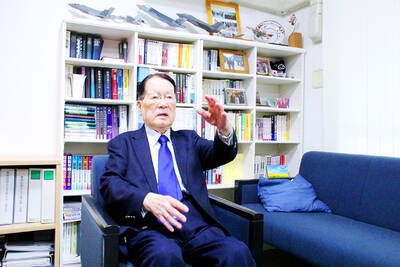
Whether Japan would help defend Taiwan in case of a cross-strait conflict would depend on the US and the extent to which Japan would be allowed to act under the US-Japan Security Treaty, former Japanese minister of defense Satoshi Morimoto said. As China has not given up on the idea of invading Taiwan by force, to what extent Japan could support US military action would hinge on Washington’s intention and its negotiation with Tokyo, Morimoto said in an interview with the Liberty Times (sister paper of the Taipei Times) yesterday. There has to be sufficient mutual recognition of how Japan could provide


 RSS
RSS