


Taipei has lodged a severe protest against Manila over its enforcement of fishing law in overlapping territorial waters between the two nations where Taiwanese fishing vessels have the right to operate, Minister of Foreign Affairs David Lin (林永樂) said yesterday.
Lin said he hoped the next round of negotiations between the two nations, scheduled to take place next month, would end controversies over fishing rights in the overlapping exclusive economic zones, which also lie in the contiguous area, 12 nautical miles (22km) beyond territorial seas or 24 nautical miles seaward from the baseline of the Philippines.
An agreement on cooperative enforcement of fisheries laws between Taiwan and the Philippines is expected to be signed soon, since both sides have gone through three rounds of negotiations on its content since May 2013, Lin said.
Lin made the remarks when approached for comment yesterday over an incident on Thursday, in which the Coast Guard Administration (CGA) sent a patrol vessel to protect a Pingtung-registered fishing boat, the Sheng Yu Feng, allegedly being chased by a Philippine government vessel in the overlapping waters.
It was the third fishing dispute between the two countries in three weeks, following the one-week detention of the Sheng Feng No. 12 — which was released after paying a US$50,000 fine — on May 7 and the boarding by Philippine law enforcement agents of the Ming Chin Tsai No. 6 on Monday.
The boat was not released until nearly four hours later, when the CGA sent a patrol vessel to intervene.
Taiwan and the Philippines reached a consensus on maritime law enforcement cooperation to avoid a repeat of a fatal incident, in which a Taiwanese fisherman, Hung Shih-cheng (洪石成), was shot and killed on May 9, 2013, when Philippine Coast Guard officers fired on his fishing boat Kuang Ta Hsin No. 28 in the disputed waters.
According to the consensus, both sides have pledged not to use force or violence when patrolling fishing grounds and agreed to inform each other in the event of sea disputes and cooperate in handling the detention and release of fishing crews.
The boarding of Ming Chin Tsai No. 6 has cast doubt on the Philippines’ compliance with the consensus, because Manila failed to inform Taiwan’s fishing authority one hour before it took enforcement action so that the targeted fishing boats could leave the scene, according to the ministry’s report presented to the weekly Cabinet meeting on Thursday.
According to the report, the ministry said that the Philippines promulgated an administrative decree in April last year that excludes the application of the one-hour notification mechanism that both sides agreed upon in its law enforcement within its contiguous waters.
Lin said the ministry expressed its position to the Philippines soon after the promulgation that the unilateral change made to the consensus was not accepted by Taiwan.
“Both sides are still at odds over the scope of law enforcement by respective authorities and we hope the difference can be ironed out in June’s negotiations,” Lin said yesterday.
In Manila, an anonymous Philippine official told the Central News Agency on Thursday that pursuant to the administrative decree, once foreign fishing boats enter its contiguous zone, they are subject to inspection or even detention.

The Ministry of Finance this afternoon announced the winning numbers for the March-April uniform invoice lottery. The winning number for the NT$10 million (US$318,060) special prize is 19531471, and the winning number for the NT$2 million grand prize is 85941329. Three numbers were drawn for the NT$200,000 first prize: 07225810, 20231230 and 83518781. Those with receipts matching the last seven digits of any of the first-prize numbers will win the NT$40,000 second prize, while those matching the last six digits will win the NT$10,000 third prize. Those whose receipts match the last five digits of the first-prize numbers can claim the NT$4,000 fourth prize,

SIX SUBSIDIES: The monthly allowance for older farmers is to increase to NT$10,000, and NT$5,000 is to be given to homemakers under the national pension system, Lai said The government is to implement major welfare policies for disadvantaged groups, including raising the monthly allowance for older farmers to NT$10,000 and providing homemakers with NT$5,000 per month, President William Lai (賴清德) said yesterday. Lai made the remarks during a visit to Wangling Temple in Chiayi County, saying that the planned increases were being introduced amid economic growth and an increase in tax revenue. Touting a policy, in which the government plans to provide a monthly allowance of NT$5,000 for every child under the age of 18 in a bid to address Taiwan’s low birthrate, Lai said that if received for the
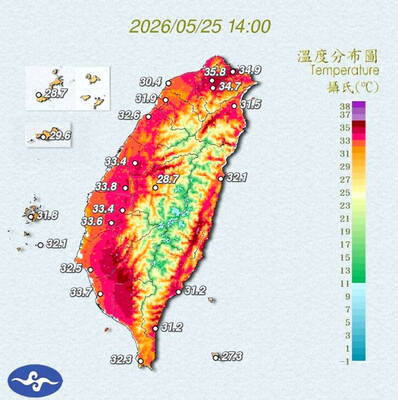
STAY COOL: The HPA recommended that people stay hydrated, use air-conditioning or fans while indoors, wear loose-fitting clothes and walk in the shade while outdoors Employers must implement measures such as installing cooling equipment, and providing drinking water and rest breaks for outdoor workers starting from Monday next week, the Taipei Department of Labor said on Sunday. Employers who fail to comply could face fines of NT$30,000 to NT$300,000 under the Occupational Safety and Health Act (職業安全衛生法), the department said. Businesses in Taipei employing fewer than 100 workers, as well as registered self-employed workers with labor insurance coverage, could receive on-site assessments and guidance from occupational safety consultants to help them apply for central government subsidies to implement or improve heat-protection measures, it said. Under the Ministry of

NATIONAL SECURITY: Authorities are working to confirm the identities of the military personnel involved and investigating possible illegal conduct and regulatory violations Authorities are probing possible national security implications after Kinmen police and immigration officers on Sunday found a Chinese woman allegedly posing as a tourist while engaging in prostitution involving more than 10 military personnel. The woman, surnamed Chen (陳), has since been deported, authorities said, adding that investigators are still working to confirm the identities of those implicated, as the records only listed code names and aliases. The case stemmed from a report received by the Kinmen District Prosecutors’ Office on Friday last week from the Jinhu Precinct of the Kinmen County Police Bureau. On Sunday, police, along with the National Immigration


 RSS
RSS