

Former Council of Indigenous Peoples minister Walis Pelin, a member of the Sediq people, on Friday announced his decision to run for legislator on the Democratic Progressive Party (DPP) ticket.
DPP Chairperson Tsai Ing-wen (蔡英文) joined Walis Pelin in his home village of Sdringan in Nantou County as he accepted the DPP’s nomination to contend for one of the three seats that represent the mountains Aborigines.
The veteran politician, who served as minister from 2005 to 2007, failed in a 2012 legislative bid on the People First Party ticket.
Before his term as minister, Walis Pelin served four legislative terms.
Over the past seven years, he has focused on promoting organic farming as a sustainable business for rural Aboriginal communities.
During a visit to Walis Pelin’s farm on Friday, Tsai praised his work on the passage of the Aboriginal Basic Act (原住民基本法) and the transfer of Aboriginal land rights from the Ministry of the Interior to the Council of Indigenous Peoples.
She said that a strong financial basis should be the pivotal concern in promoting Aboriginal autonomy, adding that the protection of Aboriginal land rights is among the crucial issues that the DPP intends to address.
Walis Pelin is among the principle architects of Tsai’s Aboriginal policies for her ongoing presidential campaign, sources have said.
Walis Pelin would face Chinese Nationalist Party (KMT) incumbent Yosi Takun, also a Sediq, in the Sediq heartland of Renai Township (仁愛) in Nantou County.

NATURE TAKES ITS COURSE: The agency’s head said he felt a sense of loss watching red-banded snakes eat the babies, as they had decided on non-intervention The Forestry and Nature Conservation Agency yesterday released a documentary on a hundred-pace viper that had incubated 16 eggs, all of which hatched, but only a baby viper escaped after they were attacked by red-banded snakes. The agency’s Taichung branch last year launched the viper reproduction monitoring project soon after forest rangers Lin Chun-yu (林俊佑) and Chou Chia-cheng (周家成) spotted a pregnant hundred-pace viper in a grass-covered burrow near a parking lot in Tbulan Village (松鶴部落). The Atayal village, in Taichung’s Heping District (和平), is headed by Ecyang Yapu, who was positive about the project and assisted in access control and power

The Coast Guard Administration (CGA) yesterday said that it had deployed vessels to “monitor” Chinese ships operating in waters off the east coast. The CGA said it dispatched vessels in response to a China Coast Guard announcement that it had carried out another “routine law-enforcement patrol” in waters off the east coast. “The CGA firmly rejects China’s cognitive warfare campaign of ‘law enforcement in name, jurisdictional expansion in practice,’” it said on X. As of 11am yesterday, two China Coast Guard ships were “loitering and drifting” about 105 nautical miles (195km) and 74 nautical miles east of Green Island (綠島) respectively, it said. It

A sharp rise in compensation to be paid by air force officers who leave before completing their required service could indicate an increase in pilots leaving the military early, an analyst said on Friday, warning that the trend could worsen a shortage of experienced personnel. Chieh Chung (揭仲), a researcher at the Association for Strategic Foresight, issued the warning even though the number of volunteer military personnel is expected to increase next year. The planned headcount for volunteer military personnel, covering officers, noncommissioned officers (NCO) and enlisted soldiers, is 158,223 for next year, up 4,258 from 153,965 this year, Chieh said. The increase
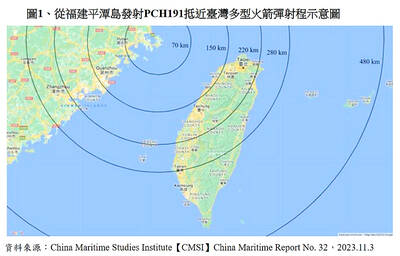
Potential improvements to munitions used by China’s long-range rocket-artillery units could extend their range to cover the entire Miyako Strait, which might give the Chinese People’s Liberation Army (PLA) the ability to secure the strategic waterway, the Mainland Affairs Council (MAC) said in a report. The PLA’s long-range rocket-artillery units deployed along the Taiwan Strait are concentrated along the coast of Fujian Province, including Changle, Pingtan and Shishi, the quarterly report on China said. The artillery brigades of the PLA’s 71st, 72nd and 73rd group armies have been deployed, with preparations for potential battlefield operations under way since August 2022, the report


 RSS
RSS