


President Ma Ying-jeou (馬英九) yesterday pressed Democratic Progressive Party (DPP) Chairperson Tsai Ing-wen (蔡英文) to elucidate the “status quo” she said she wishes to maintain, saying a presidential candidate cannot be unrealistic and elusive on the matter.
Speaking at a Mainland Affairs Council (MAC) exhibition on the history of cross-strait exchanges, Ma took issue with the DPP and Tsai in the wake of DPP accusations that Chinese Nationalist Party (KMT) Chairman Eric Chu’s (朱立倫) recent visit to China and his policy have catered to Beijing.
Ma said that former president Chen Shui-bian’s (陳水扁) “one side, one country” tenet exacerbated cross-strait tensions and harmed the mutual trust between Taiwan and the US, adding that “the cross-strait ‘status quo’ we have now is peaceful and prosperous development.”
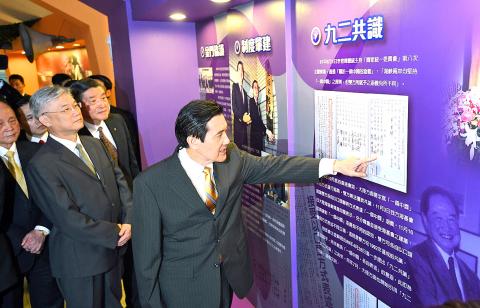
Photo: George Tsorng, Taipei Times
“Tsai said she wants the ‘status quo’ to be maintained, but everyone knows that the public wants the ‘status quo’ to be maintained, as it has more than 70 percent of support in the poll. The question is which ‘status quo’ does the public want? The one we have now? Or the one we had seven years ago?” Ma said.
Former president Lee Teng-hui (李登輝) had signed a meeting document in 1992 — which is on display in the exhibition — that endorsed the view that “there is one China with each side having its own interpretation of what China means,” or the so-called “1992 consensus,” Ma said.
“Tsai also stated at a legislative question-and-answer session in 2000 as then-Mainland Affairs Council head that each of the two sides of the Taiwan Strait has its own interpretation for the ‘one China’ controversy,” he said.
In related news, the KMT caucus said that while Chu has stuck to the “1992 consensus,” Tsai is “pursuing a ‘one China’ in the future.”
KMT Legislator Wu Yu-sheng (吳育昇) said he had found news reports dated August 2000 that reported then-MAC leader Tsai as saying that due to the affinity in culture and economics between Taiwan and China, “there is only one option for the Taiwanese people in the future, which is ‘one China in the future,’ or constructing a meaningful political relationship with the mainland in the next five to 10 years.”
Tsai should “apologize to those strongly advocating Taiwan’s formal independence in the DPP, to former president Chen’s ‘one side, one country’ tenet and to the DPP’s ‘Resolution on Taiwan’s Future,’” Wu said.
Meanwhile, DPP spokesperson Wang Min-sheng (王閔生) said the party has already clearly explained its cross-strait policy, and urged the KMT to stop manipulating the cross-strait issue for election gains.
“What [the DPP] means by ‘maintaining the status quo’ refers to maintaining the peaceful and stable development of relations across the Taiwan Strait. We have clarified it on various occasions before and the stance has received support from more than 70 percent of the public,” Wang told a brief afternoon news conference at the party’s headquarters in Taipei.
“We would like to urge the KMT to seriously face doubts from the public, respond positively to them and stop avoiding answering questions from the public,” Wang added.
Wang said that he felt sorry for a political party and a president who have been in power for seven years and “only play the cross-strait card day after day” because they do not have any accomplishments to show; they are no longer able to claim that they are “clean” and they are no longer a united party.
“Cross-strait relations is an important issue for the country; it should not become a topic or tool for political manipulation for election gains,” Wang said. “The KMT should stop doing such a thing that is not benefiting the nation and could be harmful to the public.”

Actor Darren Wang (王大陸) was sentenced to six months in prison, commutable to a fine, by the New Taipei District Court today for contravening the Personal Data Protection Act (個人資料保護法) in a case linked to an alleged draft-dodging scheme. Wang allegedly paid NT$3.6 million (US$114,380) to an illegal group to help him evade mandatory military service through falsified medical documents, prosecutors said. He transferred the funds to Chen Chih-ming (陳志明), the alleged mastermind of a draft-evasion ring, although he lost contact with him as he was already in detention on fraud charges, they said. Chen is accused of helping a

UNREASONABLE SURVEILLANCE: A camera targeted on an road by a neighbor captured a man’s habitual unsignaled turn into home, netting him dozens of tickets The Taichung High Administrative Court has canceled all 45 tickets given to a man for failing to use a turn signal while driving, as it considered long-term surveillance of his privacy more problematic than the traffic violations. The man, surnamed Tseng (曾), lives in Changhua County and was reported 45 times within a month for failing to signal while driving when he turned into the alley where his residence is. The reports were filed by his neighbor, who set up security cameras that constantly monitored not only the alley but also the door and yard of Tseng’s house. The surveillance occurred from July

SECURITY: Starlink owner Elon Musk has taken pro-Beijing positions, and allowing pro-China companies to control Taiwan’s critical infrastructure is risky, a legislator said Starlink was reluctant to offer services in Taiwan because of the nation’s extremely high penetration rates in 4G and 5G services, the Ministry of Digital Affairs said yesterday. The ministry made the comments at a meeting of the legislature’s Transportation Committee, which reviewed amendments to Article 36 of the Telecommunications Management Act (電信管理法). Article 36 bans foreigners from holding more than 49 percent of shares in public telecommunications networks, while shares foreigners directly and indirectly hold are also capped at 60 percent of the total, unless specified otherwise by law. The amendments, sponsored by Chinese Nationalist Party (KMT) Legislator Ko

A Japan Self-Defense Forces vessel entered the Taiwan Strait yesterday, Japanese media reported. After passing through the Taiwan Strait, the Ikazuchi was to proceed to the South China Sea to take part in a joint military exercise with the US and the Philippines, the reports said. Japan Self-Defense Force vessels were first reported to have passed through the strait in September, 2024, with two further transits taking place in February and June last year, the Asahi Shimbun reported. Yesterday’s transit also marked the first time since Japanese Prime Minister Sanae Takaichi took office that a Japanese warship has been sent through the Taiwan


 RSS
RSS