


Civic groups lambasted the Executive Yuan’s Referendum Review Committee members for being eligible for NT$4,000 to NT$8,000 in part-time payments per month, even when the committee was not sitting in session, which was at odds with the other committees in the Executive Yuan, who were given a NT$2,000 flat appearance fee.
The best way to rectify the situation is to abolish the referendum committee once and for all, the civic groups said.
According to the Referendum Act (公民投票法), the job of committee members is to appear at meetings to review and vote on referendum items.
The civic groups said that the current committee members had only met once in 2012, once in 2013 and three times last year.
However, directors-general and members were entitled to NT$8,000 and NT$4,000 per month respectively, even if there were no meetings that month, civic groups said, adding that if a meeting was convened, only those who appeared are entitled to the money.
By contrast, the six Environmental Protection Agency committees, the Construction and Planning Agency, the seven committees of the Food and Drug Administration and the Food Safety Consulting Committee were only eligible for a flat rate of NT$2,000 upon attendance.
The committee has caused controversy since its establishment, having turned down nine proposals for nationwide referendums, including five proposals on the cross-strait Economic Cooperation Framework Agreement, efforts to reclaim the Chinese Nationalist Party’s (KMT) illegal party assets and joining the UN using the name Taiwan.
Of the six referendums that passed the committee’s review, all failed to achieve the 50 percent of voters nationwide as mandated by law.
The civic groups called for an amendment to the Referendum Act, but the Executive Yuan turned down the requests and said the committee should not be abolished.
The issue of government members being entitled to payment without attending meetings has created negative impressions, Citizen’s Congress Watch president Shih Hsin-min (施信民) said.
Although they are small sums, it is nonetheless taxpayers’ money, Shih said.
The committee has too much power, so as long as some members attend a meeting, they can overturn a proposal backed by more than 100,000 people, Shih said.
The members are all highly educated, but have willingly become the tools of the ruler, often making decisions that belie their education, Shih said, adding that the committee should have been abolished a long time ago.
Democratic Progressive Party Legislator Lee Chun-yi (李俊俋) said that referendum reviews in other nations were mostly focused on procedure and do not pay too much attention to the topic of the referendum itself, adding that such reviews were usually handled by a court or an independent organization.
Only the Referendum Review Committee isunder the jurisdiction of the Executive Yuan has its members nominated by the president. It uses its structure to deprive people of their rights, Lee said.
In response to criticism, officials from the committee said the payments to members were based on the Executive Yuan’s Military, Civil and Teaching Staff Multi-duty Transportation and Seminar Hourly Fee Regulations (軍公教人員兼職交通費及講座鐘點費支給規定), which gave the option of offering monthly fees or attendance-based payments.
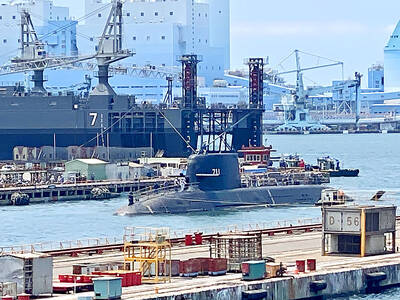
AGING: While Japan has 22 submarines, Taiwan only operates four, two of which were commissioned by the US in 1945 and 1946, and transferred to Taiwan in 1973 Taiwan would need at least 12 submarines to reach modern fleet capabilities, CSBC Corp, Taiwan chairman Chen Cheng-hung (陳政宏) said in an interview broadcast on Friday, citing a US assessment. CSBC is testing the nation’s first indigenous defense submarine, the Hai Kun (海鯤, Narwhal), which is scheduled to be delivered to the navy next month or in July. The Hai Kun has completed torpedo-firing tests and is scheduled to undergo overnight sea trials, Chen said on an SET TV military affairs program. Taiwan would require at least 12 submarines to establish a modern submarine force after assessing the nation’s operational environment and defense

A white king snake that frightened passengers and caused a stir on a Taipei MRT train on Friday evening has been claimed by its owner, who would be fined, Taipei Rapid Transit Corp (TRTC) said yesterday. A person on Threads posted that he thought he was lucky to find an empty row of seats on Friday after boarding a train on the Bannan (Blue) Line, only to spot a white snake with black stripes after sitting down. Startled, he jumped up, he wrote, describing the encounter as “terrifying.” “Taipei’s rat control plan: Release snakes on the metro,” one person wrote in reply, referring
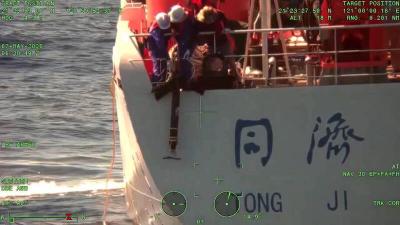
The coast guard today said that it had disrupted "illegal" operations by a Chinese research ship in waters close to the nation and driven it away, part of what Taipei sees a provocative pattern of China's stepped up maritime activities. The coast guard said that it on Thursday last week detected the Chinese ship Tongji (同濟號), which was commissioned only last year, 29 nautical miles (54km) southeast of the southern tip of Taiwan, although just outside restricted waters. The ship was observed lowering ropes into the water, suspected to be the deployment of scientific instruments for "illegal" survey operations, and the coast

Taiwan’s two cases of hantavirus so far this year are on par with previous years’ case numbers, and the government is coordinating rat extermination work, so there should not be any outbreaks, Centers for Disease Control (CDC) Director-General Philip Lo (羅一鈞) said today in an interview with the Liberty Times (the Taipei Times’ sister newspaper). An increase in rat sightings in Taipei and New Taipei City has raised concerns about the spread of hantavirus, as rats can carry the disease. In January, a man in his 70s who lived in Taipei’s Daan District (大安) tested positive posthumously for hantavirus, Taiwan’s


 RSS
RSS