


A wrongly colored deer mosaic erected by Nantou County to honor Thao Aborigines has sparked criticism, as the Thao’s founding myth has their guardian as a white deer, instead of the black deer mounted on the installation.
However, the county government said that it did not undertake the construction until the Thao community had reviewed the draft design, and the error might be attributed to flaws in the review process.
Following an inspection on Tuesday, the government said that it would carry out remedial work — either repainting the deer in white or reconstructing the mosaic based on a corrected draft approved by the Thao people.
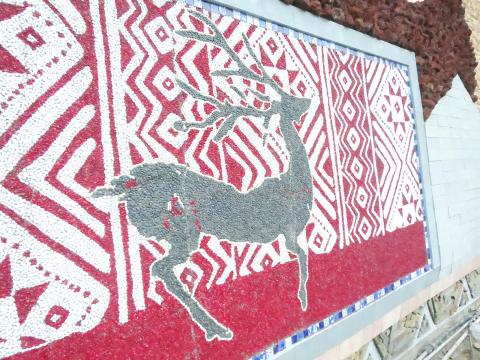
Photo: Liu Pin-chuan, Taipei Times
The contractor is to be held accountable for any expenses incurred during the reconstruction, county government officials said.
According to the founding myth of the Thao, their ancestors originally settled in Alishan in today’s Chiayi County, but a rare white deer led a group of hunters all the way to Sun Moon Lake (日月潭) in today’s Nantou, before it plunged into the water and disappeared.
The hunters later found the lake and the surrounding mountains very hospitable and therefore relocated the Thao community to areas around the lake, where Thao still dwell today.
Nantou County Councilor Shih Ching-lung (石慶龍), of Thao ethnicity, said that the installment was proposed to the Council of Indigenous People in 2010, and the construction did not start until earlier this year.
The draft design was passed by a Thao community committee before being finalized by the county government, he said.
However, the completed mosaic features a black deer instead of a white deer, he said.
The members of the committee might have overlooked the mistake in the draft due to old age, and they felt sorry for the neglect, he said.
In addition to the recoloring, lettering reading “Tapina” — the prominent Thao community where the mosaic is located — should be added to the existing lettering of “Ita Thao” — meaning “we are human” in the Thao language — to boost the community’s visibility, Shih said.
Composed of colored pebbles, the mosaic is mounted on a retaining wall along a slope on the Tapina section of Highway No. 21.

SPACE VETERAN: Kjell N. Lindgren, who helps lead NASA’s human spaceflight missions, has been on two expeditions on the ISS and has spent 311 days in space Taiwan-born US astronaut Kjell N. Lindgren is to visit Taiwan to promote technological partnerships through one of the programs organized by the US for its 250th national anniversary. Lindgren would be in Taiwan from Tuesday to Saturday next week as part of the US Bureau of Educational and Cultural Affairs’ US Speaker Program, organized to celebrate the 250th anniversary of the signing of the Declaration of Independence, the American Institute in Taiwan (AIT) said in a statement yesterday. Lindgren plans to engage with key leaders across the nation “to advance cutting-edge technological partnerships and inspire the next generation of scientists and engineers,”

UNREASONABLE SURVEILLANCE: A camera targeted on an road by a neighbor captured a man’s habitual unsignaled turn into home, netting him dozens of tickets The Taichung High Administrative Court has canceled all 45 tickets given to a man for failing to use a turn signal while driving, as it considered long-term surveillance of his privacy more problematic than the traffic violations. The man, surnamed Tseng (曾), lives in Changhua County and was reported 45 times within a month for failing to signal while driving when he turned into the alley where his residence is. The reports were filed by his neighbor, who set up security cameras that constantly monitored not only the alley but also the door and yard of Tseng’s house. The surveillance occurred from July

A Japan Self-Defense Forces vessel entered the Taiwan Strait yesterday, Japanese media reported. After passing through the Taiwan Strait, the Ikazuchi was to proceed to the South China Sea to take part in a joint military exercise with the US and the Philippines, the reports said. Japan Self-Defense Force vessels were first reported to have passed through the strait in September, 2024, with two further transits taking place in February and June last year, the Asahi Shimbun reported. Yesterday’s transit also marked the first time since Japanese Prime Minister Sanae Takaichi took office that a Japanese warship has been sent through the Taiwan

‘SAME OLD TRICK’: Even if Beijing resumes individual travel to Taiwan, it would only benefit Chinese tourism companies, the Economic Democracy Union convener said China’s 10 new “incentives” are “sugar-coated poison,” an official said yesterday, adding that Taiwanese businesses see them clearly for what they are, but that Beijing would inevitably find some local collaborators to try to drums up support. The official, speaking on condition of anonymity, made the remark ahead of a news conference the General Chamber of Commerce is to hold today. The event, titled “Industry Perspectives on China’s Recent Pro-Taiwan Policies,” is expected to include representatives from industry associations — such as those in travel, hotels, food and agriculture — to request the government cooperate with China’s new measures, people familiar with


 RSS
RSS