


A coalition of environmental protection groups yesterday rallied in front of the legislature to protest Taiwan Power Co’s (Taipower) holding of an international bid to reprocess 1,200 bundles of highly radioactive nuclear fuel rods overseas, saying the move has violated administrative procedures and could encourage the proliferation of nuclear weapons.
On the day before Lunar New Year’s Eve, Taipower issued a call for bids to deliver 480 and 720 bundles of spent fuel rods from the Jinshan Nuclear Power Plant in New Taipei City’s Shihmen District (石門) and the Guosheng Nuclear Power Plant in New Taipei City’s Wanli District (萬里) overseas for reprocessing. The state-run utility has budgeted NT$11.25 billion (US$356.4 million) despite having only an earmarked budget of NT$1.69 billion for the current fiscal year, which is still pending review by legislators.
Environmental activists have said that it is almost certain that French-based nuclear waste reprocessing company Areva will undertake the task.
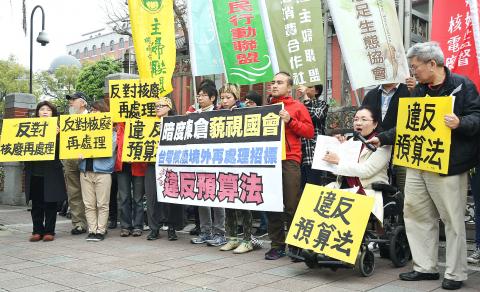
Photo: Liu Hsin-de, Taipei Times
Green Citizen Action Alliance deputy secretary-general Hung Shen-han (洪申翰) said that reprocessing nuclear waste is actually a means to extend the service life of the Jinshan and Guosheng plants, because the spent fuel pools at the facilities are nearing capacity and the New Taipei City Government will not approve Taipower’s request to set up dry storage casks outside the Jinshan plant amid concern over earthquakes and floods.
He said that nuclear waste reprocessing is aimed at recycling and reusing fissile materials — which are resold to international companies and governments — and that highly radioactive remnants of the reprocessed fissile materials will be sent back to Taiwan when the contract expires.
By then, Taiwan will still face the challenge of identifying a geologically stable site to store the nuclear waste.
Alliance researcher Hsu Shih-ya (徐詩雅) decried Taipower’s arbitrarily offering a sum much higher than the budget it asked for.
Accepting tenders for the plan violates the Budget Act (預算法), and Taipower will have to pay hefty damages — using taxpayers’ money — if the contract it inks with the project contractor is eventually revoked, Hsu said..
She said nuclear waste reprocessing is a controversial and sensitive issue, and the international community has veered away from nuclear waste reprocessing because of its steep cost and impact on the environment and public health.
Above all, the uranium and plutonium extracted during the process will likely be resold to nuclear weapons manufacturers, which will exacerbate the problem of nuclear arms proliferation, she said.
Hsu said the project proposed by Taipower would continue into 2038, but the contract discussed in the call for bids only has a 10-year validity, after which the nation will have to pay additional fees if it wants to entrust the fissile materials to the project contractor or have it resold.
Democratic Progressive Party (DPP) Legislator Tien Chiu-chin (田秋堇) said that Taipower tried to slip in information about the plan in its budget proposal this year by including it in the same package as existing plans on nuclear waste disposal.
She accused the firm of lying by saying that the call for bids is part of an ongoing plan, adding that Taipower’s acceptance of tenders is both illegal and disrespectful to the legislature.
She demanded that Taipower immediately withdraw its online call for tenders and explain to the public the ambiguous terms set forth in its contract, as well as release details of its negotiations with potential contractors and charges for overseas nuclear waste maintenance before 2038 in the upcoming legislative session.

FUKUOKA SITUATION: Japanese media reported that the pathogen is expected to be identified by the summer, while the CDC downplayed the idea that it was hMPV A “mysterious cold-like illness” reported in Japan’s Fukuoka Prefecture does not seem to be a new disease, but Japanese authorities have been asked about the situation, the Centers for Disease Control (CDC) said yesterday. The Fukuoka Prefectural Medical Association on Wednesday told a news conference that a “mystery cold” that has become a hot topic on social media is “highly likely to be caused by some kind of viral infection,” Japan’s KBC News reported. “Many people are experiencing symptoms starting with a sore throat, followed by a runny nose, phlegm and a severe cough,” KBC News reported, citing association officials. Health authorities are

Nvidia Corp CEO Jensen Huang (黃仁勳) arrived in Taiwan yesterday ahead of upcoming AI and technology events, saying he plans to meet with clients and Taiwan Semiconductor Manufacturing Co Chairman C.C. Wei (魏哲家) during his visit. After landing at Taipei Songshan Airport, Huang posed for photos with fans and handed out Yakult drinks to reporters and supporters waiting at the scene, saying he has “a lot to do” during the trip. Asked about reports that Nvidia’s planned headquarters site in Taipei’s Beitou Shilin Technology Park could break ground on May 27, Huang said that if the company holds an event, he would

The Ministry of Finance this afternoon announced the winning numbers for the March-April uniform invoice lottery. The winning number for the NT$10 million (US$318,060) special prize is 19531471, and the winning number for the NT$2 million grand prize is 85941329. Three numbers were drawn for the NT$200,000 first prize: 07225810, 20231230 and 83518781. Those with receipts matching the last seven digits of any of the first-prize numbers will win the NT$40,000 second prize, while those matching the last six digits will win the NT$10,000 third prize. Those whose receipts match the last five digits of the first-prize numbers can claim the NT$4,000 fourth prize,
Taiwan Travelogue (臺灣漫遊錄), which earlier this week became the first Taiwanese novel to win the International Booker Prize, is to be adapted into a television series through a Taiwan-Japan coproduction, producer Chang Chen-yu (張辰漁) said yesterday. Chang, a producer at World Softest Production Film Co, wrote on Facebook that the company had been searching for projects with international appeal that retain a strong Taiwanese identity after colleagues and Japanese partners strongly recommended the novel. After reading the book, Chang said he immediately decided to pursue the screen rights. “A great story has the power to transcend time and borders, and connect countless people,”


 RSS
RSS