


New Minister of Transportation and Communications Chen Chien-yu (陳建宇) highlighted the importance of the so-called “Internet army” and its opinion in his inauguration speech yesterday, saying that one of the ministry’s crucial tasks was to communicate with netizens and apply their opinions in the process of formulating transport policies.
“We have to understand the ‘Internet army’ to command the direction of public opinion. The concepts of ‘big data’ and ‘open data’ have been widely used in advanced nations to formulate public policies. The ministry must also respond and try to apply them as well,” Chen said.
“Communicating with netizens through social networks, gathering their opinions and sufficiently applying them in forming transport policies will be an indispensable task for the ministry,” he said.
Chen was appointed by the Executive Yuan to serve as transport minister after his predecessor, Yeh Kuang-shih (葉匡時), stepped down for failing to secure the Legislative Yuan’s support for the proposed financial restructuring of the Taiwan High-Speed Rail Corp (THSRC), which is expected to go bankrupt in March or April this year.
Chen’s speech took place after members of the Cabinet over the weekend listened to lectures by experts at fusing Internet and public policy.
The educational sessions encouraged government officials to embrace — rather than fear — critique and commentary from netizens.
Beyond using social media, Chen identified what he described as three urgent tasks facing the ministry in his inauguration remarks.
On the subject of THSRC’s financial problems, he said the ministry will be thoroughly prepared to take over the operation of the high-speed rail system to ensure that service will not be disrupted because of THSRC’s imminent bankruptcy — even though an amendment to the Statute for Encouragement of Private Participation in Transportation Infrastructure Project (獎勵民間參與交通建設條例) has yet to be approved by legislators.
Regarding new air routes that China unilaterally announced earlier this month, Chen said that the ministry’s position remained unchanged: China should move the primary problematic air route further west, away from the median line of the Taiwan Strait.
As the Taoyuan Aerotropolis Project is a national plan that widely affects economic development, Chen said that the project would be his top priority and he would work closely the Greater Taoyuan government and other government agencies.
Separately yesterday, former Industrial Technology Research Institute (ITRI) president Shyu Jyuo-min (徐爵民) was inaugurated as the minister of Science and Technology, filling the post vacated by Simon Chang (張善政), who last month became vice premier.
In his inauguration speech, Shyu said the world is dominated by a knowledge-based economy, in which innovation is an essential driving force.
He vowed to strengthen cooperation among government research institutes, academia and the private sector to foster an atmosphere of innovation in Taiwan.
To attain these goals, he said his ministry had launched a series of cooperative projects over the past year, as well as incentive programs to encourage innovative ideas from students.
Shyu obtained a doctorate from the Department of Electrical Engineering and Computer Science at the University of California, Berkeley, and was the head of the institute beginning in 2010 before assuming his current post.
Minister Without Portfolio Woody Duh (杜紫軍), the moderator of the inauguration ceremony, said Shyu is a luminary in Taiwan in the fields of semiconductors and photovoltaic energy, and that the new minister would continue to strengthen the ties between Taiwan’s technology sector and Silicon Valley in the US.

FUKUOKA SITUATION: Japanese media reported that the pathogen is expected to be identified by the summer, while the CDC downplayed the idea that it was hMPV A “mysterious cold-like illness” reported in Japan’s Fukuoka Prefecture does not seem to be a new disease, but Japanese authorities have been asked about the situation, the Centers for Disease Control (CDC) said yesterday. The Fukuoka Prefectural Medical Association on Wednesday told a news conference that a “mystery cold” that has become a hot topic on social media is “highly likely to be caused by some kind of viral infection,” Japan’s KBC News reported. “Many people are experiencing symptoms starting with a sore throat, followed by a runny nose, phlegm and a severe cough,” KBC News reported, citing association officials. Health authorities are

Nvidia Corp CEO Jensen Huang (黃仁勳) arrived in Taiwan yesterday ahead of upcoming AI and technology events, saying he plans to meet with clients and Taiwan Semiconductor Manufacturing Co Chairman C.C. Wei (魏哲家) during his visit. After landing at Taipei Songshan Airport, Huang posed for photos with fans and handed out Yakult drinks to reporters and supporters waiting at the scene, saying he has “a lot to do” during the trip. Asked about reports that Nvidia’s planned headquarters site in Taipei’s Beitou Shilin Technology Park could break ground on May 27, Huang said that if the company holds an event, he would

Carrefour Taiwan is to begin using a new name from the start of July, but it cannot divulge the name until then, the chairman of the supermarket chain's parent company said today. President Chain Store Co chairman Lo Chih-hsien (羅智先) was asked by reporters after a shareholders' meeting to confirm whether the company has settled on a new name for the supermarket brand. In March, the government-registered name of two Carrefour Taiwan branches was quietly changed to "Le Chia Kang" (樂家康) in Chinese, raising speculation that has been selected as the name. Lo said that because of local regulations and contractual obligations, the
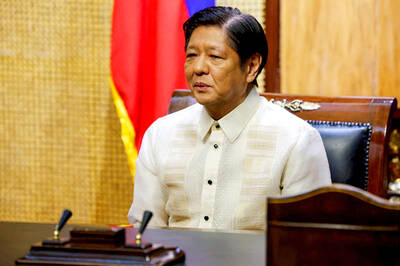
The Philippines would likely be involved in any conflict over Taiwan due to its proximity to the democracy claimed by China, President Ferdinand Marcos Jr said, reiterating a stance that risks angering Beijing. “In the Philippines, we do not have a choice because Taiwan is so close to the Philippines and we have almost 200,000 Filipino nationals living and working in Taiwan,” Marcos said in an interview with Japanese media in Manila on Monday. The Philippine leader’s comments come ahead of a state visit to Japan next week, where he is to meet with Japanese Prime Minister Sanae Takaichi to discuss security


 RSS
RSS