

After a week-long trip around Taiwan dogged by persistent protests, China’s Association for Relations Across the Taiwan Straits (ARATS) Chairman Chen Deming (陳德銘) returned to Taipei yesterday to attend the annual Cross-Strait CEO Summit — only to be greeted by more demonstrations.
Although the summit purports to facilitate business relationships across the Taiwan Strait, critics say the meeting in effect allows the Chinese Nationalist Party (KMT) and Chinese Communist Party (CCP) to formulate decisions on cross-strait trade policies while circumventing legislative and administrative procedures.
Three separate rallies — led by the Taiwan Solidarity Union (TSU), pro-independence groups and youth activist organizations — took place outside the summit’s venue in Taipei’s Xinyi District (信義), while more than 800 business and political heavyweights from both sides of the Taiwan Strait gathered inside.
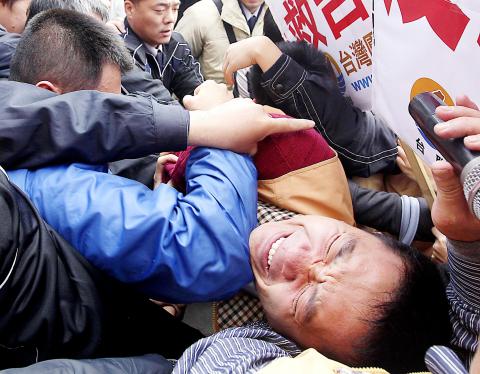
Photo: Reuters
Among the attendees at the two-day event are former vice president Vincent Siew (蕭萬長) and former Chinese vice premier Zeng Peiyan (曾培炎), who both spoke at the summit’s opening ceremony.
Business leaders participating in the summit include Jack Ma (馬雲), founder of the Chinese e-commerce giant Alibaba; Sinopec Group senior vice president Dai Houliang (戴厚良); Taiwan Semiconductor Manufacturing Co chairman Morris Chang (張忠謀); and Acer Corp founder Stan Shih (施振榮).
Scuffles with police occurred as protesters from a rally organized by the Taiwan Solidarity Union attempted to inch closer to the venue, resulting in TSU Department of Organization Deputy Director Chang Chao-lin (張兆林) being taken away by police for questioning.
Protesters from a rally led by pro-independence groups congregated across the street, waving towering flags that measured up to three stories high, emblazoned with pro-independence slogans.
A prerecorded track that chanted: “The communist livestock have arrived; the Chinese communist robbers have arrived,” blasted repeatedly through loudspeakers aimed toward the venue.
Economic Democracy Union convener Lai Chung-chiang (賴中強) led a third rally, shouting slogans that denounced participants in the summit as members of the “cross-strait privileged stratum.”
Lai was joined by members of several youth organizations that blossomed following the Sunflower movement in late March and April, in which students and activists occupied the Legislative Yuan’s main chamber for 23 days to protest the government’s handling of a proposed cross-strait service trade agreement.
With important officials from the KMT and the CCP present, Lai said the summit can be seen as an example of the party-to-party negotiation mechanism established during the KMT-CCP forum in 2005, adding that such an arrangement bypasses legal procedures required by Taiwanese law.
The summit touches on many issues that are still under legislative deliberation, Lai said, including draft bills for the proposed free economic pilot zones, as well as cross-strait cooperation in medical and biotechnological industries.
“By conducting negotiations with Chinese authorities without the approval of the Mainland Affairs Council, participants in the summit have broken the law,” Lai said. “Vincent Siew and [former Straits Exchange Foundation chairman] Chiang Pin-kun (江丙坤) should take responsibility for their criminal behavior.”
The protesters offered organizers of the summit a prop of a “moonflower,” referring to Chen’s remarks last week that cautioned against the occurrence of a “Moonflower” movement — a hypothetical sequel to the Sunflower movement — to ensure that the cross-strait trade agreement passes soon.
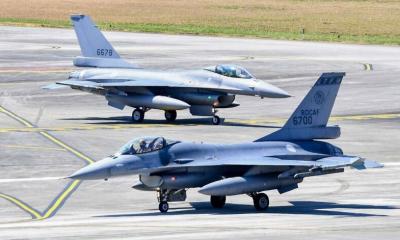
The first two F-16V Block 70 jets Taiwan purchased from the US were spotted unexpectedly turning back after departing from Hawaii yesterday, potentially further delaying delivery of the aircraft. Taiwan has purchased 66 of the F-16 C/D Block 70 jets to be deployed at Chihhang Air Base (志航基地) in Taitung County and operated by the air force's 7th Tactical Fighter Wing to defend Taiwan’s eastern region. Two single-seat jets, bearing serial No. 6727 and 6728, were spotted taking off from Hickam Field in Hawaii yesterday, observers said. Based on the precedent set during the delivery of Taiwan's older F-16 Block 20s, the new
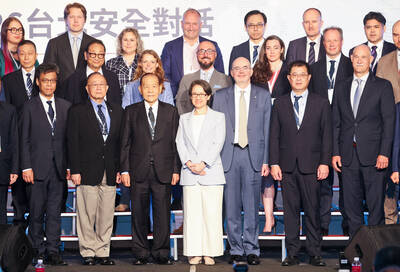
Taiwan’s growing defense preparations might be sending a stronger signal to the US than to Beijing, highlighting the need for Taipei to tailor its deterrence efforts to different audiences, a US security academic said yesterday. Stanford University Freeman Spogli Institute for International Studies fellow Oriana Skylar Mastro made the comment during a Taipei Security Dialogue panel examining lessons Taiwan could draw from the wars in Ukraine and the Middle East. Mastro said she was impressed by Taiwan’s increased defense spending, emphasis on asymmetric capabilities and efforts to prepare society for conflict, but questioned whom those initiatives were influencing. She said when she asked
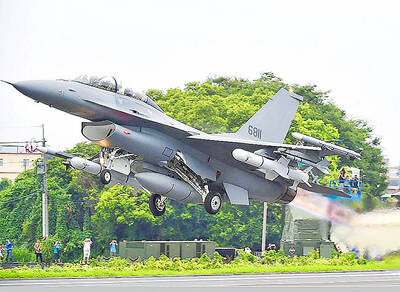
A sharp rise in compensation to be paid by air force officers who leave before completing their required service could indicate an increase in pilots leaving the military early, an analyst said on Friday, warning that the trend could worsen a shortage of experienced personnel. Chieh Chung (揭仲), a researcher at the Association for Strategic Foresight, issued the warning even though the number of volunteer military personnel is expected to increase next year. The planned headcount for volunteer military personnel, covering officers, noncommissioned officers (NCO) and enlisted soldiers, is 158,223 for next year, up 4,258 from 153,965 this year, Chieh said. The increase
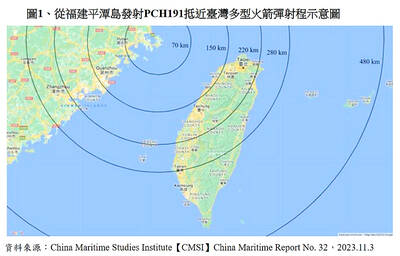
Potential improvements to munitions used by China’s long-range rocket-artillery units could extend their range to cover the entire Miyako Strait, which might give the Chinese People’s Liberation Army (PLA) the ability to secure the strategic waterway, the Mainland Affairs Council (MAC) said in a report. The PLA’s long-range rocket-artillery units deployed along the Taiwan Strait are concentrated along the coast of Fujian Province, including Changle, Pingtan and Shishi, the quarterly report on China said. The artillery brigades of the PLA’s 71st, 72nd and 73rd group armies have been deployed, with preparations for potential battlefield operations under way since August 2022, the report


 RSS
RSS