


Despite a promise to transfer power and initiate political reforms following the Chinese Nationalist Party’s (KMT) poor showing in the nine-in-one elections, President Ma Ying-jeou (馬英九) aims to retain control of the judicial system via appointments to the Council of Grand Justices, according to prominent legal expert Huang Yueh-hung (黃越宏), publisher of the Internet Gazette Law Paper (法治時報社), an influential news journal among legal professionals and in judicial circles.
Four grand justices who were appointed under former Democratic Progressive Party (DPP) president Chen Shui-bian (陳水扁) end their terms next year.
Huang said he and other observers expect Ma to be engaged in making nominations to the body that is charged with interpreting the Constitution.
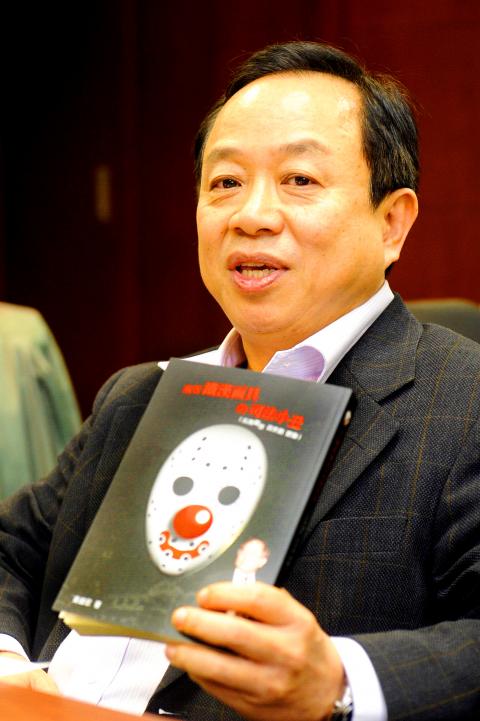
Photo: George Tsorng, Taipei Times
“When these four positions are filled, then the council will be fully composed of Ma’s appointees,” Huang said.
The appointments have direct effects on the promoting and changing of posts for a dozen or more top positions throughout the judicial system.
“Ma has meddled in the judicial process and subverted the Constitution throughout his presidency. He has pushed through several policies against the wishes of the majority,” Huang said. “Ma fears political retribution, of being prosecuted by the courts after his presidency, as has happened to former president Chen.”
“Therefore Ma is actively maneuvering for next year’s grand justices nominees, because he wants to avoid becoming a victim of political persecution,” said Huang, who is an expert on legal affairs and has written numerous books about the nation’s judicial system.
It is likely that Ma already has a shortlist of nominees, which could include Judicial Yuan Secretary-General Lin Chin-fang (林錦芳), who is on good terms with Ma, and Chen Shih-hsiung (陳世雄), the supreme court judge who handed down guilty decisions against Chen Shui-bian, Huang says in an article published in a recent issue of his publication.
Huang said grand justice nominees would affect three top posts in the Judicial Yuan and also influence changes to at least 10 leading positions in the prosecutorial system.
“This is a big domino effect; the movement will impact throughout the judicial system and will also affect top posts at the Taiwan High Court as well as lower courts,” he added.
Huang said the moves expected next year would be Ma’s most crucial judicial appointments, “because he does not want to end up in prison, like ex-president Chen.”
“However, people in power are realistic on knowing who is the boss. On finishing the presidency, he is no longer in charge and nothing can be counted on as certain. Also, Ma has often treated people badly,” Huang wrote. “After his term ends, Ma could also face prosecution over financial irregularities and corruption charges, and might also end up with a jail term — just like Chen Shui-bian.”
“The nominees must receive approval from the legislature, and this must be done during the legislative session’s first half-term. Thus, the nominee list has to be finalized early next year,” Huang said.
When the time comes for legislative approval, Ma could face a contentious battle, Huang added.
“The Constitution stipulates that [seven of 15] grand justices serve an eight-year term [while others serve for four years], but during Ma’s presidency, he subverted this with his own interpretation of ‘eight-year term for one appointee,’” which would allow a new appointee to serve for eight years, Huang wrote
Some legislators regard Ma’s position on this as unconstitutional and could be expected to challenge the president on this during the confirmation process next year, Huang said.

Trips for more than 100,000 international and domestic air travelers could be disrupted as China launches a military exercise around Taiwan today, Taiwan’s Civil Aviation Administration (CAA) said yesterday. The exercise could affect nearly 900 flights scheduled to enter the Taipei Flight Information Region (FIR) during the exercise window, it added. A notice issued by the Chinese Civil Aviation Administration showed there would be seven temporary zones around the Taiwan Strait which would be used for live-fire exercises, lasting from 8am to 6pm today. All aircraft are prohibited from entering during exercise, it says. Taipei FIR has 14 international air routes and
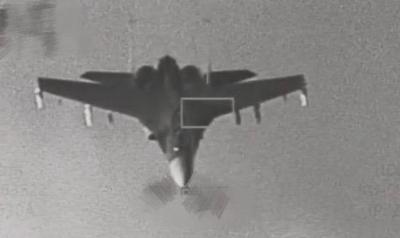
The Ministry of National Defense (MND) today released images of the military tracking China’s People's Liberation Army (PLA) movements during the latest round of Chinese drills around Taiwan. The PLA began "Justice Mission 2025" drills today, carrying out live-fire drills, simulated strikes on land and maritime targets, and exercises to blockade the nation's main ports. The exercises are to continue tomorrow, with the PLA announcing sea and air space restrictions for five zones around Taiwan for 10 hours starting from 8:30am. The ministry today released images showing a Chinese J-16 fighter jet tracked by a F-16V Block 20 jet and the

Snow fell on Yushan (Jade Mountain, 玉山) yesterday morning as a continental cold air mass sent temperatures below freezing on Taiwan’s tallest peak, the Central Weather Administration (CWA) said. Snowflakes were seen on Yushan’s north peak from 6:28am to 6:38am, but they did not fully cover the ground and no accumulation was recorded, the CWA said. As of 7:42am, the lowest temperature recorded across Taiwan was minus-5.5°C at Yushan’s Fengkou observatory and minus-4.7°C at the Yushan observatory, CWA data showed. On Hehuanshan (合歡山) in Nantou County, a low of 1.3°C was recorded at 6:39pm, when ice pellets fell at Songsyue Lodge (松雪樓), a
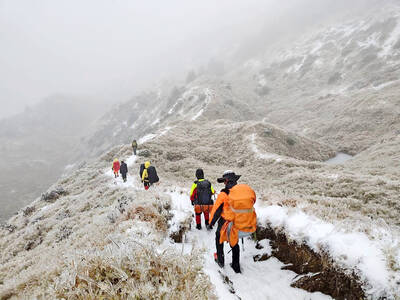
NO SHAME IN RETREAT: Hikers should consider turning back if the weather turns bad or if they do not have sufficient equipment, the Taroko park headquarters said Two people died of hypothermia over the weekend while hiking on Hsuehshan (雪山), prompting park authorities to remind hikers to bring proper equipment and consider their physical condition before setting out in the cold weather. Temperatures dropped over the weekend, bringing snow to high altitudes in Shei-pa National Park. One hiker, surnamed Lin (林), who on Friday was traveling with a group of six along the Hsuehshan west ridge trail, lost consciousness due to hypothermia and died, the Shei-pa National Park Headquarters said. On Saturday, another hiker, surnamed Tien (田), in a group of five on the southeast of the west


 RSS
RSS