


Calls for the government to resume handing out end-of-year bonuses to retired civil servants, military personnel and teachers are simply an attempt by the Chinese Nationalist Party (KMT) to reinforce its voting base in the runup to the Nov. 29 nine-in-one elections, critics said yesterday.
The original Statute on Year-end Bonuses and Pension was in effect for more than four decades, costing nearly NT$20 billion (US$651 million) per year before the Democratic Progressive Party (DPP), the People First Party and the Taiwan Solidarity Union proposed an amendment in 2012 to make only those with a monthly pension of less than NT$20,000 eligible for the bonus.
The Executive Yuan said in August that that the pension cap on year-end bonuses would be increased to NT$25,000.
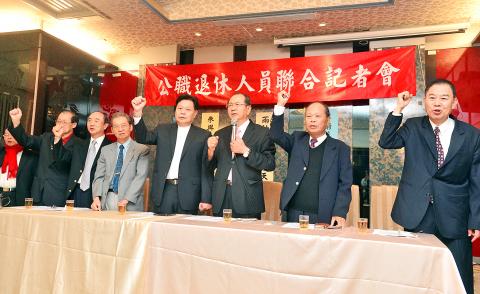
Photo: Wang Yi-sung, Taipei Times
Pundits said the move, which would cost the government an extra NT$1 billion a year, was politically motivated.
KMT Legislator Sun Ta-chien (孫大千) recently proposed restoring year-end bonuses for all retirees, a move that could cost the government NT$20 billion — which opposition lawmakers said was further proof that the KMT is attempting to pacify its supporters.
Former national policy advisor Liu Sheng-liang (劉盛良) yesterday said the Executive Yuan announcement should be upheld or there would be widespread squabbling over the bonus issue.
Liu made the remark at an event to introduce a support group for KMT Taipei mayoral candidate Sean Lien (連勝文) made up of retired civil servants.
Former Examination Yuan secretary-general Lin Shui-chi (林水吉), initiator of the group, said that the bonus issue would impact KMT election support, adding that civil servants could not tolerate being labeled “greedy and insatiable.”
Lin said he hoped the government would consider making retirees with monthly pensions of more than NT$25,000 eligible for the year-end bonus.
There are about 440,000 retirees whose monthly pensions are more than NT$25,000 — about 85 percent of former civil servants, military personnel and educators — Lin said.
If Sun’s proposal is passed, the government’s year-end bonus expenditure is expected to increase by between NT$8 billion to NT$9 billion.
However, DPP lawmakers said that the Executive Yuan’s decision to raise the cap, leading to calls for resumption of payouts on a general basis, was essentially a bid to buy votes for the KMT using taxpayers’ money.
DPP Legislator Gao Jyh-peng (高志鵬) said that retirees with an monthly income of NT$50,000 that came solely from their pensions were being paid by tax money from families who earned much less.
Gao said the KMT was unwilling to make good on its promises on reforms on the annual funds for retired civil servants, military personnel and educators.
Retirees should not be eligible for bonuses since they have no standard to be held accountable to, DPP Legislator Lee Chun-yi (李俊俋) said.
The KMT’s “generous” usage of taxpayers’ money to please certain groups is a severe breach of the governmental system and the concept of equality, Lee said, adding that the move might also be against the Civil Servants Election and Recall Act (公務人員選舉罷免法).
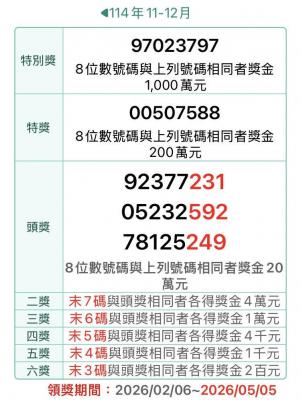
Seven of the 17 NT$10 million (US$311,604) winning receipts from the November-December uniform invoice lottery remain unclaimed as of today, the Ministry of Finance said, urging winners to redeem their prizes by May 5. The reminder comes ahead of the release of the winning numbers for the January-February lottery tomorrow. Among the unclaimed receipts was one for a NT$173 phone bill in Keelung, while others were for a NT$5,913 purchase at Costco in Taipei's Neihu District (內湖), a NT$49 purchase at a FamilyMart in New Taipei City's Tamsui District (淡水), and a NT$500 purchase at a tea shop in New Taipei City's
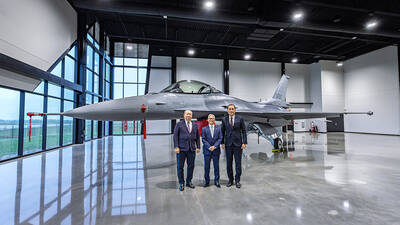
Taiwanese officials were shown the first of 66 F-16V fighter jets purchased by Taiwan from the United States, the Ministry of National Defense said yesterday, adding the aircraft has completed an initial flight test and is expected to be delivered later this year. A delegation led by Deputy Minister of National Defense Hsu Szu-chien (徐斯儉) visited Lockheed Martin’s F-16 C/D Block 70 (also known as F-16V) assembly line in South Carolina on March 16 to view the aircraft. The jet will undergo a final acceptance flight in the US before being delivered to Taiwan, the
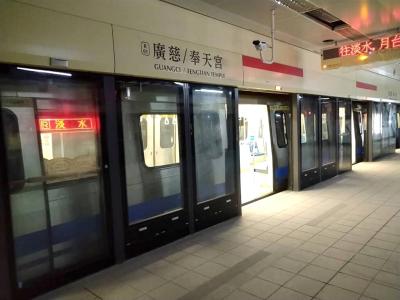
The New Taipei Metro's Sanyin Line and the eastern extension of the Taipei Metro's Tamsui-Xinyi Line (Red Line) are scheduled to begin operations in June, the National Development Council said today. The Red Line, which terminates at Xiangshan Station, would be connected by the 1.4km extension to a new eastern terminal, Guangci/Fengtian Temple Station, while the Sanyin Line would link New Taipei City's Tucheng and Yingge stations via Sanxia District (三峽). The council gave the updates at a council meeting reviewing progress on public construction projects for this year. Taiwan's annual public infrastructure budget would remain at NT$800 billion (US$25.08 billion), with NT$97.3
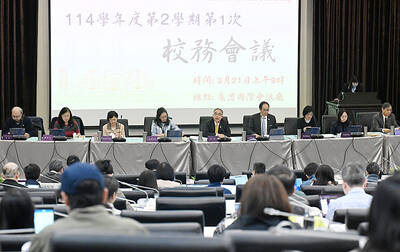
TALENT SCOUTING: The university is investing substantial funds in its future to bring in the kind of researchers that would keep the college internationally competitive National Taiwan University (NTU) plans to invest NT$2 billion (US$62.6 million) to launch two programs aimed at attracting and retaining top research talent, university president Chen Wen-chang (陳文章) said yesterday. The funding would support the “Palm Grove Scholars Project,” which targets academics aged 40 to 55. Up to 20 scholars would be selected, each receiving as much as NT$10 million annually, Chen said. The initiative is designed to attract leading researchers to Taiwan and strengthen NTU’s global competitiveness by fostering a more research-friendly environment and expanding international collaboration, he said. NTU is also introducing a “Hong Hu” chair grant, which would provide Palm


 RSS
RSS