


Leaders of the Sunflower movement made a tour of Europe from Saturday to Wednesday to talk about the ideals of their movement.
Dennis Wei (魏揚) and Wu Cheng (吳崢), two of the leaders of the Sunflower movement which originated from a coalition of student protesters who took over the Legislative Yuan in Taipei for almost 23 days in March and April, visited the London School of Economics and Political Science on Saturday to give a talk on the economics, history and development of Taiwanese social movements, before meeting with officials from the UK Foreign and Commonwealth Office.
They also visited Brussels and had separate meetings with three European political parties. They also had a separate meeting with the European External Action Service.
Wei and Wu were invited by the Taiwanese Students Association in the United Kingdom (TSAUK), the Formosan Association for Public Affairs in the UK (FAPA UK) and Danish organization Taiwan Corner, the main organizer of the trip.
Taiwan Corner chairman Michael Danielsen said he was very happy to see that political parties in Europe are interested in Taiwan and its social movements.
During an interview in London, Wei said the future of the Sunflower movement lies in keeping people whose paths merged with the movement continually interested with social activism.
The difficulty is that there are many definitions of “the future” held by participants in the movement, Wei said.
The movement must seek to strengthen the concept of “civil disobedience” and move away from keeping the movement within the bounds of “social movements,” Wei said, adding that this was not only the movement’s future, but also the future for all Taiwanese social movements.
Pointing to the Umbrella movement in Hong Kong which is strongly influenced by the Sunflower movement, Wei said that Taiwanese could continue to support the protesters by writing about it.
It is something that everyone can do, as Taiwan shares similar goals with the Hong Kong movement, Wei said.
Conflicts within families are not events particular to the Sunflower movement, but exist in every social movement — it is only that the Sunflower movement’s scale has made these conflicts more severe, Wei said.
It is not necessarily a bad thing, Wei said, adding that he did not feel it was good for individuals who believe in their cause to damage familial relations while trying to persuade others to see things from their point of view.
Wei said the movement is comprised of many different groups, and that future considerations and plans should not be placed under a general label, adding that he is aware that some groups within the organization plan to become politicians.
Wu said many of the younger generation still hope that political parties will eventually come around and match the expectations of the public.
If at some point the existing political parties can no longer be trusted, there will be people willing to implement political reform and take the appropriate action, Wu said.
At the talk in London, a Taiwanese living in the British capital had made sunflower cupcakes using bananas to avoid “misconceptions.”
The misconception refers to Chinese Nationalist Party (KMT) Legislator Chiu Yi (邱毅), who apparently mistook the sunflowers carried by protesters for bananas.
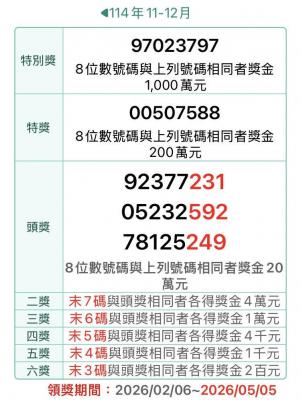
Seven of the 17 NT$10 million (US$311,604) winning receipts from the November-December uniform invoice lottery remain unclaimed as of today, the Ministry of Finance said, urging winners to redeem their prizes by May 5. The reminder comes ahead of the release of the winning numbers for the January-February lottery tomorrow. Among the unclaimed receipts was one for a NT$173 phone bill in Keelung, while others were for a NT$5,913 purchase at Costco in Taipei's Neihu District (內湖), a NT$49 purchase at a FamilyMart in New Taipei City's Tamsui District (淡水), and a NT$500 purchase at a tea shop in New Taipei City's
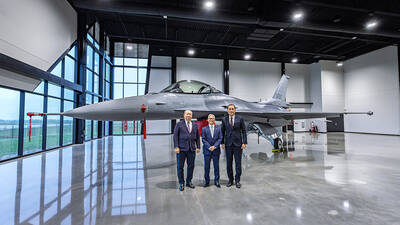
Taiwanese officials were shown the first of 66 F-16V fighter jets purchased by Taiwan from the United States, the Ministry of National Defense said yesterday, adding the aircraft has completed an initial flight test and is expected to be delivered later this year. A delegation led by Deputy Minister of National Defense Hsu Szu-chien (徐斯儉) visited Lockheed Martin’s F-16 C/D Block 70 (also known as F-16V) assembly line in South Carolina on March 16 to view the aircraft. The jet will undergo a final acceptance flight in the US before being delivered to Taiwan, the
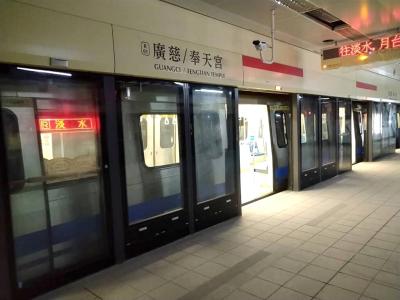
The New Taipei Metro's Sanyin Line and the eastern extension of the Taipei Metro's Tamsui-Xinyi Line (Red Line) are scheduled to begin operations in June, the National Development Council said today. The Red Line, which terminates at Xiangshan Station, would be connected by the 1.4km extension to a new eastern terminal, Guangci/Fengtian Temple Station, while the Sanyin Line would link New Taipei City's Tucheng and Yingge stations via Sanxia District (三峽). The council gave the updates at a council meeting reviewing progress on public construction projects for this year. Taiwan's annual public infrastructure budget would remain at NT$800 billion (US$25.08 billion), with NT$97.3
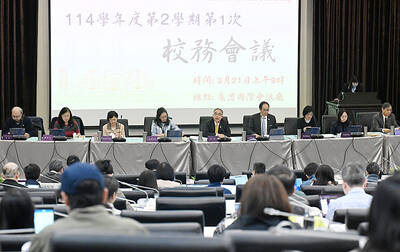
TALENT SCOUTING: The university is investing substantial funds in its future to bring in the kind of researchers that would keep the college internationally competitive National Taiwan University (NTU) plans to invest NT$2 billion (US$62.6 million) to launch two programs aimed at attracting and retaining top research talent, university president Chen Wen-chang (陳文章) said yesterday. The funding would support the “Palm Grove Scholars Project,” which targets academics aged 40 to 55. Up to 20 scholars would be selected, each receiving as much as NT$10 million annually, Chen said. The initiative is designed to attract leading researchers to Taiwan and strengthen NTU’s global competitiveness by fostering a more research-friendly environment and expanding international collaboration, he said. NTU is also introducing a “Hong Hu” chair grant, which would provide Palm


 RSS
RSS