


The cooking oil scandal involving several of Ting Hsin International Group’s (頂新國際集團) subsidiaries could intensify as the Food and Drug Administration (FDA) awaits results of tests on the firms’ oil products for dioxin, amid criticism that the agency dragged its feet on the testing.
The Changhua District Prosecutors’ Office collected samples of cooking oils at Ting Hsin Oil and Fat Industrial Co’s (頂新製油) Pingtung factory on Oct. 10 and Oct. 23.
The second set of samples was reportedly prompted by an anonymous tip-off from a Vietnam-based Taiwanese businessman that the animal feed oils Ting Hsin Oil had imported from oil manufacturer Dai Hanh Phuc Co (大幸福公司) in that country were contaminated with ingredients of “Agent Orange.”
Agent Orange was one of several herbicides and defoliants used in aerial spraying by the US military during the Vietnam War in Vietnam, eastern Laos and parts of Cambodia to eliminate forest cover that could hide North Vietnamese troops or crops that could feed them.
The use of such herbicides and defoliants has been blamed for hundreds of thousands of cases of deaths, illnesses and birth defects.
“The FDA received seven samples of Ting Hsin Oil’s refined and unrefined lard and beef tallow on Oct. 24, before receiving five more samples of the company’s coconut oil and beef tallow imported from Australia the next day,” FDA interim Director-General Chiang Yu-mei (姜郁美) told a news conference in Taipei.
Chiang said the FDA sent the two batches of samples to its laboratory on Monday and yesterday respectively to test for dioxin or dioxin-like polychlorinated biphenyls.
“The test results are expected within two weeks,” Chiang said.
The agency did not explain for the 11-day delay in sending the samples for dioxin screening, for which it has been criticized.
Chang Gung Memorial Hospital toxicologist Yen Tsung-hai (顏宗海) said Agent Orange contained dioxin, which has been dubbed the “poison of the century” and has been proven by the WHO to be a cancer-linked hazard to humans.
“Dioxin has a long half-life in animals and can easily enter the human food chain. Research has linked exposure to the substance to liver and skin diseases, impaired immune and endocrine systems, as well as an increased risk of miscarriage and fetal abnormalities,” Yen said.
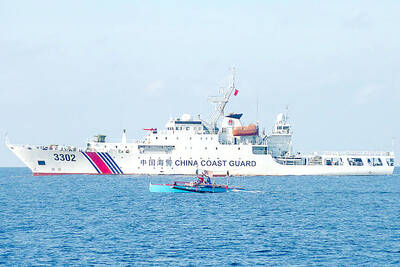
EXPANSIONIST: China deploys an average of 40 to 50 warships and coast guard vessels daily in the South China Sea, despite pledges not to militarize the region, an official said China is attempting to expand its influence across the First Island Chain and increase pressure on Japan by sending coast guard vessels into waters off of Taiwan under the pretext of maritime negotiations with Japan and the Philippines, a national security official said yesterday. China’s recent actions in the waters east of Taiwan and Japan and the Philippines’ exclusive economic zones (EEZ) are attempts to establish dominance in First Island Chain waters, said the official who declined to be named, adding that this is “expansion disguised as law enforcement.” Framing China’s actions solely as a cross-strait issue is a serious misjudgment that
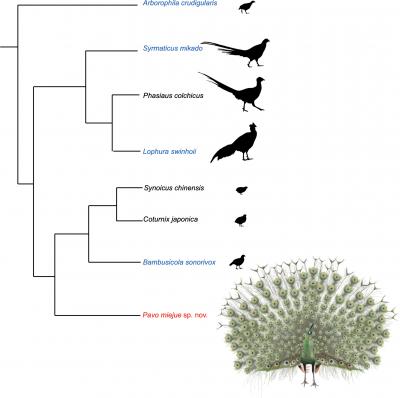
Through analyzing fossil evidence, a research team at National Taiwan University (NTU) discovered the largest endemic bird to have lived in Taiwan, naming it Pavo miejue, or extinct peafowl (滅絕孔雀). The Mikado pheasant, which is printed on the back of the NT$1,000 bank note, was previously believed to be the biggest endemic bird to Taiwan. The research team’s findings suggest that Pavo miejue lived during the Pleistocene epoch tens of thousands of years ago. It is the first endemic extinct bird species discovered and formally named in Taiwan. The study was coauthored by NTU Institute of Ecology and Evolutionary Biology professor Tsai Cheng-hsiu (蔡政修),
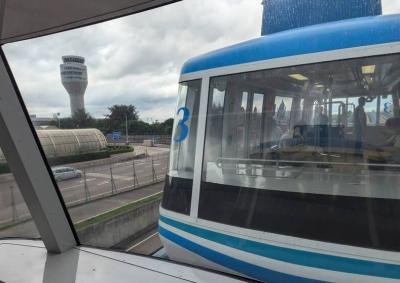
Taiwan Taoyuan International Airport is to suspend its automated Skytrain service connecting Terminal 1 and Terminal 2 starting on July 1 to facilitate connection works for the upcoming Terminal 3, the airport operator said today. Passengers and staff who need to travel between the two terminals after the suspension can instead use the Taoyuan MRT or the airport's 24-hour shuttle bus service, Taoyuan International Airport Corp said. The Taoyuan MRT Airport Line directly links the two terminals, while the shuttle buses are to operate around the clock, the company added. The Skytrain provides free transportation between the airport’s two terminals for travelers and
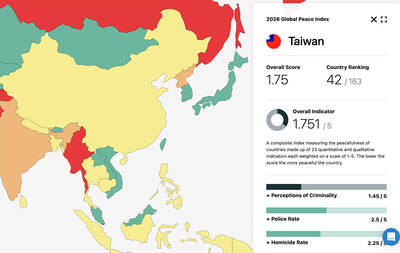
Taiwan ranked 42nd in terms of peacefulness among 163 countries, down five places from last year, according to this year’s Global Peace Index. With an overall score of 1.751, Taiwan dropped from 37th last year, the report published by the global Institute for Economics and Peace showed. The overall score measures a country’s level of peacefulness using 23 quantitative and qualitative indicators across three domains — ongoing domestic and international conflict, societal safety and security, and militarization. While Taiwan ranked 42nd worldwide, it was listed in ninth place among the 19 Asian-Pacific countries in the report, after New Zealand, Singapore, Japan, Malaysia,


 RSS
RSS