


Cash prizes are to be awarded this year to Taipei borough wardens who get their constituents to polling stations in an effort to increase voter turnout in the Nov. 29 elections, the Taipei City Government’s Department of Civil Affairs Commissioner Huang Lu Ching-ju (黃呂錦茹) said yesterday.
She made her remarks at a press conference alongside people representing immigrants and young voters, urging city residents of all backgrounds to vote. The department is responsible for the city’s election budget.
While Taipei’s voter turnout has historically been higher than that of most other cities and counties, apathy toward the mayoral candidates could hinder the department reaching its voter turnout goal of 71 percent, Huang said.
The previous mayoral election in 2009 had a 70.65 percent voter turnout, according to department statistics.
Huang said that next month, the department would provide cash rewards to borough wardens, borough administrative secretaries and district offices for increasing voter turnout in their respective boroughs or districts.
Borough chiefs and administrative secretaries would be given a supermarket gift card for NT$1,000 for each percentage point that voter turnout in their boroughs exceeds 71 percent, she said, adding that district offices which reach this goal would be given NT$10,000 to be divided among their workers.
She said that this would be the first time that such a financial reward for increasing voter turnout has been provided during a mayoral election.
National Taiwan University politics professor Wang Ye-li (王業立) yesterday said that while it was impossible to predict how effective the new measures would be at increasing the voting rate, any increase would likely benefit the campaign of Chinese Nationalist Party (KMT) Taipei mayoral candidate Sean Lien (連勝文).
Although voter affiliation in Taipei is strongly tilted toward the pan-blue camp, the KMT’s supporters have been apathetic about Lien’s candidacy, he said.
Democratic Progressive Party City Councilor Chien Yu-yen (簡余晏), the spokeswoman for independent Taipei mayoral candidate Ko Wen-je (柯文哲), yesterday said “the majority of borough wardens belong to the KMT.”
“We call on the Taipei City Government to maintain neutrality and avoid excess executive intervention in the election,” she said, adding that the voting rate in normal democratic countries is about 50 percent, unless there is extreme political polarization.

SECURITY: Starlink owner Elon Musk has taken pro-Beijing positions, and allowing pro-China companies to control Taiwan’s critical infrastructure is risky, a legislator said Starlink was reluctant to offer services in Taiwan because of the nation’s extremely high penetration rates in 4G and 5G services, the Ministry of Digital Affairs said yesterday. The ministry made the comments at a meeting of the legislature’s Transportation Committee, which reviewed amendments to Article 36 of the Telecommunications Management Act (電信管理法). Article 36 bans foreigners from holding more than 49 percent of shares in public telecommunications networks, while shares foreigners directly and indirectly hold are also capped at 60 percent of the total, unless specified otherwise by law. The amendments, sponsored by Chinese Nationalist Party (KMT) Legislator Ko

The eastern extension of the Taipei MRT Red Line could begin operations as early as late June, the Taipei Department of Rapid Transit Systems said yesterday. Taipei Rapid Transit Corp said it is considering offering one month of free rides on the new section to mark its opening. Construction progress on the 1.4km extension, which is to run from the current terminal Xiangshan Station to a new eastern terminal, Guangci/Fengtian Temple Station, was 90.6 percent complete by the end of last month, the department said in a report to the Taipei City Council's Transportation Committee. While construction began in October 2016 with an
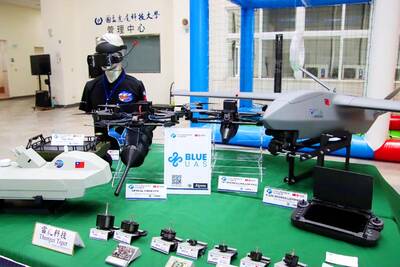
NON-RED SUPPLY: Boosting the nation’s drone industry is becoming increasingly urgent as China’s UAV dominance could become an issue in a crisis, an analyst said Taiwan’s drone exports to Europe grew 41.7-fold from 2024 to last year, with demand from Ukraine’s fight against Russian aggression the most likely driver of growth, a study showed. The Institute for Democracy, Society and Emerging Technology (DSET) in a statement on Wednesday said it found that many of Taiwan’s uncrewed aerial vehicle (UAV) sales were from Poland and the Czech Republic. These countries likely transferred the drones to Ukraine to aid it in its fight against the Russian invasion that started in 2022, it said. Despite the gains, Taiwan is not the dominant drone exporter to these markets, ranking second and fourth
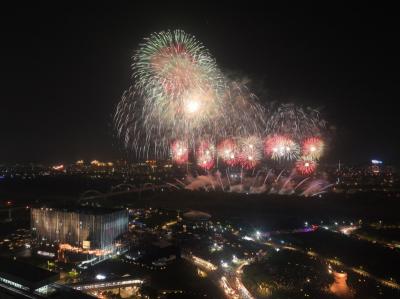
The New Taipei City Art Museum this weekend plans to celebrate its first anniversary with a two-day extravaganza featuring live concerts and a large-scale synchronized fireworks and drone display, the New Taipei City Cultural Affairs Department said. The two-day celebrations are to take place in the museum’s outdoor park, with markets and live performances by singers including Ann Bai (白安), Bii (畢書盡) and the Cosmos People (宇宙人), the department said. The highlight on both evenings would be the "Echoes of Light" show, an aerial spectacle combining fireworks and drone performances designed around the concept of "dual stages in the sky," it


 RSS
RSS