


Environmental groups and several New Taipei City residents yesterday filed a lawsuit with the Taipei High Administrative Court against the Environmental Protection Administration (EPA) over its approval of Taiwan Power Co’s (Taipower) plan to store spent nuclear fuel rods outside at the Guosheng Nuclear Power Plant.
They called on the agency to revoke its approval for the company to store thousands of spent fuel rod bundles at the plant in Wanli District (萬里).
Democratic Progressive Party Legislator Tien Chiu-chin (田秋堇) said that Taipower is building 27 stainless steel cylinders covered in concrete for storing the spent rods.
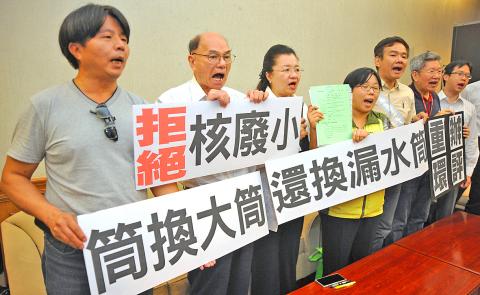
Photo: Liu Hsin-de, Taipei Times
Citing an assessment conducted on March 23, 2012, which found that an anchor bolt inside the plant’s first reactor had ruptured and two others were nearing the rupturing point, she said that the decision to build the dry storage casks at the plant poses a grave threat to national security, and that Taiwan risks becoming “the next Fukushima [Dai-ichi nuclear plant disaster].”
“We all know that Taiwan is located in an earthquake-prone area. How can the casks endure the repeated battering of typhoons? When the outer layer cracks, the nuclear wastewater will cause serious damage to the environment. There is also a problem of nuclear radiation,” she said.
The steel storage casks have been soldered and are therefore susceptible to rupturing, while those made in the US are usually molded through one-step forming and are seamless, she said.
Northern Coast Anti-Nuclear Action Alliance chief executive Kuo Ching-lin (郭慶霖) said the EPA’s environmental impact assessment (EIA) committee issued a resolution on April 7, 2010, that said Taipower could construct cylinders to hold 56 to 68 bundles of fuel rods each.
However, Taipower ignored that decision and in November 2010 acquired Modular, Advanced Generation, Nuclear All-purpose Storage (MAGNASTOR) dry cask storage technology from US-based NAC International, which stores 87 bundles of spent fuel rods inside each cask, Kuo said.
He also cited a report issued in February last year by Taipower employee Lee Tsung-lun (李宗倫) that gave accounts of leaks with the MAGNASTOR system, which had been undergoing a trial run at the McGuire Nuclear Station in North Carolina when Lee visited the US facility.
“There has not been any record of the MAGNASTOR system, which the company [Taipower] employs, having been put into actual use in the US,” the report said.
Kuo said Taipower should have undertaken another EIA, as stipulated by Article 38, Clause 1 of the Environmental Impact Assessment Enforcement Rules (環境影響評估法施行細則), which states that the project owner must undergo another EIA if a revised project creates a greater impact or has an adverse effect on the environment.
However, the environmental agency allowed the company to bypass the rules by just submitting a table that indicated the changes that were made, he said.
Kuo said the situation has become even more dire since Taipower has renewed its request to the Atomic Energy Council to delay the scheduled decommissioning of the Jinshan Nuclear Power Plant in 2019 by 20 years, even though President Ma Ying-jeou (馬英九) said in 2011 that the shutdown would not be put off, Kuo said.
“With each cylinder at the First Nuclear Plant [Jinshan] weighing approximately 228 tonnes, they are impossible to transport, meaning that once construction begins, there will be no turning back for the northern coast, because it will forever be a place associated with nuclear waste storage,” he said.
“With only Yangjin Highway [Provincial Highway 2], the West Coast Highway [Provincial Highway 61] and a number of bridges crisscrossing northern Taiwan, there will not be enough time to run if a nuclear meltdown should occur,” Kuo said.
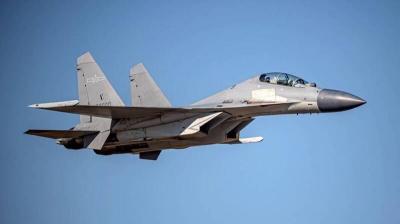
Eight Chinese naval vessels and 24 military aircraft were detected crossing the median line of the Taiwan Strait between 6am yesterday and 6am today, the Ministry of National Defense said this morning. The aircraft entered Taiwan’s northern, central, southwestern and eastern air defense identification zones, the ministry said. The armed forces responded with mission aircraft, naval vessels and shore-based missile systems to closely monitor the situation, it added. Eight naval vessels, one official ship and 36 aircraft sorties were spotted in total, the ministry said.
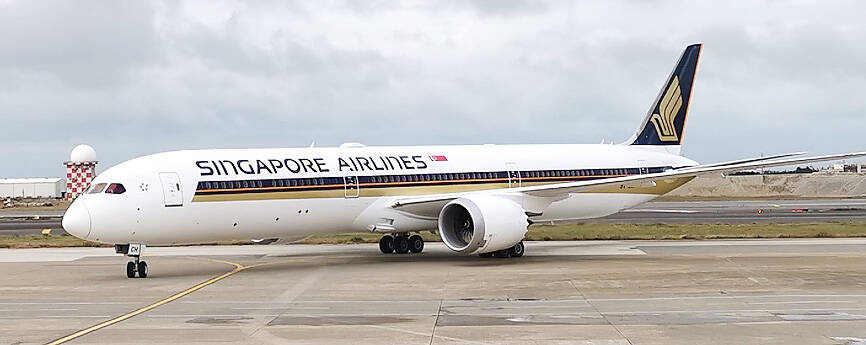
INCREASED CAPACITY: The flights on Mondays, Wednesdays, Fridays and Sundays would leave Singapore in the morning and Taipei in the afternoon Singapore Airlines is adding four supplementary flights to Taipei per week until May to meet increased tourist and business travel demand, the carrier said on Friday. The addition would raise the number of weekly flights it operates to Taipei to 18, Singapore Airlines Taiwan general manager Timothy Ouyang (歐陽漢源) said. The airline has recorded a steady rise in tourist and business travel to and from Taipei, and aims to provide more flexible travel arrangements for passengers, said Ouyang, who assumed the post in July last year. From now until Saturday next week, four additional flights would depart from Singapore on Monday, Wednesday, Friday
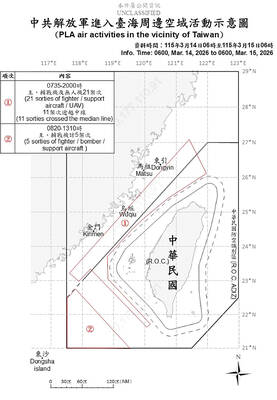
The Ministry of National Defense yesterday reported the return of large-scale Chinese air force activities after their unexplained absence for more than two weeks, which had prompted speculation regarding Beijing’s motives. China usually sends fighter jets, drones and other military aircraft around the nation on a daily basis. Interruptions to such routine are generally caused by bad weather. The Ministry of National Defense said it had detected 26 Chinese military aircraft in the Taiwan Strait over the previous 24 hours. It last reported that many aircraft on Feb. 25, when it spotted 30 aircraft, saying Beijing was carrying out another “joint combat

Taiwan successfully defended its women’s 540 kilogram title and won its first-ever men’s 640 kg title at the 2026 World Indoor Tug of War Championships in Taipei yesterday. In the women’s event, Taiwan’s eight-person squad reached the final following a round-robin preliminary round and semifinals featuring teams from Ukraine, Japan, Thailand, Vietnam, the Basque Country and South Korea. In the finals, they swept the Basque team 2-0, giving the team composed mainly of National Taiwan Normal University students and graduates its second championship in a row, and its fourth in five years. Team captain


 RSS
RSS