


Chinese-American historian and Tang Prize winner Yu Ying-shih (余英時) yesterday praised Taiwan’s democratic achievements and expressed the hope that the nation would not throw away its freedom.
Over China’s thousands of years of history, Taiwan is the only democracy that has emerged, with its people able to elect their leaders every four years, Yu said at a press conference in Taipei.
“This is precious. It is because of this that [Taiwanese] are able to enjoy true human rights and the rule of law,” the 84-year-old Princeton University professor emeritus said.
Yu won the first Tang Prize in Sinology.
On Hong Kong’s current fight for democracy, Yu said he believes that the Chinese Communist Party would rather sacrifice its economy than compromise its authoritarian rule.
The Chinese government was tolerant toward Hong Kong because it wanted to convince Taiwanese that it would be alright to become “another Hong Kong,” he said.
Yu, a critic of the Chinese government, cautioned Taiwanese against Chinese infiltration, saying “China can buy your newspapers.”
He said that he hopes Taiwanese will not “absentmindedly throw away” freedom.
Meanwhile, commenting on the proliferation of Confucius Institutes, which promote Chinese language and culture, Yu said Taiwan does not have to compete with China by establishing similar institutes.
“You should be yourself,” said the China-born academic, who quoted a news report alleging that Confucius Institutes engage in political and intelligence activities.
Asked about his views on the Sunflower movement, Yu said he approves of the student-led opposition to the cross-strait service trade pact, as the nation runs the risk of being exploited by China.
However, he stopped short of expressing full support for the demonstrations, saying that he is against violence because it is an undemocratic approach.
He said protesters in a democratic society should try to bring about changes by persuading people to vote differently.

Taiwan has received more than US$70 million in royalties as of the end of last year from developing the F-16V jet as countries worldwide purchase or upgrade to this popular model, government and military officials said on Saturday. Taiwan funded the development of the F-16V jet and ended up the sole investor as other countries withdrew from the program. Now the F-16V is increasingly popular and countries must pay Taiwan a percentage in royalties when they purchase new F-16V aircraft or upgrade older F-16 models. The next five years are expected to be the peak for these royalties, with Taiwan potentially earning
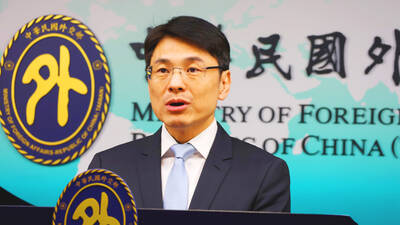
STAY IN YOUR LANE: As the US and Israel attack Iran, the ministry has warned China not to overstep by including Taiwanese citizens in its evacuation orders The Ministry of Foreign Affairs (MOFA) yesterday rebuked a statement by China’s embassy in Israel that it would evacuate Taiwanese holders of Chinese travel documents from Israel amid the latter’s escalating conflict with Iran. Tensions have risen across the Middle East in the wake of US and Israeli airstrikes on Iran beginning Saturday. China subsequently issued an evacuation notice for its citizens. In a news release, the Chinese embassy in Israel said holders of “Taiwan compatriot permits (台胞證)” issued to Taiwanese nationals by Chinese authorities for travel to China — could register for evacuation to Egypt. In Taipei, the ministry yesterday said Taiwan
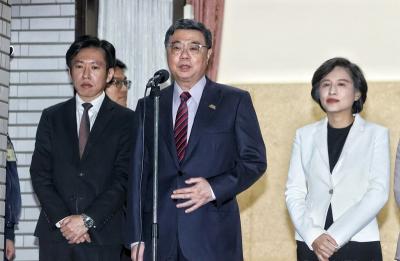
Taiwan is awaiting official notification from the US regarding the status of the Agreement on Reciprocal Trade (ART) after the US Supreme Court ruled US President Donald Trump's global tariffs unconstitutional. Speaking to reporters before a legislative hearing today, Premier Cho Jung-tai (卓榮泰) said that Taiwan's negotiation team remains focused on ensuring that the bilateral trade deal remains intact despite the legal challenge to Trump's tariff policy. "The US has pledged to notify its trade partners once the subsequent administrative and legal processes are finalized, and that certainly includes Taiwan," Cho said when asked about opposition parties’ doubts that the ART was
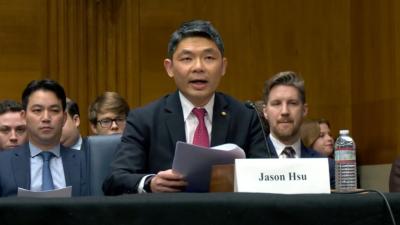
If China chose to invade Taiwan tomorrow, it would only have to sever three undersea fiber-optic cable clusters to cause a data blackout, Jason Hsu (許毓仁), a senior fellow at the Hudson Institute and former Chinese Nationalist Party (KMT) legislator, told a US security panel yesterday. In a Taiwan contingency, cable disruption would be one of the earliest preinvasion actions and the signal that escalation had begun, he said, adding that Taiwan’s current cable repair capabilities are insufficient. The US-China Economic and Security Review Commission (USCC) yesterday held a hearing on US-China Competition Under the Sea, with Hsu speaking on


 RSS
RSS