


Peng Hsiu-chun (彭秀春), widow of Chang Sen-wen (張森文) who owned the Chang Pharmacy that was torn down in the Dapu Incident (大埔), yesterday expressed her determination to stay by her ruined home and fulfill her late husband’s wish of seeing their home rebuilt.
The Dapu Incident refers to the Miaoli County Government’s seizure of farmland in the county’s Jhunan Township (竹南) to expand the Hsinchu Science Park, when it blocked roads and sent excavators onto farms that were awaiting harvest and forcibly demolished four family houses in Dapu Borough (大埔) last year.
Yesterday was the first anniversary of Chang’s death. He was found dead in an irrigation channel near where his house used to stand, one month after the land was expropriated and torn down.
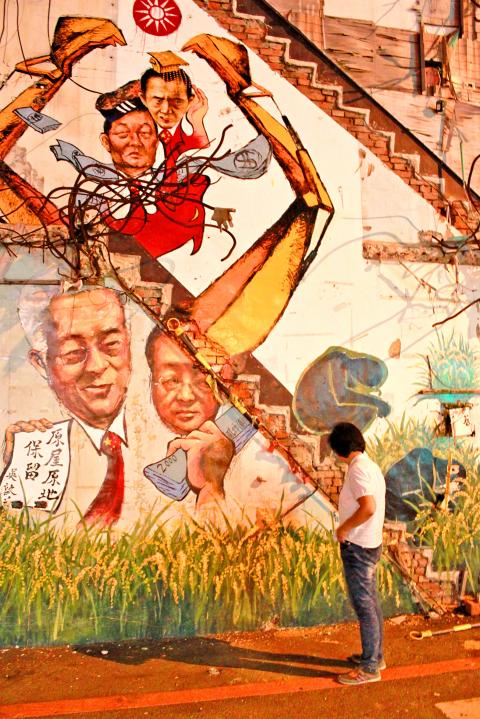
Photo: Cheng Hung-ta, Taipei Times
Although the evictions of the Changs and three other families were deemed unlawful by the court, the county government and the Ministry of the Interior has refused to return the land and rebuild the houses as the families requested.
“Miaoli County Commissioner Liu Cheng-hung (劉政鴻) had threatened us by saying: ‘There would be no road for even a scooter to pass through,’ and later forcibly demolished the building. They told us they were expropriating our land for the betterment of the people, but the rising buildings on the land expropriated for that exact reason stand witness to the great lie of the Miaoli County Government,” Peng said. “That the common people would be subjected to such despotic acts reveals problems with the nation. This is an example of the tyranny of government — an act that happened because we had no political background.”
Peng said she wanted to thank all the people who had stood by her family during the incident, adding that though she did not recognize many, they had given her the courage to carry on.
“We will stand by my husband’s wishes and see to it our home is rebuilt, right here on our own land,” she said.
Democratic Progressive Party spokesperson Lin Chun-hsien (林俊憲) accused the government of doing nothing to compensate the Changs.
“Returning the land and rebuilding the houses” is not a mercy from the government, rather, it is a responsibility that the government should take up for its policy mistakes, Lin said, urging the government to respond to the families’ requests, compensate them, and rebuild their homes.
To stop further disputes due to land expropriation, the party would restart its campaign to amend the Land Expropriation Act (土地徵收條例), Lin added.
Additional reporting by Chen Hui-ping

NATIONAL SECURITY: Authorities are working to confirm the identities of the military personnel involved and investigating possible illegal conduct and regulatory violations Authorities are probing possible national security implications after Kinmen police and immigration officers on Sunday found a Chinese woman allegedly posing as a tourist while engaging in prostitution involving more than 10 military personnel. The woman, surnamed Chen (陳), has since been deported, authorities said, adding that investigators are still working to confirm the identities of those implicated, as the records only listed code names and aliases. The case stemmed from a report received by the Kinmen District Prosecutors’ Office on Friday last week from the Jinhu Precinct of the Kinmen County Police Bureau. On Sunday, police, along with the National Immigration

GLOBALGIVING: ‘ Caving to external pressure is not acceptable for an organization that has cultivated justice reform and human rights for 30 years,’ one NGO said A slew of non-government organizations (NGOs) have withdrawn from the GlobalGiving fundraising platform after it announced it would use “Chinese Taipei” instead of “Taiwan” from next month. The Taiwan Good Rice Association wrote on Facebook on Friday that it was informed on April 28 via a teleconference call of the change, which was made because the platform wanted to operate in China. Taiwan Good Rice is to terminate all cooperative relationships with GlobalGiving in response to the platform’s “unilateral and non-negotiable” decision to remove references to Taiwan, the NGO said. “Taiwan is in the official name of Taiwan Good Rice Association and the

HEAVY WEATHER: Typhoon Jangmi is due to crash straight into the Ryukyus as airlines look to shift flights to larger aircraft or cancel flights to Okinawa entirely Taiwan’s international air carriers announced flight adjustments over the weekend as Typhoon Jangmi is forecast to hit the Ryukyu Islands today and tomorrow. The Central Weather Administration (CWA) upgraded Jangmi from a tropical storm to a typhoon at 8am yesterday, with the eye located 580km south of Naha city. It was moving north at 19kph. Today, China Airlines’ CI-120, CI-121, CI-122 and CI-123 flights between Taoyuan and Naha, Okinawa, have been canceled as well as CI-132 and CI-133 between Kaohsiung and Naha. EVA Air’s BR-112, BR-113, BR-186 and BR-185 flights between Taoyuan and Naha are also canceled. Low-cost carrier Tigerair Taiwan canceled IT-230,

Chinese Nationalist Party (KMT) Chairwoman Cheng Li-wun (鄭麗文) yesterday briefed her party’s Central Standing Committee regarding her scheduled visit to the US between Monday next week and June 16, saying that her purpose would be to persuade the US that the Republic of China (ROC) Constitution was a “one China” constitution that would foster stable and peaceful cross-strait relations. The ROC Constitution is the most important defense for all Taiwanese citizens, as it upholds our democracy and has contributed to our robust economy, which aligns with international and US interests, she said. “We would not be troublemakers and drag the US under,”


 RSS
RSS