


The suggestion by a former American Institute in Taiwan (AIT) director that Taiwan should abandon its current approach to making territorial claims in the South China Sea were his own views, the AIT said on Monday.
AIT spokesman Mark Zimmer told the Central News Agency that William Stanton, who headed the AIT’s Taipei office from 2009 to 2012, did not represent the US government and was speaking in his capacity as a private citizen.
Stanton said in a recent speech that because of the risks of sovereignty disputes in the South China Sea, Taiwan should consider abandoning its claims based on the “nine-dash line.”
Both Taiwan and China use the line, which encompasses most of the South China Sea and extends as far south as the coast of East Malaysia.
The Ministry of Foreign Affairs quickly rejected Stanton’s proposal
“The Spratly Islands [Nansha Islands, 南沙群島], Paracel Islands [Xisha Islands, 西沙群島], Macclesfield Bank [Zhongsha Islands, 中沙群島] and the Pratas Islands [Dongsha Islands, 東沙群島], as well as their surrounding waters, are inherent parts of Republic of China [ROC] territory,” the ministry said.
That sovereignty of these areas belongs to the ROC is undeniable from the perspectives of history, geography and international law, the ministry said.
The government aims to work with other nations in the region to maintain regional peace and stability based on the fundamental principle of “safeguarding sovereignty, shelving disputes, pursuing peace and reciprocity, and promoting joint exploration and development,” the ministry said.
The U-shaped nine-dash line dates back to 1947, when the ROC still controlled China, Academia Historica Director Lu Fang-shang (呂芳上) said earlier this month, and it has remained the basis for the territorial claims of both the ROC and the People’s Republic of China.
Washington has publicly challenged China’s use of the line. A US Department of State official said in February that Chinese claims to maritime rights not based on claimed land were inconsistent with international law.
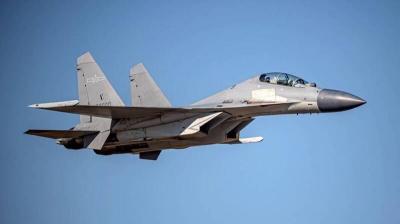
Eight Chinese naval vessels and 24 military aircraft were detected crossing the median line of the Taiwan Strait between 6am yesterday and 6am today, the Ministry of National Defense said this morning. The aircraft entered Taiwan’s northern, central, southwestern and eastern air defense identification zones, the ministry said. The armed forces responded with mission aircraft, naval vessels and shore-based missile systems to closely monitor the situation, it added. Eight naval vessels, one official ship and 36 aircraft sorties were spotted in total, the ministry said.
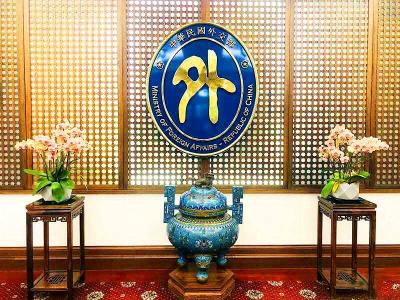
The Ministry of Foreign Affairs (MOFA) today said that if South Korea does not reply appropriately to its request to correct Taiwan’s name on its e-Arrival card system before March 31, it would take corresponding measures to alter how South Korea is labeled on the online Taiwan Arrival Card system. South Korea’s e-Arrival card system lists Taiwan as “China (Taiwan)” in the “point of departure” and “next destination” fields. The ministry said that it changed the nationality for South Koreans on Taiwan’s Alien Resident Certificates from “Korea” to “South Korea” on March 1, in a gesture of goodwill and based on the

Taiwanese officials were shown the first of 66 F-16V fighter jets purchased by Taiwan from the United States, the Ministry of National Defense said yesterday, adding the aircraft has completed an initial flight test and is expected to be delivered later this year. A delegation led by Deputy Minister of National Defense Hsu Szu-chien (徐斯儉) visited Lockheed Martin’s F-16 C/D Block 70 (also known as F-16V) assembly line in South Carolina on March 16 to view the aircraft. The jet will undergo a final acceptance flight in the US before being delivered to Taiwan, the
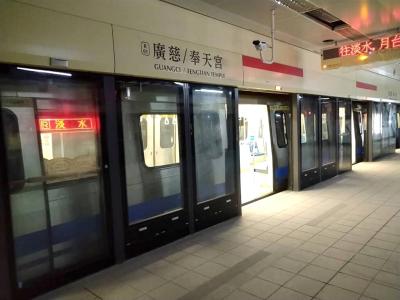
The New Taipei Metro's Sanyin Line and the eastern extension of the Taipei Metro's Tamsui-Xinyi Line (Red Line) are scheduled to begin operations in June, the National Development Council said today. The Red Line, which terminates at Xiangshan Station, would be connected by the 1.4km extension to a new eastern terminal, Guangci/Fengtian Temple Station, while the Sanyin Line would link New Taipei City's Tucheng and Yingge stations via Sanxia District (三峽). The council gave the updates at a council meeting reviewing progress on public construction projects for this year. Taiwan's annual public infrastructure budget would remain at NT$800 billion (US$25.08 billion), with NT$97.3


 RSS
RSS