


The Foundation for Compensation for Improper Trials During the Martial Law era is to cease operations tomorrow despite people who are familiar with its work saying its mission might not be complete.
The foundation was established to act on the Compensation Act for Wrongful Trials on Charges of Sedition and Espionage during the Martial Law Period (戒嚴時期不當叛亂暨匪諜審判案件補償條例). According to the act, unjust, fake and false charges made against people during the White Terror era are to be compensated for by the government, with an aim to expunge wrongful convictions and restore reputations.
The foundation says it has dealt with 10,062 cases and has a 99.99 percent settlement rate.
A total of NT$19.623 billion (US$656 million) in compensations has been awarded, and related files have been turned over to the Preparatory Office of the National Human Rights Museum.
Despite the achievements, Tsai Kuan-yu (蔡寬裕), secretary-general of the Taiwan Association for the Care of the Victims of Political Persecution During the Martial Law Period, said the truth of the White Terror era was still not fully revealed 15 years after the foundation was established.
While some of the case files for people charged during the White Terror era have been transferred from the Ministry of National Defense to the National Archives Administration, a comprehensive study is still restricted by the Personal Information Protection Act (個人資料保護法), Tsai said.
“There will be no conciliation without truth,” said Tsai, who suffered political persecution during the White Terror era, adding that the foundation focused on compensation, which had become a mere formality.
“Making the files and data transparent is not to settle accounts with the the Chinese Nationalist Party’s [KMT] authoritarian rule, but it is to uncover the truth,” he said, adding that the government’s replacement of “indemnities” with “compensation” has not helped people acquire genuine restoration of all that they lost.
Taiwan Association for Truth and Reconciliation executive secretary Yeh Hung-ling (葉虹靈) said the foundation achieved its high settlement rate because it was lax on the confirmation of reported cases, adding that compensation is merely a compromise, leaving the core of the problem untouched from the perspective of transitional justice.
Yeh said compensation is an administrative remedy, not a legal proceeding.
Furthermore, with Article 9 of the National Security Act (國家安全法) placing restrictions on appeals if a case was of a political nature during the Martial Law period, the claimants cannot call for a judicial reinvestigation, she said.
From a legal point of view, political prisoners persecuted during the White Terror era have remained convicted, Yeh said.
Citing research on responsibility for the 228 Massacre as an example, Yeh said the report has identified the main culprits, the secondary culprits, accomplices and people who bear joint responsibilities, illustrating the system of persecution and clarifying accountability.
The government should be responsible for restoring the historical account, she said, adding that “the claims should not be glossed over as unjust, false and fake.”
National Taiwan University history professor Chen Tsui-lien (陳翠蓮) said in the 27 years since the lifting of martial law, Taiwan’s “democratic transition” has been limited to an electoral system, without the cultivation of a political culture.
Had the truth of the White Terror era been recovered and had society realized how the authoritarian regime worked, remarks such as independent Taipei mayoral candidate Ko Wen-je (柯文哲) praising former president Chiang Ching-kuo (蔣經國) would be unthinkable, Chen said.
While non-governmental estimation of the number of people affected during the White Terror amounts to more than 100,000, the foundation’s records show that only about 10,000 have applied for compensation, Chen said, calling on the government to investigate and galvanize historical discussions.
Only when rights and wrongs are rightly identified can a consensus on the history of authoritarian rule be reached, Chen said.
Chen said that since the files have been handed to the museum, it should take on the responsibility to investigate the cases the foundation did not take on.
Museum director Wang Yi-chun (王逸群) said the transfer of files is ongoing.
As for investigations into the White Terror era, cross-ministerial coordination is required and the museum is only part of it, Wang said.
The museum will continue the effort to make a permanent record out of oral history, as well as create human rights exhibitions, Wang added.
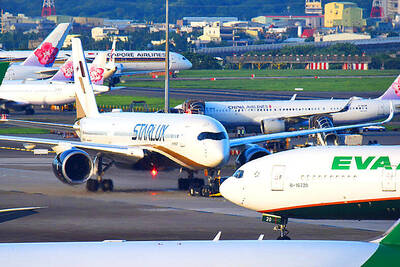
Trips for more than 100,000 international and domestic air travelers could be disrupted as China launches a military exercise around Taiwan today, Taiwan’s Civil Aviation Administration (CAA) said yesterday. The exercise could affect nearly 900 flights scheduled to enter the Taipei Flight Information Region (FIR) during the exercise window, it added. A notice issued by the Chinese Civil Aviation Administration showed there would be seven temporary zones around the Taiwan Strait which would be used for live-fire exercises, lasting from 8am to 6pm today. All aircraft are prohibited from entering during exercise, it says. Taipei FIR has 14 international air routes and
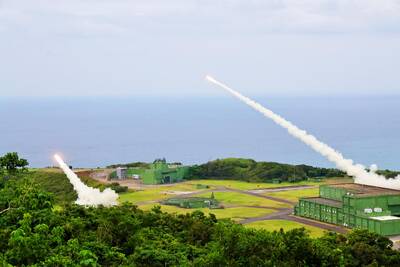
Taiwan lacks effective and cost-efficient armaments to intercept rockets, making the planned “T-Dome” interception system necessary, two experts said on Tuesday. The concerns were raised after China’s military fired two waves of rockets during live-fire drills around Taiwan on Tuesday, part of two-day exercises code-named “Justice Mission 2025.” The first wave involved 17 rockets launched at 9am from Pingtan in China’s Fujian Province, according to Lieutenant General Hsieh Jih-sheng (謝日升) of the Office of the Deputy Chief of the General Staff for Intelligence at the Ministry of National Defense. Those rockets landed 70 nautical miles (129.6km) northeast of Keelung without flying over Taiwan,
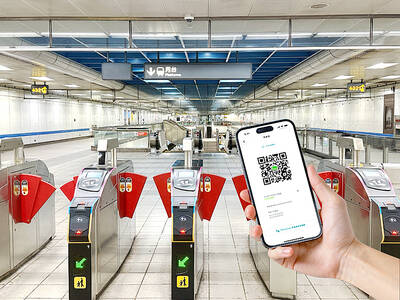
City buses in Taipei and New Taipei City, as well as the Taipei MRT, would on Saturday begin accepting QR code payments from five electronic payment providers, the Taipei Department of Transportation said yesterday. The new option would allow passengers to use the “transportation QR code” feature from EasyWallet, iPass Money, iCash Pay, Jkopay or PXPay Plus. Passengers should open their preferred electronic payment app, select the “transportation code” — not the regular payment code — unlock it, and scan the code at ticket readers or gates, General Planning Division Director-General Liu Kuo-chu (劉國著) said. People should move through the
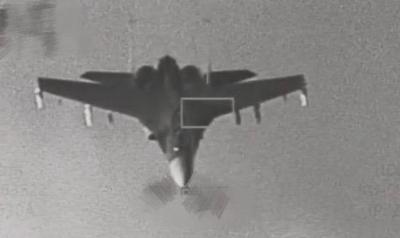
The Ministry of National Defense (MND) today released images of the military tracking China’s People's Liberation Army (PLA) movements during the latest round of Chinese drills around Taiwan. The PLA began "Justice Mission 2025" drills today, carrying out live-fire drills, simulated strikes on land and maritime targets, and exercises to blockade the nation's main ports. The exercises are to continue tomorrow, with the PLA announcing sea and air space restrictions for five zones around Taiwan for 10 hours starting from 8:30am. The ministry today released images showing a Chinese J-16 fighter jet tracked by a F-16V Block 20 jet and the


 RSS
RSS