


The number of “factories” that promote history and culture through tourism in the nation has ballooned to 117 this year from 14 in 2008, according to the Industrial Technology Research Institute, which added that the number of “tourism factories” has grown sevenfold in as many years.
Factories focusing on alcoholic drinks and food top the list at 40, with King Car Group’s Kavalan Whiskey Factory in Yilan County and the Kuo Yan-ye Museum of Cake and Pastry in Taoyuan County being notable examples.
Factories focusing on commodities came in second at 28, such as the Hsing Lung Towel Factory in Yunlin County, Les Enphant’s museum in Taoyuan County and the Taiwan Metal Creative Museum in Greater Tainan.
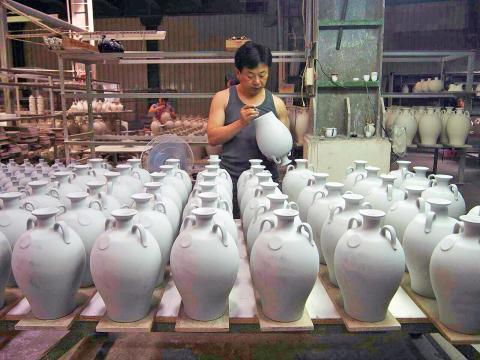
Photo: Lai Hsiao-tung, Taipei Times
Nineteen factories specialize in healthcare, such as the Brand’s Health Museum in Changhua County, while 17 factories specialize in the humanities, such as Chang Lien-chang’s Saxophone Museum in Greater Taichung.
There are 13 factories focusing on oils, salt and rice, with Tatung’s Soy Sauce Brewing Museum and the Zhong Xin Rice Castle in Changhua being notable examples.
In terms of geographical location, Greater Tainan leads the list with 19 factories, New Taipei City is second with 16 and Taoyuan County is third with 12 factories.
Department of Innovative Industrial Clustering Director Tsai Hsiu-ju (蔡秀如) said on Monday that the latest tourism factory to be approved was the Homestretch Hydrogel Tourism Factory in Greater Tainan’s Rende District (仁德).
“The factory is the first in the nation to be based on hydrogel, and it has been established so that Taiwanese can better understand medical-grade hydrogel and its functions,” she said.
Tourism factories are miniature reflections of their respective industries, Tsai added.
The assessment of tourism factories is based on five main factors — the type of business, their size, tourism facilities, the level of service and management capabilities, the institute said.
In a drive to facilitate the transition from a manufacturing to a service-based economy, the Ministry of Economic Affairs has encouraged traditional factories to incorporate tourism.
Since 2003, 160 factories have applied for the ministry to assess and aid them in their transition, with 117 passing the assessment.
The rising popularity of tourism factories and number of factories willing to make the transition may be increasing due to there being more emphasis placed on leisure time, the institute said.
Tsai said that tourism factories have become common for weekend excursions and school tours, adding that the volume of tourists during the summer vacation has greatly increased.
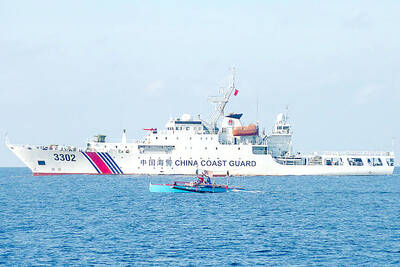
EXPANSIONIST: China deploys an average of 40 to 50 warships and coast guard vessels daily in the South China Sea, despite pledges not to militarize the region, an official said China is attempting to expand its influence across the First Island Chain and increase pressure on Japan by sending coast guard vessels into waters off of Taiwan under the pretext of maritime negotiations with Japan and the Philippines, a national security official said yesterday. China’s recent actions in the waters east of Taiwan and Japan and the Philippines’ exclusive economic zones (EEZ) are attempts to establish dominance in First Island Chain waters, said the official who declined to be named, adding that this is “expansion disguised as law enforcement.” Framing China’s actions solely as a cross-strait issue is a serious misjudgment that
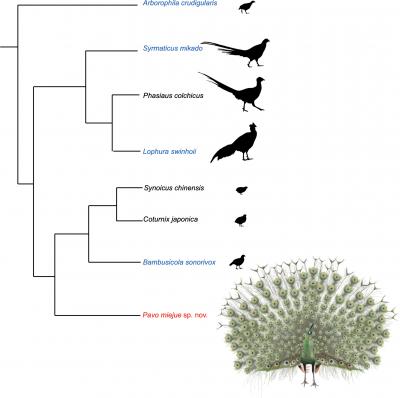
Through analyzing fossil evidence, a research team at National Taiwan University (NTU) discovered the largest endemic bird to have lived in Taiwan, naming it Pavo miejue, or extinct peafowl (滅絕孔雀). The Mikado pheasant, which is printed on the back of the NT$1,000 bank note, was previously believed to be the biggest endemic bird to Taiwan. The research team’s findings suggest that Pavo miejue lived during the Pleistocene epoch tens of thousands of years ago. It is the first endemic extinct bird species discovered and formally named in Taiwan. The study was coauthored by NTU Institute of Ecology and Evolutionary Biology professor Tsai Cheng-hsiu (蔡政修),
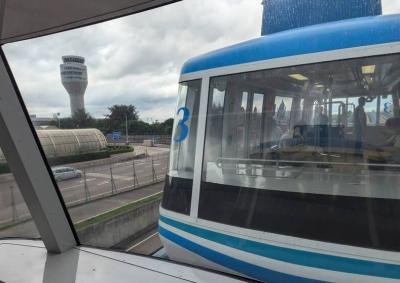
Taiwan Taoyuan International Airport is to suspend its automated Skytrain service connecting Terminal 1 and Terminal 2 starting on July 1 to facilitate connection works for the upcoming Terminal 3, the airport operator said today. Passengers and staff who need to travel between the two terminals after the suspension can instead use the Taoyuan MRT or the airport's 24-hour shuttle bus service, Taoyuan International Airport Corp said. The Taoyuan MRT Airport Line directly links the two terminals, while the shuttle buses are to operate around the clock, the company added. The Skytrain provides free transportation between the airport’s two terminals for travelers and
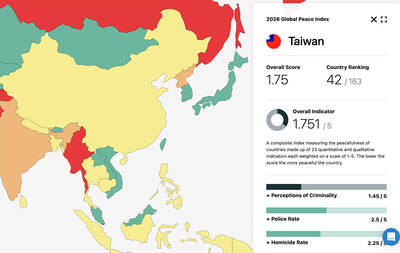
Taiwan ranked 42nd in terms of peacefulness among 163 countries, down five places from last year, according to this year’s Global Peace Index. With an overall score of 1.751, Taiwan dropped from 37th last year, the report published by the global Institute for Economics and Peace showed. The overall score measures a country’s level of peacefulness using 23 quantitative and qualitative indicators across three domains — ongoing domestic and international conflict, societal safety and security, and militarization. While Taiwan ranked 42nd worldwide, it was listed in ninth place among the 19 Asian-Pacific countries in the report, after New Zealand, Singapore, Japan, Malaysia,


 RSS
RSS